
Dry, Aging Skin: Causes, What Helps and How to Repair, Nourish and Defend Your Skin
Dry skin can happen at any age, but there is something different about the dryness many people begin to notice as they get older. The moisturiser that worked perfectly well for years may suddenly seem to disappear into the skin without making much difference. Your face may feel tight after cleansing, your arms and legs may become rough or flaky, and areas that once felt soft can begin to look thin, crepey or dull. Sometimes the skin becomes more easily irritated or itchy as well. You may find yourself applying more products while wondering why your skin seems less responsive than it used to be.
These changes do not necessarily mean that you have been looking after your skin badly. Skin itself changes with age, and so do many of the processes that help it retain water, produce protective oils and recover from everyday stresses. Years of sun exposure, climate, cleansing habits, lifestyle and the products we use can also influence how our skin looks and feels later in life. For women, hormonal changes around menopause can add another dimension to these changes. This is why caring for dry, aging skin often requires a different approach from simply applying more moisturiser.
The useful question therefore isn’t only “What moisturiser should I use?”
A better question is:
“What does my skin need now that it didn’t need twenty years ago?”
Understanding that difference can completely change the way we approach mature skin.
Why Does Skin Become Drier as We Age?
Healthy skin has a remarkable ability to hold water while protecting the body from the outside environment. The outermost layer of the skin, known as the stratum corneum, can be thought of as part of this protective system. Skin cells and the lipids surrounding them help limit excessive water loss while creating a physical boundary between the body and the world around us. Sebum and other naturally occurring substances on the skin also contribute to its surface environment. When these systems are functioning well, skin tends to feel softer, more flexible and comfortable.
As we grow older, several of these processes can become less efficient. Sebum production often declines, particularly later in life, leaving the skin with less of its natural oiliness. The composition and organisation of skin lipids can change, and the skin’s ability to retain moisture may decline. Cell turnover and recovery can also become slower. The result is skin that may lose water more easily and recover less quickly from environmental stress.
That is why mature skin can sometimes feel dry again only a few hours after moisturising.
The problem isn’t necessarily that the moisturiser has failed. The environment in which that moisturiser is expected to work has changed.
Dryness and Aging Can Reinforce Each Other
Dryness does more than make skin uncomfortable. Dehydrated or poorly moisturised skin can make fine lines, roughness and crepey texture appear more obvious. Light reflects differently from a rough surface than from smooth, well-hydrated skin, which is one reason dry skin can appear dull. When skin is adequately moisturised, it often looks temporarily plumper and smoother even though moisturiser cannot reverse the underlying biological process of aging.
Persistent dryness can also make skin more susceptible to irritation. Once skin becomes irritated, people often respond by adding more products, exfoliating more aggressively or trying stronger ingredients. Unfortunately, that can sometimes make the situation worse.
This creates a pattern we see repeatedly in mature skincare:
Dryness → discomfort → more products → more irritation → greater dryness.
Sometimes the most effective intervention is not adding another active ingredient.
It is simplifying what you are already doing.
10 Common Reasons Skin Can Become Drier With Age
There is rarely one single explanation for dry, aging skin. Several factors can operate simultaneously.
1. Reduced Natural Oil Production
Sebum helps lubricate the skin surface. Production tends to decline with age, leaving many older adults with noticeably drier skin than they experienced earlier in life.
Someone who spent their twenties trying to control oily skin may therefore find themselves dealing with the opposite problem decades later.
2. Changes in the Skin’s Protective Barrier
The outer layers of the skin help control how much water escapes from the body. Changes associated with aging can make this system less efficient, allowing moisture to be lost more readily.
This is one reason barrier-supportive skincare becomes increasingly important as we age.
3. Hormonal Changes
For many women, perimenopause and menopause coincide with significant changes in the skin. Declining estrogen levels are associated with changes in collagen, thickness, hydration and elasticity.
The transition can therefore feel surprisingly sudden. Skin that behaved predictably for decades may start responding differently within a relatively short period.
4. Decades of Sun Exposure
Ultraviolet radiation is one of the major environmental contributors to premature skin aging. Its effects accumulate over many years and can contribute to wrinkles, uneven pigmentation, changes in texture and loss of elasticity.
This is why sun protection is not merely something for younger people trying to prevent future aging. It remains important at every age.
5. Hot Showers and Baths
Very hot water can remove some of the oils from the skin surface. Long, hot showers may feel wonderful, particularly in winter, but they can leave already-dry skin feeling tighter afterwards.
Warm rather than very hot water is generally kinder to dry skin.
6. Harsh Cleansing
Mature skin does not always tolerate the same cleansing routine it tolerated decades earlier. Strong soaps, aggressive cleansers and repeated washing can remove surface lipids and contribute to dryness.
Cleansing should leave the skin feeling clean, not stripped.
7. Over-Exfoliation
The popularity of acids, scrubs, retinoids and other active skincare has created a strange situation: some people are simultaneously trying to repair their skin while repeatedly irritating it.
Exfoliation can have a place in skincare, but more is not automatically better. If your skin constantly burns, stings, flakes or feels tight, increasing exfoliation is unlikely to be the first answer.
8. Dry Air and Climate
Cold weather, air conditioning, indoor heating, wind and low humidity can all increase moisture loss from the skin.
This means your skincare requirements may change with the seasons even if nothing else in your routine changes.
9. Certain Medicines and Health Conditions
Dry skin is sometimes influenced by medication or an underlying health condition rather than skincare alone.
Persistent, severe or unexplained dryness — particularly when accompanied by significant itching, cracking, inflammation or other symptoms — deserves professional assessment rather than endless experimentation with cosmetics.
10. Skincare Overload
A modern skincare routine can easily contain cleanser, toner, essence, exfoliant, vitamin C, retinoid, peptides, niacinamide, acids, serum, eye cream, moisturiser and facial oil.
That does not necessarily mean your skin needs all of them.
For dry or easily irritated mature skin, a smaller number of well-chosen products may sometimes produce a more comfortable routine than continually layering additional actives.
How Can You Tell If Your Skin Is Simply Dry?
Dry skin can present in several ways. It may feel tight, particularly after bathing or cleansing. You may notice flaking, scaling, roughness or a slightly ashy appearance. Fine surface lines can become more noticeable, while some areas may become itchy or uncomfortable. On the body, the lower legs, hands, arms and elbows are common places for dryness to become particularly obvious.
But not every red, itchy or flaky patch is simply dry skin.
Eczema, psoriasis, contact dermatitis, fungal infections and other skin conditions can sometimes resemble ordinary dryness. A new or persistent skin change should not automatically be treated as a cosmetic problem. If an area is painful, bleeding, weeping, significantly inflamed, rapidly changing or simply refuses to improve, professional medical advice is appropriate.
Good skincare begins with recognising the limits of skincare.
What Actually Helps Dry, Aging Skin?
The temptation is to search for one miraculous ingredient.
In practice, mature skin usually benefits more from a consistent routine than from chasing individual ingredients.
A useful routine has four basic objectives:
Clean gently.
Replace and retain moisture.
Reduce unnecessary irritation.
Protect the skin from further environmental stress.
This can be surprisingly simple.
Step 1: Cleanse Without Stripping the Skin
Cleansing is necessary, but your face does not need to feel squeaky after washing.
If your skin feels tight immediately after cleansing, consider whether your cleanser or cleansing frequency may be too aggressive for your current skin. Look for gentle cleansers designed for dry or sensitive skin, and avoid very hot water. Some people with particularly dry mature skin may not need a heavy cleansing routine in the morning at all.
The purpose of cleansing is to remove unwanted material while disturbing the skin as little as reasonably possible.
That principle becomes increasingly valuable with age.
Step 2: Moisturise While the Skin Is Still Slightly Damp
Timing matters.
Applying moisturiser shortly after washing can help retain some of the water already present on the skin. This is particularly useful after bathing, when people often wait until their skin has completely dried before applying body moisturiser.
A good moisturising formulation may combine different types of ingredients. Humectants such as glycerin and hyaluronic acid help attract water. Emollients help soften and smooth the skin. More occlusive ingredients help reduce water loss from the surface.
You do not necessarily need to remember those technical categories.
The practical test is simpler:
Does your skin remain comfortable for several hours after you apply the product?
Step 3: Stop Fighting Your Skin
This may be one of the most overlooked principles in mature skincare.
When skin looks dull or rough, the instinct is often to scrub the dullness away. When wrinkles appear, we reach for stronger actives. When pigmentation appears, another treatment gets added. Before long, the routine becomes a chemistry experiment performed twice every day.
Active ingredients can be useful, but skin also needs periods in which it is simply being cared for.
If your face is repeatedly stinging, burning, peeling or becoming increasingly reactive, consider simplifying your routine. Introduce new products individually rather than several at once. That makes it much easier to recognise which products your skin actually tolerates.
Sometimes progress begins with removing something rather than adding something.
Step 4: Protect Your Skin From the Sun
If there is one anti-aging skincare habit worth maintaining throughout adulthood, sun protection belongs near the top of the list.
Ultraviolet exposure contributes to photoaging, including wrinkles, pigmentation changes and deterioration in skin texture. Broad-spectrum sunscreen, protective clothing, shade and sensible avoidance of intense sun exposure can all play a role.
And there is an important point for people in their 60s and 70s:
It is not too late to protect your skin.
Sun protection is not only about what your skin might look like twenty years from now. It is also about reducing additional cumulative exposure today.
A Simple Morning Routine for Dry, Aging Skin
A mature skincare routine does not need ten steps.
For many people, a practical morning routine can be:
1. Gentle cleansing if needed
Use lukewarm water and a mild cleanser that does not leave your skin tight.
2. Optional serum or treatment
If you use vitamin C, niacinamide or another well-tolerated treatment, this is usually where it can fit.
3. Moisturiser
Apply enough to leave the skin comfortable rather than merely coating it lightly.
4. Broad-spectrum sunscreen
Use appropriate sun protection on exposed skin and follow the product directions, including reapplication when required.
Four steps.
That may be enough.
A Simple Night Routine for Dry, Aging Skin
Evening skincare can be equally straightforward:
1. Remove makeup and sunscreen.
2. Cleanse gently.
3. Apply any treatment product you already tolerate.
4. Apply a nourishing moisturiser or cream.
People using retinoids, exfoliating acids or other active treatments should follow appropriate directions and pay attention to irritation. Mature skin does not receive bonus points for tolerating the strongest possible formulation.
Consistency usually matters more than complexity.
Beyond Moisturising: A Different Way to Think About Mature Skin
Moisturising is essential for dry skin, but we believe mature skincare deserves a broader conversation.
At Reno Skincare, we think about that conversation through three simple ideas:
Repair
First, support skin that has become dry, stressed or compromised by everyday environmental pressures and years of accumulated exposure.
This does not mean claiming that a cosmetic cream can reverse aging or heal disease. It means creating a routine that supports the skin’s own protective barrier and provides an environment in which dry, stressed skin can feel more comfortable.
Nourish
Mature skin often needs more than a light splash of hydration.
Humectants, emollients, oils and other conditioning ingredients can work together to improve softness, hydration and skin feel. The goal is not simply to make the skin wet for a few minutes but to help it remain comfortable for longer.
Defend
Skin exists in constant contact with the outside world.
Sunlight, dry air, wind, cleansing, friction and microorganisms are all part of that environment. Sensible skincare therefore also involves reducing unnecessary environmental stress and supporting the skin’s protective surface.
We call this approach the Skin Trifecta Method™: Repair. Nourish. Defend.
It is not intended to replace dermatological care or medical treatment. It is simply a practical framework for thinking about what dry, mature skin may need from everyday skincare.
Where Reno Cream Fits
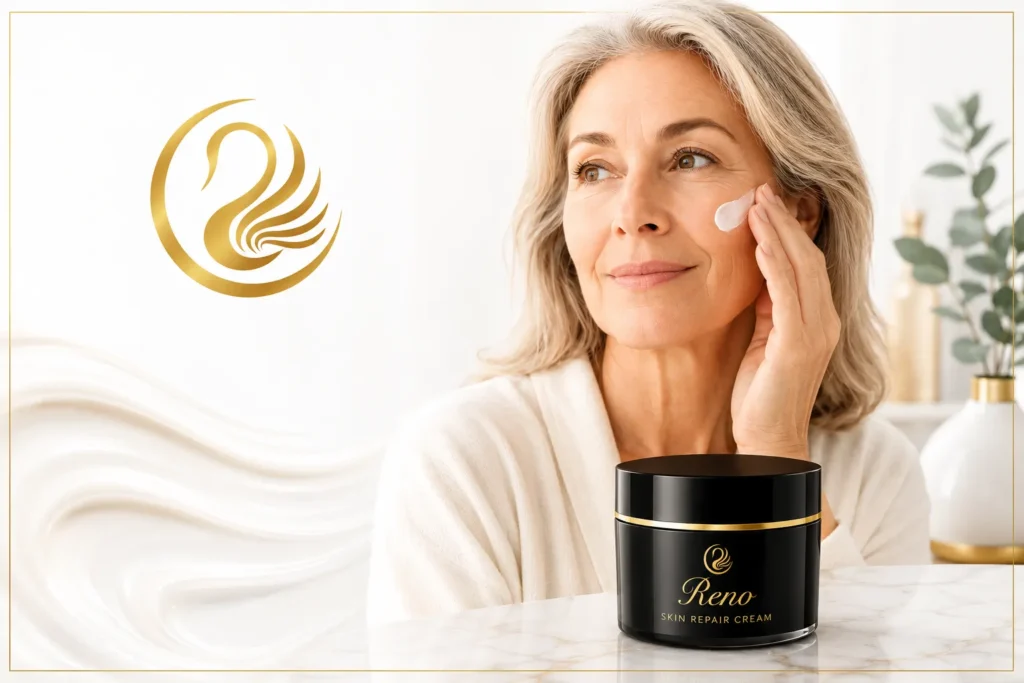
Reno Cream was developed around this Repair, Nourish and Defend philosophy rather than around the idea that mature skin needs another complicated collection of products.
Its formulation brings together ingredients including black seed oil, MSM and allantoin, alongside moisturising and conditioning ingredients such as glycerin, hyaluronic acid, vitamin E and vitamin C derivative, supported by selected botanical extracts.
The objective is straightforward: provide a rich everyday cream for dry, mature and stressed-looking skin within a simplified skincare routine.
Reno Cream is a cosmetic skincare product, not a medicine, and we think that distinction matters. No cream can turn 65-year-old skin back into 25-year-old skin. What thoughtful skincare can do is help dry skin feel softer, smoother, better moisturised and more comfortable while supporting the way you care for it every day.
That is a much more realistic promise.
Do You Need a Separate Cream for Every Skin Concern?
Probably not.
Modern beauty marketing has encouraged us to divide the face into an extraordinary number of problems. There is a product for the forehead, another for the eyes, another for the neck and sometimes another for the chest. Then there are separate products for hydration, brightening, firming, smoothing and “repair.”
Some specialised products certainly have useful roles.
But before adding another jar, ask a simpler question:
What does my skin actually need?
If dryness and irritation are your biggest problems, begin there. Establish a gentle cleansing, moisturising and sun-protection routine. Once your skin feels comfortable and predictable, you can decide whether additional treatments are genuinely necessary.
What About Skin After 50?
The 50s can be a significant transition period, particularly for women experiencing menopause.
Changes in estrogen can influence skin hydration, collagen and elasticity. Dryness may become more noticeable, and products that once felt comfortable can suddenly seem insufficient or irritating. This is a useful time to reassess cleansers, moisturisers and the number of active ingredients being used.
Rather than automatically buying “stronger” skincare, consider whether your skin now needs gentler and richer skincare.
That distinction is important.
What About Skin After 60?
By the 60s, dryness can become more persistent.
Skin may feel thinner and less resilient, while bruising and irritation can occur more readily for some people. Hands, arms and lower legs often require as much attention as the face. Regular moisturising after bathing becomes particularly useful, and aggressive scrubbing should generally be avoided.
The objective shifts increasingly from correcting every visible sign of age toward maintaining comfortable, well-supported skin.
Healthy-looking mature skin does not have to look young.
It should look cared for.
What About Skin After 70?
Skin in the 70s and beyond deserves gentleness.
Natural oil production may be considerably lower than it was earlier in life, and skin can become increasingly fragile. Very hot bathing, harsh soaps, aggressive exfoliation and repeated friction may therefore create more problems than benefits.
Rich moisturisation, gentle cleansing, sun protection and attention to persistent skin changes become increasingly important.
And at this age particularly, new or unusual lesions, wounds that do not heal, unexplained bleeding or persistent areas of irritation deserve medical assessment rather than cosmetic experimentation.
Can You Reverse Dry, Aging Skin?
We need to be careful with the word reverse.
Aging is biological. No cosmetic product can permanently reverse the passage of time.
But the appearance and comfort of dry skin can often be improved considerably.
Hydrated skin can appear smoother and plumper. Rough texture may become less obvious. Fine dehydration lines can soften in appearance. Comfortable skin may also reduce the temptation to scratch, rub or continually experiment with aggressive treatments.
That is meaningful improvement without pretending aging has disappeared.
How Long Does It Take to See a Difference?
Some effects of moisturisation can be noticed quickly.
Skin may feel softer and less tight soon after applying an appropriate moisturiser. Improvements in persistent dryness and roughness generally require consistent care rather than a single application. Other concerns related to pigmentation, collagen or photoaging can take much longer and may require treatments beyond ordinary moisturisation.
Rather than examining your face in the mirror every morning looking for dramatic change, pay attention to broader signs.
Does your skin stay comfortable longer?
Is it less tight after cleansing?
Are rough areas becoming smoother?
Do you feel less need to keep adding products?
Those changes can tell you more than a marketing promise about “younger-looking skin in seven days.”
When Should Dry Skin Be Checked by a Doctor?
Most ordinary dryness can be managed with sensible skincare, but persistent symptoms deserve attention.
Consider speaking with your GP or dermatologist if your skin becomes severely itchy, painful, cracked, bleeding, weeping or significantly inflamed. The same applies if dryness appears suddenly without an obvious explanation, interferes with sleep, covers a large area or does not improve despite reasonable skincare.
A dermatologist can also help distinguish ordinary dryness from conditions that can look similar.
Skincare should never become a reason to delay appropriate medical assessment.
The Most Important Change May Be How You Think About Your Skin
Aging skin is often spoken about as though it is something that needs to be defeated.
Wrinkles must be erased. Age must be reversed. Skin must somehow be forced to behave as though decades of life never happened.
We prefer a different approach.
Your skin has spent decades protecting you from sunlight, weather, microorganisms, friction, temperature changes and the outside world. It has changed because you have changed. Caring for it now does not require pretending those years did not happen.
It requires understanding what the skin in front of you needs today.
For dry, mature skin, that often means fewer unnecessary irritants, more consistent moisturisation, sensible sun protection and a routine designed around supporting rather than constantly challenging the skin.
That is the thinking behind the Skin Trifecta Method™:
Repair what has become stressed.
Nourish what has become dry.
Defend what you want to preserve.
Because good mature skincare should not be about fighting your age.
It should be about taking better care of the skin that has carried you this far.