
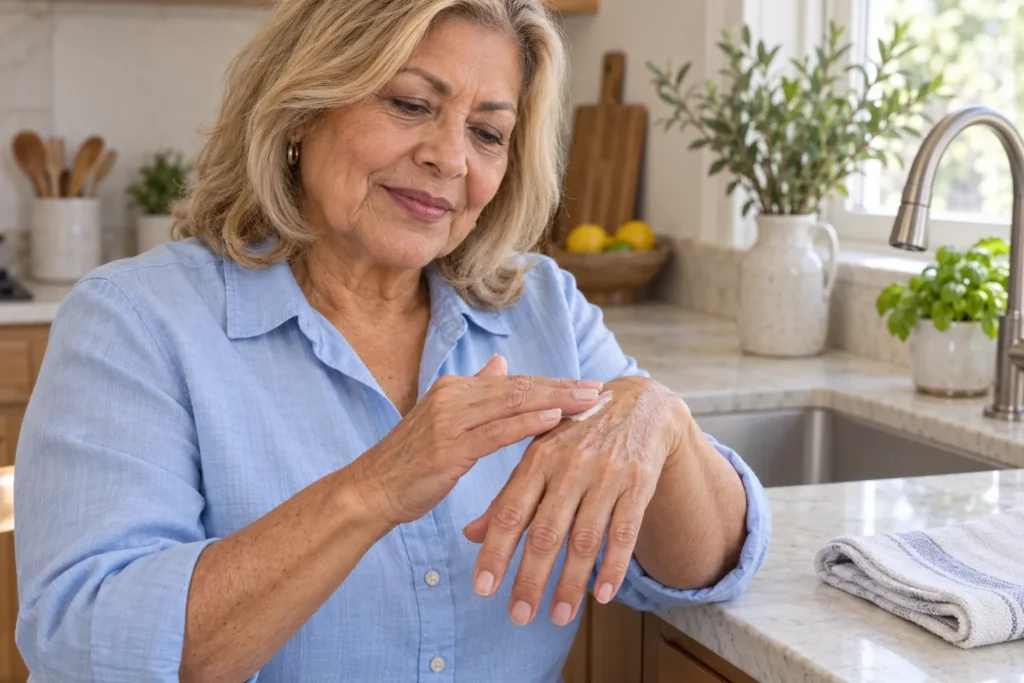
Your hands can tell you surprisingly quickly when your skincare routine is not keeping up with your daily life. You wash them, dry them, get on with your day and then wash them again. Before long, the skin around your knuckles may feel tight, the backs of your hands can look rough and fine lines suddenly seem much more noticeable. For mature skin, frequent washing can make an already dry area feel even more uncomfortable.
The answer is obviously not to stop washing your hands when hygiene requires it. The more useful question is how to protect the comfort of your skin while continuing to wash appropriately. That means looking at how you wash, how you dry and what you apply afterwards. Small changes repeated consistently can make an enormous difference to how dry hands feel.
Why Does Frequent Hand Washing Make Hands Feel So Dry?
Hand washing removes dirt, oils, microorganisms and other material from the skin. That is exactly why it is useful, but repeated exposure to water and cleansing products can also remove some of the oils associated with the skin’s surface. When this happens repeatedly throughout the day, hands can begin feeling increasingly dry and tight. Hot water and strong cleansers may make that sensation even more noticeable.
Your hands are also exposed to much more than soap and water. Cleaning products, sanitiser, detergents, weather, air conditioning and occupational exposure can all contribute to dryness. Add normal age related changes to the skin and the cumulative effect can become significant. This is why hand care should be considered part of your everyday skincare routine rather than something reserved for bedtime.
Why Can Mature Hands Become Particularly Dry?
As we get older, skin can become less oily and less efficient at maintaining comfortable hydration. The backs of the hands may also become thinner in appearance, while veins, tendons, pigmentation and fine lines become more noticeable. Years of ultraviolet exposure can contribute to visible changes as well. Frequent washing is therefore being added to skin that may already have different needs from the skin you had decades earlier.
This helps explain why a hand cream that once seemed unnecessary can suddenly become something you reach for several times a day. Your hands have not become difficult simply because you are older. Their circumstances have changed. Mature skincare works best when the routine changes with them.
Your Hands Work Harder Than Almost Any Other Area of Skin
Think about everything your hands encounter during an ordinary day. They handle food, phones, steering wheels, cleaning products, laundry, gardening equipment and countless household surfaces. Then they are washed repeatedly because of those activities. Few areas of the body experience that combination of exposure and cleansing.
Yet many people carefully moisturise their face twice a day while giving their hands almost no attention. We discussed this in Why Your Hands Can Start Looking Older Before Your Face. Hand care does not need to become complicated. It simply needs to become consistent.
The Way You Wash Your Hands Matters
You do not need to treat your hands harshly for washing to be effective. Use an appropriate cleanser or soap and wash thoroughly when hygiene requires it. Extremely hot water is unnecessary and can leave already dry hands feeling even tighter. Comfortably warm or cool running water can be a more sensible choice.
The important distinction is between proper hand hygiene and unnecessary skin punishment. Washing because your hands need washing is very different from repeatedly scrubbing them with excessively harsh products without a reason. If your occupation requires frequent hand hygiene, moisturising becomes even more important. The goal is not to compromise cleanliness but to support the skin alongside it.
Do Not Forget What Happens After Washing
How you dry your hands can influence how they feel too. Aggressively rubbing already dry skin with a rough towel may add unnecessary friction. Dry them thoroughly but gently, particularly around the fingers. Then consider moisturising before the familiar tightness returns.
Keeping moisturiser beside the sink can make this much easier. You do not need to perform a complete skincare ceremony every time you wash your hands. A small amount applied consistently can be more practical than waiting until bedtime and trying to compensate with a huge application. Convenience often determines whether a routine actually becomes a habit.
Why Does Hand Moisturiser Sometimes Seem to Disappear So Quickly?
You apply cream, your hands feel comfortable and then another hand wash removes much of what you just applied. That cycle can happen repeatedly throughout the day. It is one reason hand care can feel frustrating compared with moisturising an area that is not constantly being washed. The solution is partly about accepting that reapplication may sometimes be necessary.
But the formulation matters too. If an extremely lightweight lotion leaves your hands feeling dry again almost immediately even when you have not washed them, it may simply not feel substantial enough for your current skin. We explored this broader issue in Why Mature Skin Needs More Than a Lightweight Body Lotion. Your skin’s response between applications is often more informative than how luxurious the product feels during the first minute.
Your Skin Barrier Is Part of the Story
The outer skin barrier helps reduce excessive water loss and provides protection from the surrounding environment. Repeated exposure to water, cleansers, detergents and other irritants can leave hands feeling dry, rough or uncomfortable. This does not mean every pair of dry hands has a medically damaged skin barrier. It simply means barrier supportive habits deserve attention.
Our guide Skin Barrier Repair: What Actually Helps and What Can Make It Worse? explains this in greater detail. Moisturising consistently is useful, but reducing avoidable stress matters too. The best cream in your bathroom cannot completely compensate for repeatedly exposing bare hands to irritating household chemicals.
Cleaning Products Deserve Special Attention
Washing dishes, cleaning bathrooms and handling detergents can be surprisingly demanding on dry hands. If a task involves prolonged contact with water or cleaning chemicals, appropriate protective gloves can provide a useful physical barrier. This is particularly relevant if you already know a particular product leaves your hands feeling dry. Prevention can sometimes be easier than repeatedly trying to restore comfort afterwards.
Gloves should still be used sensibly. Hands that become hot and sweaty inside gloves for long periods may become uncomfortable for different reasons. Choose protection appropriate to the task and follow the safety directions for the cleaning product you are using. Skincare should work alongside sensible household safety practices.
What About Alcohol Based Hand Sanitiser?
Hand sanitiser can be an important hygiene tool when appropriate, particularly when soap and water are not readily available. Some people find frequent use drying, especially when their hands are already rough or cracked. That does not mean sanitiser should automatically be avoided when it is needed. It means moisturising may become particularly useful when frequent hand hygiene is part of your day.
Try not to interpret every momentary sensation as evidence that your skin has been permanently damaged. Dryness can fluctuate according to how often you wash, the environment and the products you use. Look at the overall pattern. If your hands are becoming progressively more uncomfortable, your routine deserves attention.
Why Knuckles Often Become Rough First
The skin around the knuckles moves constantly. Every time you make a fist, pick something up or bend your fingers, that skin stretches and folds. When it becomes very dry, the surface can look rougher and fine lines become more obvious. In more severe cases, dry areas can become uncomfortable or crack.
Moisturising the backs of the hands without paying attention to the knuckles can therefore miss one of the driest areas. Massage a small amount of moisturiser across the knuckles and around the fingers rather than applying it only to the palms. The goal is good coverage, not excessive product. A little consistency goes a long way.
Why Do Hands Look Older When They Are Dry?
Dryness can exaggerate surface texture. Fine lines can appear more noticeable, and the skin may look dull or rough rather than smooth and conditioned. Moisturising can improve that dryness related appearance relatively quickly. This is one reason well moisturised hands can appear healthier and better cared for without any claim that ageing has been reversed.
There are also structural changes that moisturiser cannot undo. A cream cannot permanently replace lost volume, remove prominent veins or return mature hands to their biological state decades earlier. Sun related pigmentation also requires a more nuanced discussion than simply applying moisturiser. Realistic skincare focuses on what topical care can genuinely improve.
Sun Protection Is Hand Care Too
The backs of your hands receive considerable ultraviolet exposure over a lifetime. Driving, walking, gardening and ordinary outdoor activities can all contribute. Because we wash our hands frequently, sunscreen applied to them can also be removed during the day. Reapplication may therefore be appropriate when continued exposure is expected.
Under Australian conditions, sun protection deserves particular attention. Follow current sun protection advice, including appropriate sunscreen, shade and protective clothing where practical. Moisturiser and sunscreen perform different jobs. A good hand care routine recognises the value of both.
Do You Need a Separate Hand Cream?
Not necessarily. Some people enjoy a dedicated hand cream because of its texture, portability or particular formulation. Others prefer using the same suitable moisturising cream on their hands, arms and other dry areas. There is no rule stating that each body part must have its own jar.
The more useful question is whether the product meets the needs of the area where you are using it. If your moisturiser leaves your hands soft and comfortable without interfering with normal activities, it may work perfectly well. This is part of the thinking behind One Cream, Multiple Skin Needs: Why We Designed Reno Cream Differently. Simpler skincare can make consistent skincare easier.
Our Ingredient Philosophy Starts With the Problem, Not the Trend
When we developed Reno Cream, we did not begin by selecting one fashionable ingredient and asking how many claims we could build around it. We looked instead at overlapping needs commonly seen in dry, mature and problem prone skin. Hydration is one need, oils and conditioning are another, and everyday skin comfort depends on the complete formulation. That naturally leads towards ingredients performing different but complementary jobs.
Our philosophy can be summarised simply: skin needs first, ingredient jobs second, formulation third. That matters for hands because repeated washing can create a situation where several moisturising and conditioning needs overlap. We are not looking for one ingredient to become the hero of the story. We are looking at how the formulation works as a system.
Glycerin and Hyaluronic Acid Have Hydration Jobs
Glycerin and hyaluronic acid contribute to the hydration side of Reno Cream. They are humectant ingredients commonly used in cosmetic skincare to help support water within the outer skin. For hands that repeatedly feel dry after washing, hydration is an obvious part of the formulation story. But hydration alone is not the entire story.
That is why we do not treat hyaluronic acid as though it is a complete skincare philosophy. It performs a useful job alongside ingredients performing different jobs. Mature hands can benefit from thinking about the overall condition of the skin rather than simply chasing the ingredient currently dominating beauty advertising. The formula matters more than the fame of one component.
Why Black Seed Oil Has a Different Role
Black seed oil from Nigella sativa provides an oil based component within Reno Cream. Its role is different from the humectant contribution of glycerin and hyaluronic acid. That difference is intentional because dry skin does not necessarily have only one cosmetic need. Complementary ingredients allow the complete formulation to approach moisturisation and conditioning more broadly.
We consider black seed oil an important ingredient, but we do not present it as a miracle cure for dry hands. It cannot make hand washing unnecessary, permanently reverse ageing or medically treat every condition that causes dryness. Its value is as part of the wider formula. Different ingredients, different jobs, one cream.
MSM, Allantoin and the Wider Formula
MSM and allantoin are also included within Reno Cream as part of the broader formulation. They sit alongside glycerin, hyaluronic acid and black seed oil rather than competing with them for the title of hero ingredient. Vitamin E, our vitamin C derivative and selected botanical extracts are also part of that wider system. Each ingredient was chosen within the context of the complete formulation.
This is why ingredient synergy matters so much to our philosophy. Consumers are often encouraged to search for one famous ingredient on a label and ignore everything surrounding it. We prefer to look at whether ingredients have sensible complementary jobs. The finished cream is what ultimately touches your skin.
Can Reno Cream Be Used on Dry Hands?
Reno Cream is designed as a multifunctional cosmetic moisturising cream for dry, mature and problem prone skin. Dry hands are therefore one of the areas where a moisturising and conditioning cream can fit naturally into an everyday routine, used according to the product directions. Applying it after washing or whenever your hands begin feeling dry can help keep the skin moisturised and conditioned. The aim is softer, smoother and more comfortable feeling skin.
That does not mean Reno Cream is a medical treatment for hand eczema, dermatitis, infection or another underlying condition. It cannot diagnose why somebody’s hands are cracking, inflamed or persistently itchy. If ordinary dryness is the problem, moisturising makes practical sense. When symptoms suggest something more than ordinary dryness, appropriate assessment matters.
A Simple Daytime Routine for Frequently Washed Hands
Wash your hands properly when hygiene requires it, using comfortably warm water rather than unnecessarily hot water. Dry them gently and thoroughly, then apply a small amount of moisturiser when practical. Keep a moisturiser near the sink or in your bag if frequent washing is unavoidable. Use suitable protective gloves for wet work and household cleaning.
This routine is deliberately uncomplicated. The objective is not to make you anxious about every hand wash. It is to build moisturising into the same routine so dryness does not have days to accumulate before you respond. Good skincare habits work best when they fit into ordinary life.
Give Your Hands a Little More Attention at Night
Night time provides a useful opportunity because most people are washing their hands less frequently while sleeping. Apply your moisturiser after your final hand wash and give particular attention to the backs of the hands, fingers, cuticles and knuckles. You do not necessarily need to coat your hands in an uncomfortable layer of product. Use an amount that leaves them comfortably moisturised.
Some people like cotton gloves over moisturised hands overnight, particularly when dryness is significant. Whether that feels useful or annoying is very individual. The important part is the moisturising itself and avoiding known irritants. A routine you actually follow is better than an elaborate routine abandoned after three nights.
Be Careful About Scrubbing Rough Hands
Rough hands can tempt you to reach for scrubs, acids or vigorous exfoliation. A little appropriate exfoliation may sometimes improve surface feel, but excessive exfoliation can make already dry hands feel worse. If your hands sting, burn or become increasingly sensitive after exfoliating, more exfoliation is unlikely to be the sensible response. Give the skin a chance to settle.
Our article Over Exfoliated Skin: Signs You’ve Gone Too Far and How to Simplify Your Routine explains why restraint can be useful. You do not need to polish mature skin into submission. Often the roughness you are trying to remove becomes less noticeable when dryness is managed consistently. Comfortable skin should come before perfectly polished skin.
Repair, Nourish and Defend Your Hands
Our Skin Trifecta Method™ provides a useful way to think about frequent hand washing. Repair means reducing avoidable stress while supporting the skin with gentle care and consistent moisturising. That might mean turning down excessively hot water, avoiding unnecessary harsh scrubbing and giving very dry skin time to become comfortable again. It does not mean claiming that a cosmetic cream medically repairs every cause of hand damage.
Nourish means supplying hydration, oils and conditioning through a suitable moisturising formulation. Because your hands are repeatedly washed, nourishment may need to be repeated during the day. This is where complementary ingredient jobs become useful rather than relying on one fashionable component. Consistency matters more than occasionally applying an enormous amount of cream.
Defend means protecting your hands from avoidable future stress. Gloves during appropriate household tasks, sensible sun protection and reducing unnecessary contact with known irritants can all play a role. Defending the skin is often easier than continually trying to compensate after it becomes extremely dry. Hand care is therefore about protection as well as moisturisation.
When Dry Hands Need Professional Attention
Ordinary dry hands are common, particularly with frequent washing, but not every hand problem is simply dryness. Persistent redness, intense itching, significant swelling, painful deep cracks, bleeding, weeping, blistering or signs of infection deserve appropriate professional assessment. Occupational exposure can also cause or aggravate hand dermatitis in some people. A moisturiser should not be used to delay assessment when symptoms are significant or persistent.
If your hands suddenly change after starting a new medication or using a new product, mention that information when seeking advice. Do not stop prescribed medication without discussing it with the appropriate healthcare professional. Cosmetic skincare has useful boundaries. Recognising those boundaries is part of caring for your skin properly.
You Do Not Have to Choose Between Clean Hands and Comfortable Hands
Frequent hand washing and comfortable skin are not mutually exclusive. Proper hygiene can continue while you make the surrounding routine gentler and more supportive. Wash when necessary, avoid unnecessarily harsh habits, moisturise consistently and protect your hands during activities that repeatedly expose them to irritants. Those simple actions can become remarkably effective when repeated every day.
Your hands do an extraordinary amount of work, yet they are often one of the last areas we remember when applying skincare. They deserve the same thoughtful approach we give the face, particularly as the skin becomes older and drier. This is exactly where the philosophy behind Reno Cream and the Skin Trifecta Method™ becomes practical rather than theoretical. For hands that are washed again and again, remember three simple ideas: Repair, Nourish and Defend.