
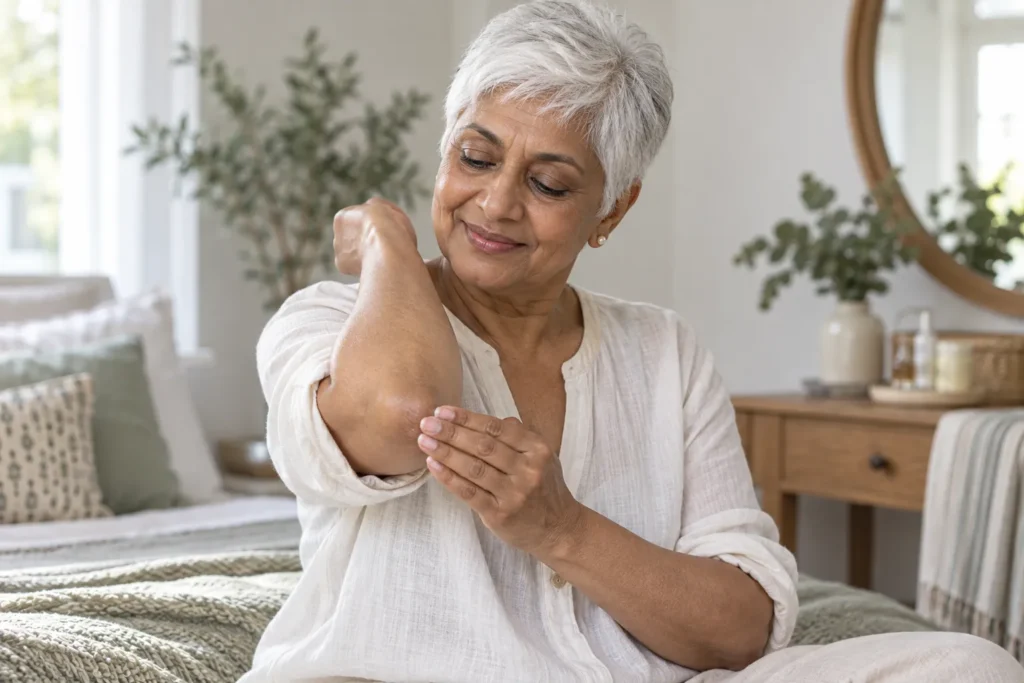
Dry elbows are one of those small problems that can become surprisingly persistent. You moisturise them, they feel better for a while, and then a day or two later the roughness seems to be back. For some people, particularly as the skin matures, the elbows can become so dry that they look dull, thickened or noticeably different from the surrounding skin.
It is easy to assume that the answer is simply to apply more moisturiser. Sometimes that helps, but stubbornly dry elbows can involve more than a temporary shortage of moisture. Understanding why this area behaves differently can make it much easier to build a routine that actually supports what the skin needs.
Why Do Elbows Become So Dry?
The elbows spend a great deal of time bending, stretching and rubbing against clothing, bedding, desks, armrests and other surfaces. They are also an area where the skin naturally tends to feel thicker and less soft than areas such as the inner arms. Add repeated washing, hot showers, dry weather or harsh cleansing products, and roughness can become increasingly noticeable.
Then there is age.
As the skin matures, its ability to retain moisture can change. Natural oils may become less abundant, and the skin barrier may not perform quite as efficiently as it once did. This can make areas already prone to dryness, including the elbows, knees, hands and lower legs, particularly noticeable.
So although dry elbows may look like a very local problem, they can be part of a much broader change in the way the skin is holding moisture and responding to everyday stresses.
Why Moisturiser Sometimes Seems to Work Only Temporarily
Many people apply body lotion to their elbows immediately after noticing dryness. The area feels smoother for several hours, which seems encouraging, but the rough texture soon returns. This can create the impression that the product has somehow stopped working.
Often, the explanation is simpler.
A lightweight moisturiser may increase hydration and improve the immediate feel of the skin without providing enough lasting conditioning for an unusually dry area. If the underlying routine still includes very hot showers, aggressive scrubbing, frequent friction or inconsistent moisturising, the skin may repeatedly return to the same dry state.
This is why the question should not only be, “How can I moisturise my elbows?”
A better question is, “What does the skin on my elbows need to remain comfortable and conditioned between applications?”
That difference is important.
Mature Skin Can Make Rough Elbows More Noticeable
Dry elbows are certainly not limited to older adults. However, people often become much more aware of them as the skin changes with age.
The skin may become less supple and dryness may become more persistent. Areas that once responded quickly to an ordinary body lotion may begin requiring more consistent care. Rough texture can also become visually more obvious when the surrounding skin is itself becoming drier or thinner-looking.
This does not necessarily mean that something is seriously wrong with the skin.
It may simply mean that the routine that worked at 30 or 40 is no longer providing everything the skin needs at 50, 60 or 70.
That is a recurring theme in mature skincare. The answer is not always to use more products. Sometimes it is to use a more thoughtful combination of products and habits.
Be Careful About Scrubbing the Roughness Away
When elbows feel rough, one of the first instincts is often to exfoliate them aggressively.
A little appropriate exfoliation may help some people with accumulated rough surface skin. But there is an important difference between gently improving texture and repeatedly scrubbing an already dry area because you are trying to make it instantly smooth.
More exfoliation is not automatically better.
If you scrub too aggressively, particularly when the skin is already dry or sensitive, you may leave the area feeling uncomfortable. The temptation is then to apply more products, scrub again a few days later and gradually turn a straightforward dryness problem into an unnecessarily complicated routine.
For mature or easily irritated skin, gentleness is usually the better starting point.
Your Shower Could Be Part of the Problem
The way you bathe can have a surprisingly large effect on dry elbows.
Very hot water may feel wonderful, especially during colder weather, but prolonged hot showers can leave dry skin feeling even tighter afterwards. Strong soaps and cleansers can also remove more surface oils than the skin comfortably tolerates.
You do not necessarily need to abandon enjoyable showers. A few practical changes can make a difference.
Try using warm rather than extremely hot water. Avoid repeatedly scrubbing the elbows with rough cloths or abrasive products, and choose a gentle cleanser rather than assuming that squeaky-clean skin is healthier skin. After bathing, gently pat the area dry instead of vigorously rubbing it with a towel.
Then moisturise while the skin still feels slightly hydrated from the shower.
What Does the Skin on Dry Elbows Actually Need?
Persistent dryness usually calls for more than a single dramatic ingredient.
The skin needs water, but it also needs help holding onto that moisture. It benefits from ingredients that condition and soften the surface, and a sensible routine should support rather than repeatedly challenge the skin barrier.
This is where formulation becomes important.
Humectants such as glycerin and hyaluronic acid can help support hydration. Oils and conditioning ingredients can contribute to softness and suppleness. Ingredients such as allantoin can also have a useful role in formulas designed for dry, stressed-looking skin.
Rather than asking which one ingredient is the “best” for elbows, it can be more useful to consider how several complementary ingredients work together.
Why Reno Was Formulated This Way
Reno Cream was developed around exactly this idea.
We did not begin by looking for one fashionable ingredient that could become the centre of the marketing story. We started with the overlapping needs commonly seen in dry, mature and problem skin and asked what different ingredient jobs could be brought together within one formula.
That is why Reno Cream combines black seed oil, MSM and allantoin with glycerin and hyaluronic acid, alongside vitamin E, a vitamin C derivative and a complementary botanical complex.
Each part of the formulation has a purpose.
The humectants contribute to hydration. Oils and conditioning ingredients help support the feel and suppleness of the skin. Other components were selected to complement those functions rather than forcing one ingredient to carry the entire formula.
This becomes particularly relevant for areas such as dry elbows because the problem is rarely just about making the surface feel wet for an hour. The aim is to provide consistent, multi-functional care for skin that repeatedly feels dry and rough.
Repair. Nourish. Defend.
We organise this formulation philosophy around The Skin Trifecta Method™: Repair, Nourish and Defend.
Repair is about supporting the skin barrier and helping the skin maintain the moisture and conditioning it needs.
Nourish means providing a combination of moisturising, conditioning and botanical ingredients rather than relying on hydration alone.
Defend means supporting the skin as it faces the ordinary environmental and lifestyle stresses that can contribute to dryness and a rough appearance.
For dry elbows, that way of thinking can be more useful than simply applying another layer of lotion whenever roughness becomes visible.
The goal is not overnight perfection. It is to create better conditions for the skin through consistent care.
A Simple Routine for Dry, Rough Elbows
Start by reducing the things that may be working against your moisturiser.
Keep showers comfortably warm rather than excessively hot. Avoid harsh soap and aggressive scrubbing on the elbows. If you lean your elbows against a desk for long periods, simply being aware of repeated friction may also help you understand why one area seems particularly stubborn.
After showering or bathing, gently dry the skin and apply your moisturising cream before the area becomes completely dry.
If your elbows are particularly dry, apply the cream again later in the day or before bed. Give the routine enough time to judge the result rather than changing products every few days.
Consistency usually tells you much more than a single application.
Should You Use the Same Cream on Your Elbows and Other Dry Areas?
There is no rule saying every dry area of the body requires a different jar.
The elbows, hands, knees, arms and legs are not identical, but they can share overlapping cosmetic needs. If several areas are experiencing dryness, roughness and reduced suppleness, a well-designed multi-functional cream may be useful across more than one of them.
This was part of the thinking behind Reno Cream.
Instead of creating a separate moisturising cream for every body area, we wanted a formulation capable of supporting several of the common needs associated with mature, dry and problem skin.
That does not make Reno Cream a substitute for sunscreen, cleansers, prescribed treatments or specialised medical care. It simply means that everyday moisturising and conditioning do not necessarily have to become complicated.
When Dry Elbows Need More Than Skincare
Most ordinary dry elbows can be approached with gentle skincare and consistent moisturising, but not every persistent change should automatically be treated as cosmetic dryness.
If the area becomes painful, cracked, bleeding, very inflamed, unusually itchy, rapidly changes in appearance or simply refuses to improve despite sensible care, consider speaking with a doctor, pharmacist or other qualified healthcare professional. Certain skin conditions can affect the elbows, and a moisturising cream should not be used as a substitute for diagnosis when something does not look or feel right.
Knowing when skincare is appropriate and when professional advice is appropriate is part of looking after the skin well.
Your Elbows May Be Telling You Something About Your Routine
Dry elbows can seem like an isolated nuisance, but they often reveal something useful.
Perhaps your showers are too hot. Perhaps your cleanser is harsher than the skin now tolerates. Perhaps you are relying on a lightweight lotion that provides temporary hydration but not enough conditioning. Or perhaps the skin has simply changed with age and now needs more consistent support than it once did.
The answer does not necessarily have to be another complicated routine.
Start by being gentler with the skin. Reduce unnecessary friction and aggressive exfoliation. Moisturise consistently and look for a formulation that approaches hydration, conditioning and barrier-conscious skincare together.
You can discover Reno Cream and its multi-functional approach to mature, dry and problem skin here.
For a deeper explanation of the philosophy behind Repair, Nourish and Defend, you can also get The Skin Trifecta Method™ here.
Sometimes stubborn dry elbows do not need ten different solutions.
They need you to understand what the skin has been missing.