
Some skincare ingredients become famous because they are new, exotic or suddenly everywhere on social media. Allantoin is almost the opposite. It has been used in cosmetic and personal-care formulations for many years, yet most people would struggle to recognise its name on an ingredient list. That lack of celebrity does not make it unimportant.
When we were developing Reno Cream, we were not looking only for ingredients that would give us impressive marketing headlines. We wanted ingredients with sensible jobs within a formula for mature, dry and problem skin. Allantoin became one of the three core ingredients in Reno Cream alongside black seed oil and MSM. Its inclusion says a great deal about the way we think skincare should be formulated.
What Is Allantoin?
Allantoin is a compound widely used in skincare and personal-care products. It has a long history in cosmetic formulations, particularly products designed for the skin that feels dry, rough or uncomfortable. Today, the allantoin used in cosmetics can be manufactured to provide a consistent ingredient suitable for modern formulations. This allows formulators to use it without depending on plant extraction.
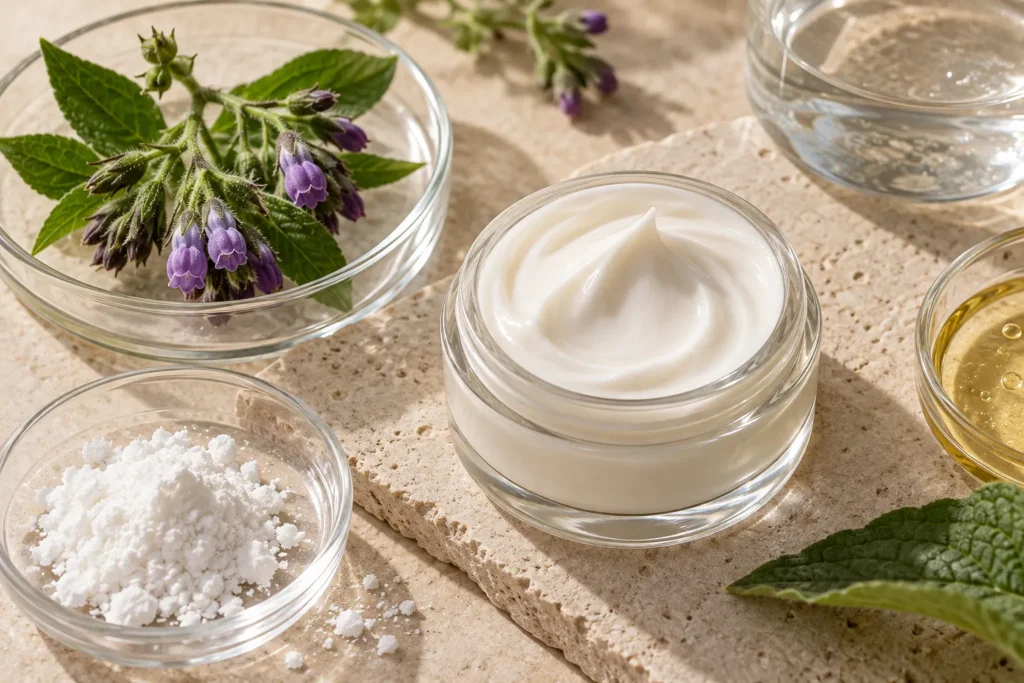
That last point sometimes surprises people because allantoin is frequently associated with the comfrey plant. Its historical connection with plants is interesting, but the practical question for a modern skincare formulation is what the cosmetic ingredient contributes to the finished product. We do not need a romantic botanical story to justify its inclusion. Allantoin earned its place in Reno Cream because its function fitted what we wanted the formula to do.
Why Dry, Stressed-Looking Skin Needs Thoughtful Care
Dry skin is not simply skin that looks less radiant. It can feel tight, rough and uncomfortable, and its surface may become flaky or visibly uneven. When this happens in mature skin, other changes can appear more pronounced as well. Fine lines, crepey texture and dullness can all become more noticeable when the surface of the skin is poorly hydrated or conditioned.
That is why we do not approach mature skincare purely as a wrinkle problem. The condition of the skin matters too. Improving hydration and conditioning cannot stop biological ageing, but it can help the skin feel softer, smoother and more comfortable. Allantoin fits naturally into a formula built around that more practical approach.
What Does Allantoin Do in Skincare?
Allantoin is commonly used as a skin-conditioning ingredient in cosmetic formulations. It is particularly relevant in products intended for dry, rough or stressed-feeling skin. Its established cosmetic use is one reason it appears in many different types of skincare and personal-care products. It does not need to be the star ingredient to make a useful contribution.
Allantoin is also associated with helping improve the feel of rough skin and supporting a smoother surface appearance. That makes it particularly interesting when formulating for mature skin, where dryness and roughness can frequently occur together. These are modest claims compared with promises to reverse ageing, but modest does not mean unimportant. Sometimes improving how the skin feels day after day is exactly what a skincare product should be trying to accomplish.
Why We Use the Words “Stressed-Looking Skin”
You will often see us describe Reno Cream as being formulated for mature, dry and stressed-looking skin. We use that language deliberately. The skin can look depleted, rough, dull or uncomfortable without that description becoming a medical diagnosis. A cosmetic product can reasonably be designed to support the appearance and condition of such skin.
There is an important boundary here. Allantoin in a cosmetic cream should not be presented as though it diagnoses or treats a medical skin disorder. Persistent redness, severe irritation, wounds, infection or other concerning changes deserve appropriate professional attention. Cosmetic skincare has a valuable role, but that role should be described accurately.
Allantoin Is Not a Moisturiser by Itself
It is tempting to take any ingredient associated with dry skin and describe it as though it provides the entire moisturising system. That would oversimplify what happens inside a well-designed cream. Effective moisturising formulations often bring together ingredients with different roles. Humectants, oils, emollients and conditioning ingredients can contribute in different ways.
This is why allantoin is not alone in Reno Cream. Glycerin and hyaluronic acid contribute to the hydration side of the formula, while black seed oil contributes to its richer conditioning character. Allantoin occupies its own place within that broader architecture. The point is not to make one ingredient perform every job.
Why Allantoin Works Alongside Black Seed Oil
Black seed oil and allantoin are very different ingredients, and that is precisely what we wanted. Black seed oil contributes oil-based conditioning and richness to the formula. Allantoin has a different cosmetic role and history of use. Putting them together allows the formulation to approach dry mature skin from more than one direction.
This also explains why asking which ingredient is “better” misses the purpose of the formula. Black seed oil does not need to defeat allantoin, and allantoin does not need to replace black seed oil. Their usefulness lies partly in their differences. A formula can become more versatile when different ingredients perform complementary jobs.
And Where Does MSM Fit?
MSM completes the trio of core Reno Cream ingredients. Like allantoin, it is not included because we expect it to carry the entire product. It has different chemical characteristics from both allantoin and black seed oil. That gives the three core ingredients distinct identities within the formulation.
This was deliberate from the beginning. We did not want three ingredients that were essentially variations of one another. We wanted a core around which hydration, conditioning, vitamins and botanical ingredients could be built. Black seed oil, MSM and allantoin became that foundation.
Why Allantoin Makes Sense for Mature Skin
Mature skin frequently becomes drier as it changes with age. It may also feel rougher or less supple, particularly on areas such as the hands, arms, legs, elbows, neck and chest. These changes do not necessarily require an aggressive skincare routine. In fact, repeatedly attacking mature skin with strong exfoliation can sometimes make an already uncomfortable routine harder to tolerate.
An ingredient such as allantoin fits a different philosophy. Instead of trying to force dramatic overnight transformation, it belongs comfortably in products focused on conditioning and supporting the feel of dry, stressed-looking skin. That makes sense within Reno Cream because our formulation philosophy is not based on attacking the skin. It is based on supporting what the skin needs.
Roughness Is Not Always a Signal to Exfoliate More
When the skin feels rough, many people instinctively reach for an exfoliating acid, scrub or stronger active. Exfoliation can certainly have a place in skincare, but roughness can also occur when the skin is very dry. In that situation, simply exfoliating more aggressively may not address what the skin actually needs. Hydration and conditioning deserve equal consideration.
This becomes especially important with mature skin. The goal should not always be to remove more from the surface. Sometimes the better question is whether the skin is receiving enough moisture and conditioning support. Allantoin belongs naturally within that gentler conversation.
Why Established Ingredients Still Matter
The skincare industry loves novelty. A newly fashionable ingredient can appear in hundreds of products within months, while ingredients that have been used successfully for years may receive very little attention. Consumers can easily begin to assume that newer automatically means better. Formulation does not work that way.
Glycerin is another good example. It has been used for generations and remains one of the most useful humectants available to cosmetic formulators. Allantoin has a similarly established place in skincare. We would rather choose an ingredient because it performs a useful job than reject it because it is not currently trending.
Why We Did Not Need Allantoin to Become the Hero
If Reno Cream followed the conventional hero-ingredient model, we might choose the ingredient with the strongest marketing story and build everything around it. Allantoin would probably struggle in that competition because it is not exotic and its name is not particularly glamorous. But formulation and advertising are not the same discipline. The ingredient that sounds most exciting is not automatically the ingredient a formula needs most.
Allantoin therefore does not have to become the hero of Reno Cream. Neither do black seed oil or MSM. Each ingredient can perform its role while allowing other ingredients to perform theirs. The finished formula remains more important than any individual ingredient.
The Hydration System Still Matters
Allantoin alone would not give Reno Cream the hydration architecture we wanted. That is why the formula also contains glycerin and hyaluronic acid. Both are humectants used to support hydration within the outer layers of the skin. They complement rather than compete with the other components of the cream.
This combination matters because mature dry skin may need both water-attracting ingredients and richer conditioning components. Focusing only on one category can leave part of the picture missing. Reno Cream was designed to bring these different jobs together. Allantoin forms one piece of that larger system.
Vitamins Add Another Layer
The formula also contains vitamin E and ascorbyl palmitate, a vitamin C derivative. These ingredients contribute another dimension to the wider formulation rather than replacing the core ingredients. They sit alongside the hydration and conditioning systems as part of the overall ingredient architecture. Again, the purpose is complementary function.
This is why reading a Reno Cream ingredient list as a collection of isolated ingredients can miss the point. We did not choose allantoin first and then randomly add vitamins around it. We considered different needs of the skin and built ingredient groups around those needs. The finished formulation is the result of that process.
The Botanicals Have a Supporting Role Too
Reno Cream also contains a botanical complex that includes ingredients such as Centella asiatica, chamomile, licorice, green tea, rosemary and ginger. Botanical ingredients often receive a great deal of marketing attention because their names are familiar and their stories can be appealing. We still believe they should be treated as parts of the formula rather than miracle ingredients. Their presence should have a reason.
That philosophy is exactly the same one we apply to allantoin. Whether an ingredient comes from a plant, a laboratory or another source matters less than whether it makes sense in the formulation. The formula should not become a competition between “natural” and “scientific” ingredients. It should be designed around the needs of the skin.
Why Reno Was Formulated This Way
We began Reno Cream with a question: what does mature, dry and problem skin actually need? We considered hydration, conditioning, barrier-conscious care, nourishment and protection before deciding how the ingredient architecture should look. That sequence is important. The skin came before the ingredient list.
Allantoin earned its place because it fitted those needs. Black seed oil and MSM brought different characteristics to the core, while glycerin, hyaluronic acid, vitamins and botanicals broadened the formulation. We were not trying to find one extraordinary ingredient. We were trying to build a useful system.
Repair. Nourish. Defend.
That thinking eventually became The Skin Trifecta Method™: Repair, Nourish and Defend. The framework is not a claim that three ingredients correspond neatly to three jobs. It is a way of thinking about the broader needs of mature, dry and problem skin. Allantoin contributes within that framework alongside the rest of the formula.
Repair reflects our barrier-conscious approach and the importance of supporting the conditions that help the skin retain moisture and remain comfortable. Nourish reflects hydration, oils, conditioning ingredients, vitamins and botanicals working within the formulation. Defend recognises the everyday environmental stresses the skin encounters and the importance of sensible protection as part of a complete routine. No single ingredient can represent all three.
Can Allantoin Repair the Skin?
The word “repair” needs to be used carefully in skincare. The skin is a living organ with its own biological processes, and a cosmetic cream should not be described as though it reconstructs damaged tissue or treats wounds unless there is appropriate evidence and regulatory basis for that claim. That is not how we position Reno Cream. Our use of Repair within the Skin Trifecta Method™ refers to a barrier-conscious skincare approach.
Allantoin can play a useful conditioning role within that approach without needing exaggerated medical claims. Helping dry, rough skin feel better conditioned is a legitimate cosmetic objective. Supporting a routine that is gentler and more appropriate for mature skin is also valuable. Those benefits do not become less meaningful because they sound less dramatic.
Can Allantoin Make Wrinkles Disappear?
No cosmetic ingredient should be expected to make every wrinkle disappear. Wrinkles develop through complex biological changes influenced by age, repeated facial movement, genetics, sun exposure and other factors. Allantoin does not turn mature skin back into young skin. That is not why it is in Reno Cream.
What good moisturising and conditioning can do is improve the surface appearance of dry skin. When the skin is better hydrated and conditioned, it may look softer and smoother, and dehydration-related lines can appear less pronounced. That is a much more realistic way to think about the cosmetic care of mature skin. Allantoin contributes within a formula designed around those achievable goals.
Who Might Appreciate Allantoin in a Formula?
People whose skin feels persistently dry, rough or uncomfortable may appreciate products containing ingredients selected with those concerns in mind. This can be particularly relevant as the skin matures and products that once felt sufficient no longer provide the same sense of comfort. Areas such as the arms, legs, elbows and hands can become especially demanding. A richer, thoughtfully formulated cream may suit those areas better than a very light lotion.
That does not mean allantoin is automatically suitable for every person or every skin concern. Individual tolerance varies, and any product can be unsuitable for someone. Patch testing can be sensible when introducing a new product, particularly if your skin is reactive. Persistent or severe symptoms deserve professional assessment.
What Should You Look for in an Allantoin Cream?
Do not stop at the word “allantoin” on the ingredient list. Ask what else the formula contains and what the complete product is designed to accomplish. If you are dealing with mature dry skin, look for a sensible combination of hydration and conditioning rather than expecting allantoin to do everything. The surrounding formula matters.
You should also consider whether the product fits your routine. A technically sophisticated cream that you dislike using will probably spend most of its life in a drawer. Texture, comfort and consistency of use all matter in real-world skincare. Ingredient science is important, but skincare still has to work in everyday life.
Sometimes the Quiet Ingredient Deserves More Credit
Allantoin may never dominate skincare advertising, and perhaps it does not need to. Its value is not dependent on becoming the next social-media trend. It has remained relevant because it continues to make sense in cosmetic formulations designed around the condition and feel of the skin. For Reno Cream, that was more important than novelty.
That is ultimately why allantoin became one of our three core ingredients. It complements black seed oil and MSM, while the wider formula adds humectants, vitamins, conditioning ingredients and botanicals with their own jobs. Allantoin does not have to do everything to deserve its place. It simply needs to do its part within a thoughtfully designed formula.
The Skin Comes Before the Ingredient
The principle connecting all of these ingredient decisions is simple. We do not begin by asking which ingredient we can promote most aggressively. We begin by asking what the skin needs and then look for ingredients capable of contributing to those needs. That is how allantoin became part of Reno Cream.
For mature, dry and stressed-looking skin, gentle conditioning can matter just as much as fashionable actives. Allantoin fits that philosophy particularly well because it reminds us that useful skincare does not always have to be dramatic. Sometimes the ingredients doing quiet, complementary jobs are exactly what a formula needs. That is the role allantoin plays in Reno Cream.
You can explore Reno Cream and its complete formulation here to see how allantoin works alongside black seed oil, MSM and the wider ingredient system. You can also get The Skin Trifecta Method™ here to explore our Repair, Nourish and Defend approach to mature, dry and problem skin. The philosophy behind both is the same: start with the skin, understand its needs, and choose ingredients for complementary jobs.