
Black seed oil has been used traditionally for centuries, but tradition alone is not enough to tell us what an ingredient can realistically do for mature skin. Today, Nigella sativa, the plant from which black seed oil is obtained, is also the subject of scientific research. That combination of traditional use and modern interest has made black seed oil increasingly visible in skincare. But it has also led to claims that sometimes run much further than the evidence.
So what does the research actually suggest? There are interesting reasons for studying black seed oil and its naturally occurring compounds, particularly thymoquinone. At the same time, laboratory findings should not automatically be interpreted as proof that applying a cosmetic containing black seed oil will produce the same effects in human skin. Understanding that distinction is essential if we want to talk about the ingredient responsibly.
What Is Black Seed Oil?
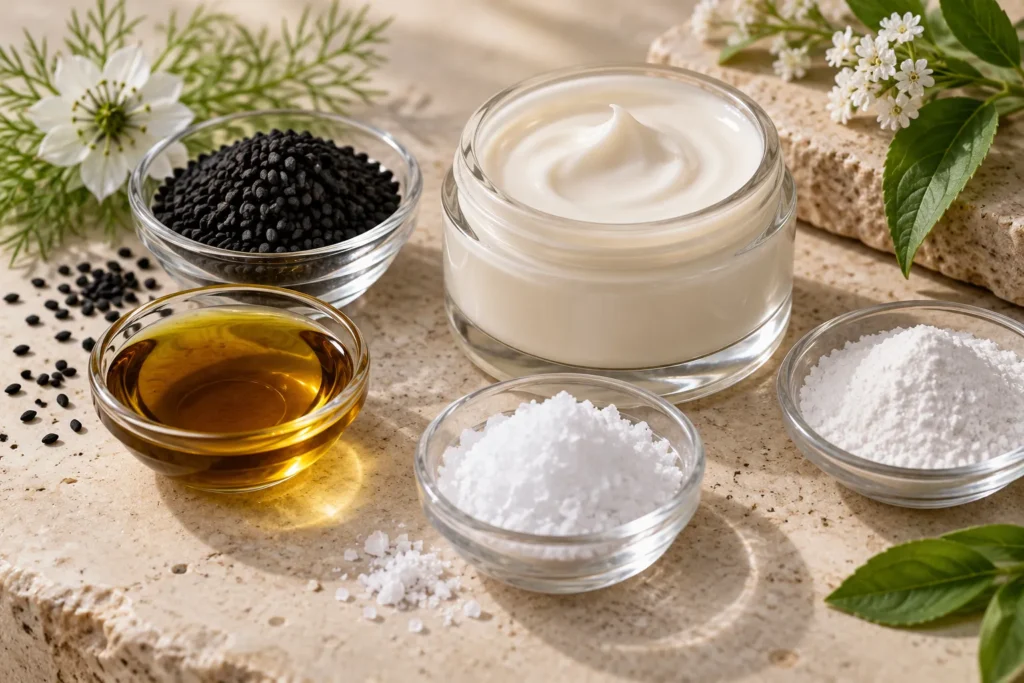
Black seed oil is obtained from the seeds of Nigella sativa, a flowering plant also known as black cumin or black caraway. Its seeds and oil have a long history of traditional use across parts of the Middle East, Africa and Asia. The oil contains fatty acids and a range of naturally occurring compounds. One of the most widely studied is thymoquinone.
That chemical complexity is one reason Nigella sativa has attracted scientific attention. Researchers have investigated antioxidant, inflammatory and microbial pathways associated with components of the plant in laboratory and other experimental settings. These findings are interesting, but they need to be interpreted according to the type of study that produced them. A laboratory experiment is not the same thing as a clinical trial of a finished skincare product.
Why Black Seed Oil Is Interesting for Mature Skin
Mature skin can become drier and less supple as it changes with age. The skin barrier and the natural lipids associated with it also become increasingly important when dryness is a concern. This makes oils and other conditioning ingredients relevant when formulating products for dry mature skin. Black seed oil fits naturally into this part of the skincare conversation.
Its fatty-acid content makes it useful as an oil within a conditioning formulation. In practical cosmetic terms, this may be more immediately relevant than some of the dramatic claims made about black seed oil online. An ingredient does not need to reverse ageing to have value. Helping create a richer, more conditioning formulation for dry mature skin is already a worthwhile job.
What Does the Research Tell Us About Thymoquinone?
Much of the scientific interest surrounding Nigella sativa involves thymoquinone, one of its best-known bioactive constituents. Experimental research has examined thymoquinone in relation to oxidative stress and inflammatory pathways. These areas are scientifically relevant because oxidative processes and inflammation are involved in many biological systems, including processes affecting the skin. However, this does not mean that a black seed oil cosmetic has been proven to reverse those processes in ageing human skin.
This is where skincare discussions can easily become misleading. A study showing an effect on cells in a laboratory may help researchers understand a possible biological mechanism. It does not automatically establish what will happen when a person applies a finished cream to the skin. Concentration, formulation, absorption, stability and many other factors can influence the real-world result.
Antioxidant Research: Interesting, but Keep It in Perspective
Black seed oil and compounds associated with Nigella sativa have been studied for antioxidant activity. Antioxidants are relevant to skincare because the skin is continually exposed to environmental factors capable of contributing to oxidative stress. This is one reason antioxidant ingredients are common in products designed for mature-looking skin. The scientific idea behind studying them is reasonable.
The important question is how far the evidence allows us to go. Laboratory antioxidant activity does not prove that a cosmetic product will erase wrinkles, reverse sun damage or make the skin biologically younger. Those would require much stronger and more directly relevant human evidence. It is better to describe antioxidant research as part of the scientific interest surrounding black seed oil rather than turning it into an anti-ageing guarantee.
What About Inflammation?
Research involving Nigella sativa and thymoquinone has also explored inflammatory pathways. That has contributed to the ingredient’s reputation online, where black seed oil is sometimes discussed in connection with a very wide range of skin conditions. The existence of research into a biological pathway, however, should not be confused with proof that a cosmetic cream treats inflammatory skin disease. Those are very different claims.
Reno Cream is a cosmetic skincare product, not a medicine. We therefore do not position black seed oil as a treatment for eczema, psoriasis, dermatitis or another diagnosed skin disorder. Someone experiencing persistent inflammation, pain, broken skin or another concerning change should seek appropriate professional advice. Cosmetic skincare has an important role, but it also has appropriate limits.
Black Seed Oil and Microbial Research
Another area of interest involves research into the interaction of Nigella sativa constituents with certain microorganisms. Laboratory studies are useful for investigating these possibilities and understanding how particular compounds behave under controlled conditions. This research helps explain why black seed oil continues to attract scientific attention. But once again, the level of evidence matters.
An antimicrobial result produced under laboratory conditions does not mean that every skincare product containing black seed oil should be described as treating a bacterial or fungal infection. A finished cosmetic has its own formulation, concentration and intended use. Medical infections require appropriate diagnosis and treatment. Responsible skincare communication should maintain that distinction.
The Evidence Is Not All the Same
When people hear that an ingredient is “scientifically studied,” it can sound as though all research carries equal weight. It does not. A laboratory study involving isolated cells or microorganisms answers a different question from an animal study, and both are different again from a well-designed human clinical trial. Research on an isolated compound is also not automatically evidence for a finished cosmetic containing an oil in which that compound occurs.
This hierarchy matters when evaluating black seed oil. There is enough research around Nigella sativa and its constituents to make the ingredient scientifically interesting. There is much less reason to treat every claim circulating online as established clinical fact. Mature-skin consumers deserve to know the difference.
What Has Actually Been Studied in People?
Human research involving Nigella sativa exists, including studies examining topical applications in particular contexts. However, the body of evidence is much smaller and more varied than the enormous range of claims found online might suggest. Different studies may use different preparations, concentrations, formulations and participant groups. That makes broad conclusions difficult.
This is particularly important when our question is specifically about mature skin. Research involving a particular skin condition or a younger study population cannot simply be translated into proof that black seed oil reverses visible ageing. Nor can research on an isolated constituent automatically tell us how a multi-ingredient cosmetic cream will perform. Those gaps should be acknowledged rather than hidden.
Can Black Seed Oil Reduce Wrinkles?
This is one of the questions people naturally ask when discussing any ingredient used in mature skincare. At present, it would be too strong to say that black seed oil has been conclusively demonstrated to remove or reverse wrinkles in mature human skin. Wrinkles arise from complex structural and environmental changes that develop over many years. No cosmetic oil should be expected to simply undo all of them.
There is, however, another way skincare can influence the appearance of mature skin. When dry skin becomes better moisturised and conditioned, the surface can appear softer and smoother, and dehydration-related fine lines may become less noticeable. That is a realistic cosmetic benefit and does not require claiming that the biological ageing process has been reversed. It is also much closer to the role black seed oil plays within Reno Cream.
Dryness May Be the More Useful Starting Point
For many people with mature skin, dryness is not a minor issue. The skin may feel tight after bathing, rough areas may persist despite regular moisturising, and previously comfortable products may no longer feel sufficient. These changes can also influence how visible other signs of ageing appear. A dry, rough surface reflects light differently from one that is well moisturised and conditioned.
This is why we believe black seed oil makes most sense when considered as part of a broader mature-skin formulation rather than as a stand-alone anti-ageing miracle. Its oil-based conditioning role complements ingredients that address hydration in other ways. The objective is to support the condition and feel of the skin. That is both useful and realistic.
Why an Oil and a Humectant Are Not the Same Thing
One of the easiest mistakes in skincare is to treat all moisturising ingredients as though they work in exactly the same way. Humectants such as glycerin and hyaluronic acid are used to support hydration within the outer layers of the skin. Oils and other conditioning ingredients contribute differently. A thoughtful moisturising formulation can therefore benefit from having more than one type of ingredient.
Reno Cream contains black seed oil alongside glycerin and hyaluronic acid for precisely this reason. We do not expect black seed oil to replace the hydration system, and we do not expect hyaluronic acid to perform the same role as an oil. They have complementary jobs. This is where ingredient synergy becomes more meaningful than hero-ingredient marketing.
Why Reno Cream Uses Black Seed Oil
When we formulated Reno Cream, we did not begin with black seed oil and then search for reasons to justify using it. We began with mature, dry and problem skin and considered the overlapping needs that frequently appear as the skin changes. Conditioning was one of those needs. Black seed oil therefore found a logical place within the formula.
It became one of our three core ingredients alongside MSM and allantoin. The three ingredients are very different, which was intentional. They were not selected to repeat one another’s jobs. They were selected as parts of a broader formulation in which different ingredients could make complementary contributions.
Black Seed Oil Is Only One Layer of Reno Cream
Black seed oil may be one of the core ingredients, but Reno Cream is not simply black seed oil in a jar. The formula also includes glycerin and hyaluronic acid for hydration, alongside vitamin E and a vitamin C derivative. A broader botanical complex includes ingredients such as Centella asiatica, chamomile, licorice, green tea, rosemary and ginger. Each group contributes another layer to the formulation.
This matters when evaluating the product because the finished formula is what actually goes onto the skin. Consumers do not apply an academic paper or an isolated laboratory compound. They apply a cosmetic containing many ingredients in a particular formulation. The performance and usefulness of that complete product should therefore remain the central consideration.
Why We Do Not Call Black Seed Oil a Miracle Ingredient
There is a temptation in skincare to take a promising piece of research and turn it into a much bigger marketing claim. An ingredient shows antioxidant activity in a laboratory, and suddenly it is described as reversing ageing. Researchers investigate inflammatory pathways, and before long the ingredient is being promoted as though it treats medical conditions. That leap is where useful science can become misleading marketing.
We would rather keep the claims proportionate to the evidence. Black seed oil is an interesting cosmetic ingredient with a long traditional history, useful oil characteristics and an expanding body of scientific research around Nigella sativa and its constituents. That is already a strong reason to be interested in it. We do not need to turn it into something the evidence has not established.
Why Reno Was Formulated This Way
Our approach to black seed oil reflects the broader philosophy behind Reno Cream. We start by asking what the skin needs, rather than asking which ingredient is currently receiving the most attention. We then choose ingredients capable of performing different but complementary jobs. Finally, those ingredients are brought together into one coherent formulation.
Black seed oil contributes to the conditioning side of that system. Glycerin and hyaluronic acid support hydration, while MSM, allantoin, vitamins and botanical ingredients contribute in other ways. No single ingredient has to carry the entire product. The formula is designed around cooperation rather than competition.
Repair. Nourish. Defend.
This formulation philosophy is expressed through The Skin Trifecta Method™: Repair, Nourish and Defend. It recognises that mature, dry and problem skin may have several needs at the same time. Instead of reducing skincare to one ingredient or one visible concern, the framework encourages us to look at the skin more broadly. That is exactly how black seed oil fits into Reno Cream.
Repair reflects our barrier-conscious approach, while Nourish includes the hydration and conditioning components that help the skin feel softer and better moisturised. Defend recognises the everyday environmental stresses the skin encounters and the importance of sensible protection as part of a wider routine. Black seed oil contributes within that system rather than representing the whole system.
What Should Consumers Take From the Research?
Perhaps the most useful lesson is that you do not have to choose between enthusiasm and scepticism. It is perfectly reasonable to find black seed oil scientifically interesting while also recognising the limits of current evidence. Early and experimental research can help identify promising mechanisms and guide future human studies. It should not automatically be converted into a guaranteed cosmetic result.
When assessing claims, ask what was actually studied. Was it black seed oil, an extract or an isolated compound such as thymoquinone? Was the research conducted in a laboratory, in animals or in people, and was the finished skincare product itself tested? Those simple questions can prevent a great deal of confusion.
A Useful Ingredient Does Not Need an Impossible Promise
Black seed oil does not need to erase every wrinkle or reverse biological ageing to earn a place in mature skincare. For us, its value lies in being a useful component of a broader formulation designed around the needs of dry, mature and problem skin. Its traditional history is interesting, and the research surrounding Nigella sativa gives scientists good reasons to continue studying it. But the finished cosmetic formula remains more important than any one research headline.
That is why Reno Cream does not ask black seed oil to do everything. It works alongside MSM, allantoin, glycerin, hyaluronic acid, vitamins and botanical ingredients with different roles. Together, they reflect the philosophy behind Reno Cream: start with what the skin needs, then choose ingredients that can work together to support those needs. That is a more useful way to think about mature skincare than searching for the next miracle ingredient.
You can explore Reno Cream and its complete formulation here to see how black seed oil fits into the wider formula. You can also get The Skin Trifecta Method™ here to explore our Repair, Nourish and Defend approach to mature, dry and problem skin. The aim is not to promise miracles, but to make thoughtful formulation easier to understand.