
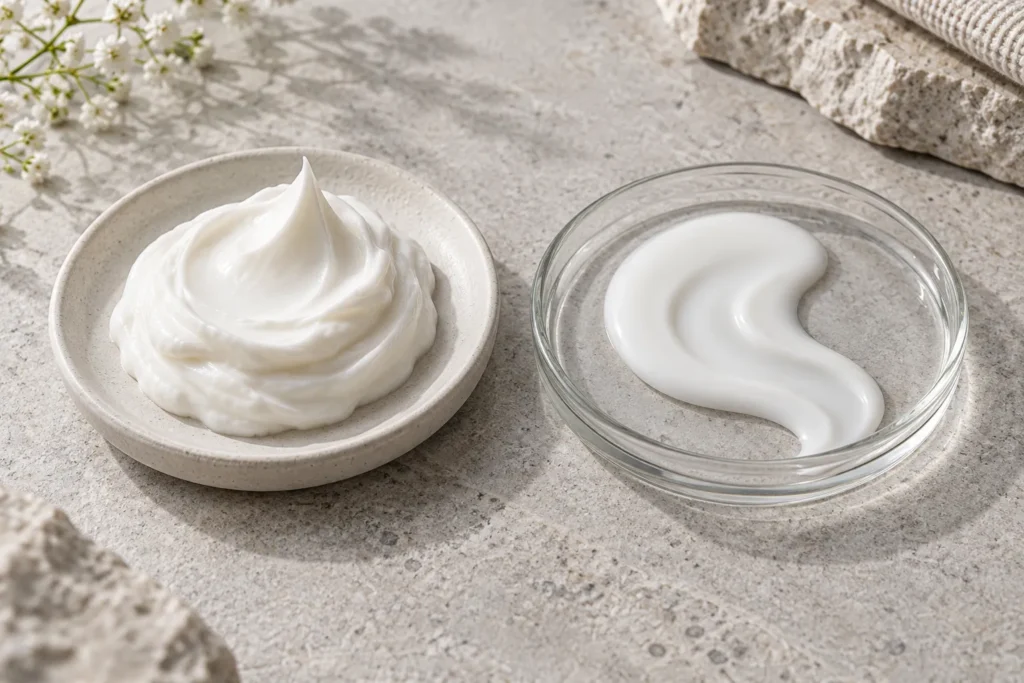
Walk into almost any skincare aisle and you will find creams and lotions sitting beside each other, often making very similar promises. Both can moisturise the skin, both can contain useful ingredients, and both may be labelled for dry or mature skin. So what is actually the difference, and does choosing a cream rather than a lotion really matter as the skin gets older?
For many people, it begins to matter when the lotion they have used for years no longer seems to be enough. You apply it after showering, the skin initially feels comfortable, but a few hours later the dryness or tightness is back. That does not necessarily mean lotions are bad products. It may simply mean that the needs of your skin have changed.
What Is the Difference Between a Cream and a Lotion?
Creams and lotions are both emulsions that generally combine water and oil-based components. The biggest practical difference is usually their consistency and the proportions of ingredients used to create that consistency. Lotions tend to be lighter and more fluid, while creams are generally thicker and richer.
That difference affects how the products feel and behave on the skin. A lotion can spread quickly across a large area and may absorb with a lighter finish. A cream usually provides a more substantial layer of conditioning, which can be particularly useful when the skin feels persistently dry or rough.
Is a Cream Always Better Than a Lotion?
No. There is no rule saying that every mature person should abandon lotions and use only creams. The right choice depends on the condition of the skin, the formulation, the climate, the area of the body and your personal preference.
Someone with relatively comfortable skin may find a lightweight lotion perfectly adequate, particularly during warm or humid weather. Someone whose skin feels dry again shortly after moisturising may prefer the richer feel of a cream. The important question is not whether the label says “cream” or “lotion,” but whether the formulation is doing enough for your skin.
Why Can Mature Skin Need More?
The skin changes throughout life. As we get older, natural oil production, hydration and the structure of the skin can change. These changes can make dryness, roughness and tightness increasingly noticeable.
This is why a body lotion that worked beautifully in your thirties or forties may begin feeling too light later in life. The product itself may not have changed at all. The skin receiving it has changed.
When a Lotion Seems to Disappear
One of the complaints we hear about mature skin is that some lotions seem to disappear almost immediately. You apply a generous amount, the skin feels softer for a while, and before long you feel as though you need to apply it again. This can be particularly noticeable on the legs, arms and hands.
Fast absorption is not automatically a sign that a moisturiser is ineffective. But if the skin repeatedly feels dry again soon after application, that tells you something useful. Your current moisturising routine may not be providing enough lasting hydration and conditioning for the skin you have now.
Creams Can Feel More Substantial
A richer cream generally feels more substantial because of the way its water, oils, emollients and other ingredients are formulated. For dry mature skin, that richer texture can provide a feeling of greater comfort and softness. It may also make the product particularly useful on rougher areas such as the hands, elbows, lower legs, neck and chest.
Texture alone, however, does not tell you whether a product is well formulated. A thick cream containing poorly chosen ingredients is not automatically superior to a carefully formulated lotion. What is inside the product matters just as much as how thick it feels.
Look Beyond the Texture
This is where skincare shopping can become confusing. Consumers often judge a moisturiser by whether it feels rich, silky or luxurious during the first few minutes after application. Those qualities can be pleasant, but they do not tell the whole story.
A mature-skin moisturiser should be considered in terms of what the skin actually needs. Does the formulation provide hydration? Does it help condition and soften the surface? Does it support the skin barrier? Are its ingredients performing complementary jobs rather than simply making the product feel nice?
These are more useful questions than simply asking which jar contains the thickest cream.
Hydration Is One Part of the Story
Dry mature skin needs water, and humectant ingredients can help support hydration within the outer layers of the skin. Glycerin and hyaluronic acid are two familiar examples used in modern skincare formulations. They perform a different job from oils and emollient ingredients.
This distinction matters because dry-feeling skin often benefits from more than one type of support. Hydration can help the skin feel more comfortable, while conditioning ingredients can contribute softness and improve the way the surface feels. A thoughtfully designed product can bring these roles together.
The Skin Barrier Matters Too
The outermost part of the skin acts as a protective barrier between the body and the environment. One of its important functions is helping limit excessive water loss. When the skin becomes very dry or stressed, supporting that barrier becomes an important part of everyday skincare.
This is also why your cleansing routine matters. If you repeatedly use very hot water, harsh cleansers or aggressive scrubbing, even a rich cream may spend much of its time compensating for what the rest of your routine is doing. Moisturising works best as part of a sensible overall routine.
Cream vs Lotion After Showering
The period immediately after bathing is a particularly useful time to moisturise dry mature skin. After gently patting the skin so it remains slightly damp, applying your moisturiser can help support hydration and comfort. For some people, a lightweight lotion is all that is required.
Others find that a richer cream leaves their skin feeling comfortable for considerably longer. This can become particularly noticeable during winter or in environments with air conditioning and indoor heating. Your choice can therefore change with the seasons rather than remaining fixed throughout the year.
What About the Face?
Some people hear “cream” and immediately think of a heavy product that will feel uncomfortable on the face. That depends entirely on the formulation. Creams vary enormously in richness, spreadability and finish.
Mature facial skin that has become dry may appreciate a more substantial moisturising product, particularly at night. Other people prefer a lighter texture during the day and something richer in the evening. There is no requirement that every part of your routine use exactly the same texture.
What About the Neck and Chest?
The neck and upper chest are often neglected until dryness, fine lines or crepey texture become more noticeable. These areas receive considerable environmental exposure but frequently receive much less moisturising attention than the face. Extending your skincare beyond the jawline can therefore make good practical sense.
A cream can be particularly convenient when you want one moisturising product that can be used across several dry areas. Rather than treating the face, neck and chest as completely unrelated pieces of skin, consider the needs they have in common. Hydration, conditioning and protection are relevant across all three.
Body Skin May Tell You the Answer
If you are unsure whether your current lotion is enough, pay attention to your arms and legs. Apply the product as you normally would and notice how the skin feels several hours later. Does it remain soft and comfortable, or does the tight, dry feeling return quickly?
Your skin can give you useful feedback. Persistent dryness does not automatically mean you need the most expensive moisturiser on the shelf. It may simply mean you need a richer or more comprehensive formulation.
Repair: Do More Than Cover Dryness
The first part of the Skin Trifecta Method™ is Repair. In cosmetic skincare, we use this to describe supporting the condition of the skin barrier and reducing everyday habits that repeatedly contribute to dryness. Applying moisturiser is important, but so is considering what happens to the skin before the moisturiser goes on.
Gentler cleansing, comfortably warm showers and less aggressive scrubbing can all become part of that approach. If your skin feels stripped immediately after washing, that is worth paying attention to. The aim is to create an environment in which your moisturising product has a better opportunity to do its job.
Nourish: Give Different Ingredients Different Jobs
The second part is Nourish. We do not think mature skincare should revolve around finding one fashionable ingredient and expecting it to do everything. The skin has overlapping cosmetic needs, so a formulation can make more sense when different ingredients perform complementary jobs.
Humectants can support hydration, while oils and emollient ingredients can help condition and soften the skin. Other ingredients can contribute additional cosmetic functions within the formulation. It is the way those components work together that matters.
Why Reno Was Formulated as a Cream
This thinking is one reason Reno Cream was developed as a multi-functional skin cream rather than simply another lightweight moisturising lotion. We began with the needs we repeatedly saw in dry, mature and problem skin. We then looked at what types of ingredients could perform complementary roles within one formulation.
Reno Cream combines black seed oil, MSM and allantoin as core ingredients, alongside glycerin and hyaluronic acid for hydration support. Vitamin ingredients and selected botanicals form additional parts of the formula. The objective was not to create the longest ingredient list possible, but to give the ingredients purposeful jobs within the overall system.
You can learn more about Reno Cream Skin Repair Cream here.
Defend: Make the Results Easier to Maintain
The third part of the Skin Trifecta Method™ is Defend. Once the skin feels better conditioned, consistent care can help prevent the routine from becoming a constant cycle of extreme dryness followed by rescue moisturising. Everyday protection becomes part of maintaining comfortable skin.
That includes appropriate sun protection, particularly on exposed areas such as the face, neck, chest and hands. It also includes adjusting your moisturising routine when the weather changes. The product that feels perfect during a Melbourne summer may not feel substantial enough in the middle of winter.
When Should You Choose a Lotion?
A lotion may be a good choice when you prefer a lightweight texture, want something that spreads easily over large areas or find richer creams uncomfortable. It can also be useful when the skin is only mildly dry or during warm, humid weather. A good lotion is still a legitimate moisturising product.
The important thing is to judge it by the condition of your skin rather than by assumptions about product categories. If your skin stays comfortable and well conditioned, there may be no reason to change. Skincare does not need to become complicated simply because you have reached a certain age.
When Might a Cream Make More Sense?
A cream may make more sense when the skin is persistently dry, rough, tight or increasingly difficult to keep comfortable. It may also be useful when lightweight products need to be reapplied frequently. Mature body areas such as the lower legs, arms, hands, neck and chest can particularly benefit from richer conditioning.
Seasonal changes can influence the decision as well. Many people naturally prefer lighter products in summer and richer ones during winter. The best moisturising routine is one that responds to the skin rather than following a rigid rule.
You May Not Need Separate Products for Everything
The beauty industry often divides the body into increasingly small product categories. Face cream, neck cream, chest cream, hand cream, elbow cream and body lotion can easily become six different purchases. Sometimes specialised products have a legitimate purpose, but every dry area does not automatically require its own jar.
When the underlying needs overlap, a well-designed multi-functional cream can simplify the routine. That is particularly useful for mature skin, where dryness, roughness and loss of softness may occur across several areas at once. Simpler routines can also be easier to use consistently.
So, Cream or Lotion for Mature Skin?
There is no universal winner. A well-formulated lotion may be completely sufficient for one person, while another person’s dry mature skin may feel far more comfortable with a richer cream. The condition of the skin should guide the choice.
If your current lotion keeps your skin soft and comfortable, there is no reason to abandon it simply because you are older. But if you are applying lotion repeatedly and wondering why your skin feels dry again so quickly, it may be time to try something more substantial.
The bigger lesson is to look beyond the words cream and lotion. Ask what the formulation is designed to do, which ingredients perform which jobs and whether the product addresses the changing needs of the skin rather than simply adding temporary moisture.
That is the thinking behind Repair, Nourish and Defend. If you would like to explore the approach in more depth, read The Skin Trifecta Method™: Repair, Nourish & Defend for Adult and Mature Skin and discover why mature skincare can be simpler when the needs of the skin are considered together.