
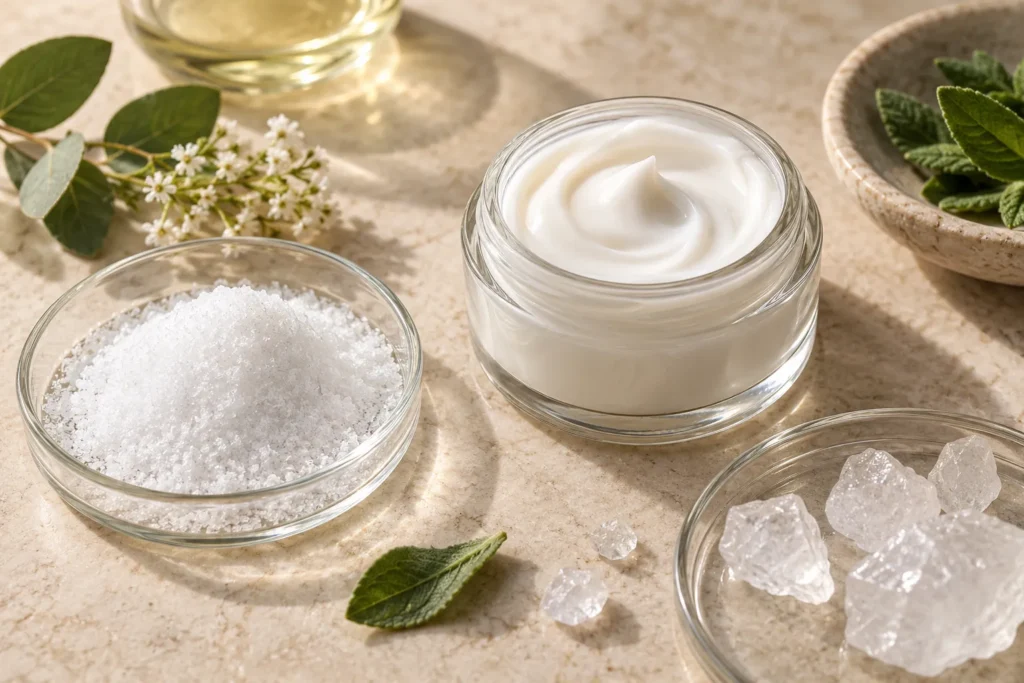
Walk down almost any skincare aisle today and you will see individual ingredients competing for your attention. Hyaluronic acid, vitamin C, retinol and botanical extracts are often displayed prominently on labels as though one ingredient is the secret to better-looking skin. When we began developing Reno Cream, we wanted to approach things differently. Instead of choosing a fashionable ingredient first and building a story around it, we started by asking what mature, dry and problem skin actually needs.
That question changed the way we thought about the entire formula. Mature skin rarely has just one concern, because dryness can exist alongside roughness, dehydration, reduced suppleness and a skin barrier that may need greater care. We therefore did not believe it made sense to expect one ingredient to do everything. Reno Cream was developed around the idea that different ingredients should have different, complementary jobs.
We Started With the Skin, Not the Ingredient
There is an important difference between building skincare around an ingredient and building it around the needs of the skin. If you begin with a fashionable ingredient, the temptation is to make that ingredient the centre of every claim. We preferred to begin with the problems people actually notice as the skin matures. Only then did we consider which ingredients could contribute to addressing those cosmetic needs.
Mature skin may become dry, rough, dull or less supple, while fine lines can appear more obvious when dehydration is present. The hands, arms, legs, neck and chest may also begin to feel different from the way they did years earlier. These concerns may look separate, but several can share underlying skincare needs such as hydration, conditioning and barrier support. That overlap became one of the foundations of the Reno Cream formulation.
Instead of asking which ingredient could become the star of the product, we started thinking about jobs. What could help support hydration? What could condition dry mature skin, and what could complement the skin barrier? What roles could vitamins, oils and carefully selected botanicals play when brought together in one formula?
Building Reno Cream in Layers
One way to understand Reno Cream is to stop looking at the ingredient list as a collection of individual names. Instead, think of the formula as several layers working together. There are core ingredients, a hydration system, vitamin and antioxidant support, and a broader botanical complex. Each layer exists because it contributes something different to the overall formulation.
This matters because a long ingredient list is not automatically a good ingredient list. Adding more ingredients simply to make a product sound sophisticated was never the objective. Each ingredient needed a reason to be included and a role that complemented the rest of the formula. That principle eventually became one of the simplest ways of explaining how Reno Cream was developed.
The Core: Black Seed Oil, MSM and Allantoin
At the centre of the Reno Cream formulation are black seed oil, MSM and allantoin. These ingredients are quite different from one another, and we see that as a strength rather than a problem. We did not want three ingredients trying to perform exactly the same job. We wanted a core combination that could contribute different characteristics to a formula created for mature, dry and stressed-looking skin.
Why We Chose Black Seed Oil
Black seed oil comes from Nigella sativa and has a long history of traditional use. In Reno Cream, however, we do not present it as a miracle oil or suggest that it can solve every mature-skin concern by itself. Its place within the formula is more practical than that. As an oil, it contributes to the conditioning side of a cream intended for the skin that can become increasingly dry and less supple with age.
The important point is that black seed oil does not have to perform every other job within Reno Cream. It works alongside humectants, vitamins, allantoin, MSM and botanical ingredients that have their own roles. This allows us to think about black seed oil as one useful part of a larger system. That is very different from building an entire product around one headline ingredient.
Why MSM Has a Place in the Formula
MSM, or methylsulfonylmethane, is another ingredient we selected as part of Reno Cream’s core formulation. It is quite different from a moisturising oil, which is precisely why we do not view MSM and black seed oil as interchangeable ingredients. They occupy different places within the overall formulation strategy. What matters to us is how MSM fits into the complete product rather than how dramatic we can make its story sound.
That same test applies to every ingredient in Reno Cream. We ask what purpose an ingredient serves and whether it contributes something useful alongside the rest of the formula. We do not expect MSM to carry Reno Cream on its own. It is part of a broader combination designed around overlapping needs of mature, dry and problem skin.
Why Allantoin Matters
Allantoin may not receive the same attention as some of the fashionable ingredients dominating skincare advertising, but popularity was never one of our formulation requirements. It is widely used in skincare formulations designed to support the feel and condition of the skin. That made it a natural fit within a cream intended for dry, rough and stressed-looking skin. Its value becomes even clearer when it is considered alongside the other components of the formula.
Allantoin is not presented as the secret ingredient that makes everything else unnecessary. It has a job, just as the oils, humectants, vitamins and botanicals have jobs. Together, those different roles begin to explain the reasoning behind Reno Cream. The formula is deliberately broader than any one ingredient.
Hydration Needed Its Own System
Dry mature skin needs hydration, but hydration is not exactly the same thing as applying something rich or oily to the surface. We therefore wanted Reno Cream to contain ingredients specifically associated with helping the outer layers of the skin maintain hydration. This is where glycerin and hyaluronic acid enter the formulation. Both are humectants, but neither is expected to do the entire job of the cream.
Humectants help support hydration by attracting and holding water within the outer layers of the skin. When the skin is better hydrated, it can feel softer and more comfortable, while dehydration-related roughness and fine surface lines may appear less noticeable. This is particularly relevant to mature skin, where dryness can exaggerate changes that are already becoming visible. Hydration therefore deserved its own place within the Reno formulation architecture.
Hyaluronic acid receives enormous attention in modern skincare, and it can be a valuable hydrating ingredient. Glycerin is less glamorous from a marketing perspective, but it remains one of the most established and useful humectants in skincare. We saw no reason to choose between an ingredient people recognise and one that has quietly been doing an important job for years. They are there because hydration matters, not because either ingredient needs to become the hero of Reno Cream.
Why We Included Vitamin E
The skin does not exist separately from the environment around it. Over a lifetime, it encounters sunlight, weather and other everyday environmental stresses that can influence its appearance. This is one reason vitamin and antioxidant-supporting ingredients are so widely used in skincare for mature skin. Reno Cream includes vitamin E, or tocopherol, as part of this broader formulation approach.
Vitamin E also fits comfortably within the richer, conditioning side of a mature-skin formula. We do not present it as an ingredient capable of reversing ageing or making wrinkles disappear. Instead, it performs its role alongside the other ingredients in Reno Cream. That allows vitamin E to contribute without carrying an unrealistic promise.
Why We Also Use a Vitamin C Derivative
Vitamin C has become one of the best-known ingredients in modern skincare, particularly in products aimed at dull and mature-looking skin. Reno Cream contains ascorbyl palmitate, a vitamin C derivative, as part of its wider vitamin and antioxidant-supporting system. We included it because it complements the broader formulation rather than because we wanted to build Reno Cream around a vitamin C marketing story. Its job makes sense within the whole.
This is an important distinction in the way we think about formulation. Vitamin C has a role, vitamin E has a role, and the hydration ingredients have their own roles. The oils, core ingredients and botanical complex contribute in other ways. Reno Cream becomes more interesting when we consider how those different jobs fit together.
Why Reno Cream Contains a Botanical Blend
Botanical skincare can easily fall into the same hero-ingredient trap. One fashionable plant extract appears on the label and suddenly the entire product is marketed around it. We wanted Reno Cream’s botanical ingredients to follow the same principle as the rest of the formulation. Rather than relying on one token botanical, we selected a broader complementary blend.
The formula includes botanicals such as Centella asiatica, chamomile, licorice, green tea, rosemary and ginger, alongside other selected extracts. These ingredients are not identical and were never intended to be. Centella is not chamomile, and chamomile is not green tea or licorice. Their differences are precisely why a botanical blend made more sense to us than expecting one plant extract to represent everything.
We also did not include botanicals simply because a long list of plant names sounds natural or impressive. The botanical layer needed to fit the same philosophy as the rest of Reno Cream. Different ingredients should contribute different things while supporting the overall direction of the formula. That is what gives the blend a reason to be there.
A Long Ingredient List Is Not Automatically Better
It is worth making this clear because skincare consumers are often encouraged to judge products by the number of recognisable ingredients on the label. More ingredients do not automatically mean better skincare. A formula can contain an impressive list of ingredients without having a particularly coherent formulation philosophy. What matters is whether those ingredients have a reason to be together.
Some ingredients contribute to hydration, while others help with conditioning or support the texture and usability of the finished cream. Others may provide vitamin, antioxidant or botanical support. Even ingredients that consumers rarely notice can be important to the stability and performance of a cosmetic formula. The real question is not how long the ingredient list is, but whether the ingredients have complementary jobs.
The Whole Formula Matters More Than One Hero Ingredient
Skincare marketing often encourages us to search for the one ingredient that will change everything. The problem is that mature skin rarely has only one need. Hyaluronic acid can help support hydration, but it does not perform exactly the same role as an oil or emollient ingredient. A botanical extract may make a useful contribution without replacing the rest of the formulation.
Think of it like an orchestra. A brilliant violinist can create beautiful music, but one violinist is not an orchestra. Different musicians perform different parts, and the result comes from how those parts work together. We think about Reno Cream in much the same way.
The objective was never to decide which ingredient deserves all the credit. The objective was to create a formula in which different ingredients could make complementary contributions. We call this ingredient synergy. For us, that idea is more useful than searching endlessly for the next skincare hero ingredient.
Why This Matters as the Skin Matures
Younger skin can sometimes tolerate a surprisingly simple routine, but the needs of the skin can become more noticeable as the years pass. Dryness may begin appearing alongside roughness, reduced suppleness and dehydration. The skin barrier may require greater consideration at the same time that years of environmental exposure become increasingly visible. Several concerns can therefore begin appearing together.
This is why we question the idea that every mature-skin concern automatically requires a completely different product. Someone concerned about dry, crepey arms may also have rough hands and very dry legs. Another person may notice that the neck, chest and face all seem to be becoming drier at the same time. Different areas of the body are not identical, but many of their basic skincare needs can overlap.
That overlap is where multi-functional skincare begins to make sense. Rather than viewing every visible change as an unrelated problem, we can ask what the skin may need across several of those concerns. Hydration, conditioning, barrier-conscious care and protection frequently appear in the answer. Reno Cream was developed around that broader view.
Why Reno Was Formulated This Way
Reno Cream was designed around the needs of the skin first, and the ingredients were selected afterwards. We wanted hydration, so the formula includes humectants such as glycerin and hyaluronic acid. We wanted a core combination suited to mature, dry and stressed-looking skin, which helped shape our use of black seed oil, MSM and allantoin. We also wanted vitamin, antioxidant and botanical support to complement those parts of the formula.
That sequence is important because it explains why Reno Cream contains ingredients from several different skincare categories. They are not there simply to make the label look sophisticated. Each group has a different part to play within the overall formulation. The finished cream is the point where those individual roles come together.
This is what we mean when we say Reno Cream was built as a system. We did not formulate around a trend and then search for a problem the trend could solve. We started with mature, dry and problem skin and asked what a useful multi-functional cream should provide. The ingredient choices followed from that question.
Repair. Nourish. Defend.
Once the formulation philosophy had taken shape, we needed a simple way to explain what we were trying to achieve. That eventually became The Skin Trifecta Method™: Repair, Nourish and Defend. The three parts do not represent three miracle ingredients. They represent three broad needs that frequently overlap when caring for mature, dry and problem skin.
Repair reflects our barrier-conscious approach and the importance of supporting the conditions that help the skin remain hydrated and comfortable. Nourish represents the combination of hydration, conditioning ingredients, oils, vitamins and botanicals within the formulation. Defend recognises that the skin exists in a real environment where sun exposure, weather, repeated washing and other everyday stresses matter. Together, these ideas provide a much simpler way of thinking about what the formula was designed to support.
No individual ingredient represents the entire Skin Trifecta Method™. The framework belongs to the formula as a whole. That is why it makes little sense for us to claim that black seed oil, MSM, allantoin or hyaluronic acid alone is “the secret.” Reno Cream was deliberately designed so there would not have to be one.
What Reno Cream Is and What It Is Not
Reno Cream is a cosmetic skincare product designed for mature, dry and problem skin. It is not a medicine and is not intended to diagnose, treat or cure medical skin conditions. It cannot stop ageing, replace sunscreen or make every wrinkle disappear. Those would be unrealistic expectations for a cosmetic cream.
What Reno Cream can provide is a thoughtfully designed combination of moisturising, conditioning and skin-supporting ingredients within one multi-functional formula. It can form part of a routine intended to help the skin feel softer, smoother, better hydrated and better conditioned. We believe being clear about those limits makes the formulation story stronger rather than weaker. Good skincare should not need impossible promises.
How to Read an Ingredient List More Thoughtfully
You do not need to become a cosmetic chemist to make better decisions about skincare. Instead of searching an ingredient list for whichever name is currently fashionable, start asking what the formulation appears to be trying to accomplish. Look for where the hydration comes from, what provides conditioning and whether different ingredients appear to have complementary roles. Those questions can reveal much more than a single ingredient printed in large letters on the front of a jar.
It is also worth thinking about your own skin rather than following ingredient trends automatically. Someone dealing with persistent dryness, roughness and reduced suppleness may have different priorities from someone whose main concern is simply a lightweight daytime moisturiser. The best ingredient is not necessarily the ingredient receiving the most attention online. It is the ingredient, or combination of ingredients, that makes sense for what the skin actually needs.
The Formula Is the Hero
If we had to choose one hero in Reno Cream, it would not be black seed oil, MSM or allantoin. It would not be hyaluronic acid, glycerin, vitamin E or any individual botanical either. The formula itself is the hero. Every ingredient has to contribute to the bigger picture.
That is why we describe Reno Cream as a multi-functional skin cream rather than an ingredient-led beauty product. It was designed around the reality that mature, dry and problem skin can have several overlapping needs at the same time. Different ingredients were selected for complementary jobs, and those jobs were brought together through the philosophy of Repair, Nourish and Defend. The purpose is not to make one ingredient famous, but to make the whole formulation useful.
You can explore Reno Cream and its multi-functional formulation here and see how the different parts of the formula come together. You can also get The Skin Trifecta Method™ here to explore our Repair, Nourish and Defend approach in greater detail. Both reflect the same philosophy that guided Reno Cream from the beginning. Start with what the skin needs, choose ingredients with complementary jobs, and build the formula as a system.