
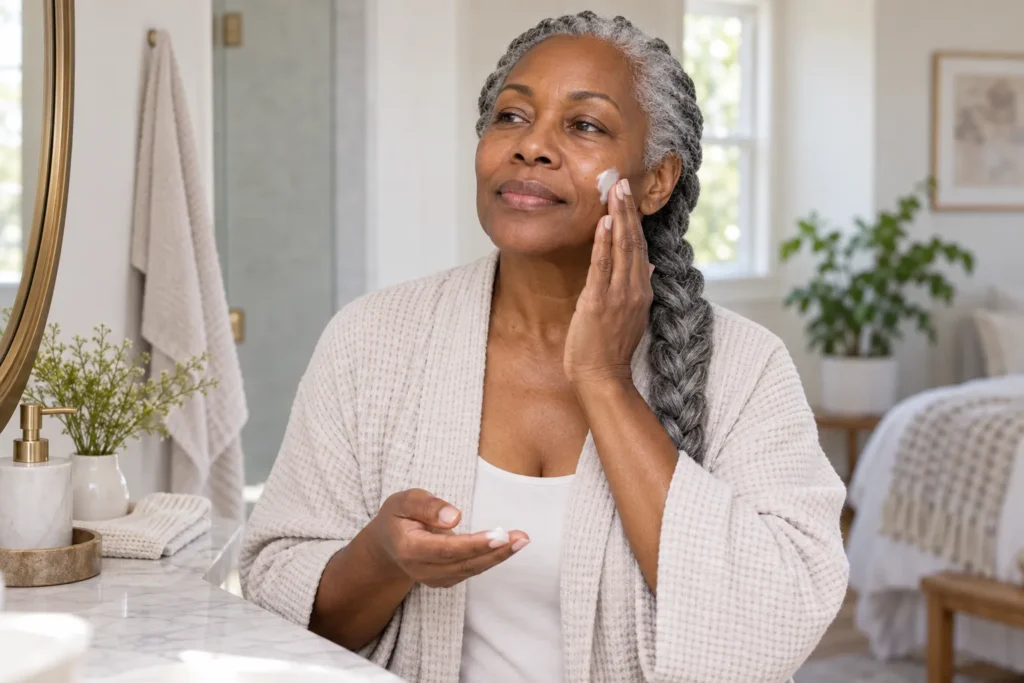
A morning makeup routine can become a quiet measure of how much the skin has changed. What once took a quick moisturiser and a few confident brush strokes may now involve patchy cheeks, a tight mouth area and foundation that looks tired before the day has properly begun. The frustration is rarely only about cosmetics. It can affect how ready, capable and recognisable a person feels when facing work, family, photographs or an ordinary outing.
Mature skin does not need a punishing list of products to look better under makeup. It needs a morning sequence that respects dryness, allows useful ingredients time to settle and gives each layer a clear purpose. Cleansing, hydration, nourishment, sun protection and makeup can work together when they are applied calmly. The routine becomes more effective when it stops trying to force the skin back into the behaviour it had decades ago.
The goal is not a perfectly smooth or expressionless finish. The goal is skin that feels comfortable enough for foundation, concealer and powder to sit with greater flexibility. Reno Cream fits this approach by bringing several supportive cosmetic functions into one practical step. Through the Skin Trifecta Method, the morning becomes a way to Repair, Nourish and Defend before colour is added.
Begin by noticing the skin you have this morning
Before reaching for cleanser, notice how the face feels. The cheeks may feel comfortable while the mouth area is tight, or the forehead may feel balanced while the jaw looks rough. Mature skin can vary with weather, sleep, indoor heating, air conditioning and the products used the night before. A fixed routine works better when it still leaves room for these daily differences.
Look for signs that affect makeup directly. Flaking can catch foundation, tightness can make expression lines look sharper and an oily centre may cause product to move. These conditions can exist together, so treating the entire face as uniformly dry or uniformly oily may create new problems. Observation helps you place richer care where it is needed and lighter layers where it is not.
This pause should be practical rather than critical. Magnifying mirrors and harsh overhead lights can turn normal texture into a source of anxiety. Stand at an ordinary distance and assess comfort as well as appearance. The routine should respond to the skin, not begin by judging it.
Use the gentlest cleansing that does the job
Morning cleansing should remove what needs removing without leaving the face stripped. A strong foaming cleanser, hot water and vigorous cloth can take away surface oils that help mature skin feel flexible. If the face feels tight immediately after washing, the next steps are already trying to recover lost comfort. Makeup may then exaggerate the resulting dryness later in the day.
Some people prefer a gentle cleanser in the morning, while others find a warm-water rinse sufficient after a simple night routine. The right choice depends on the products used overnight and how the skin behaves. Use lukewarm water and light pressure, then pat with a soft towel rather than rubbing. The face should feel fresh but not squeaky.
Cleansing is part of Repair within the Skin Trifecta Method because avoiding unnecessary stress helps preserve the barrier. Repair does not mean forcing the surface to renew through daily aggression. It means supporting the skin’s ability to retain comfort and reducing habits that repeatedly disturb it. A kinder cleanse creates a better starting point for everything that follows.
Apply skincare while the surface is receptive
After cleansing, do not leave the face exposed until it begins to feel tight. Apply moisturising care while the skin is still comfortable and slightly receptive, without leaving it dripping wet. This helps make hydration a planned step rather than an emergency response. Consistency matters more than chasing a dramatic sensation.
Humectants such as glycerin and hyaluronic acid help support water in the outer layers of the skin. Emollient ingredients help soften roughness and improve flexibility, which is especially useful where foundation tends to catch. Mature skin often benefits when these functions appear together in one formulation. Water attraction and surface nourishment solve related but different parts of the morning problem.
A quick wet feeling can disappear before makeup is finished if the formula does not provide enough broader support. Our guide to the difference between a basic moisturiser and a multi-functional skin cream explains why several overlapping needs may deserve one thoughtful response. The best morning product is not necessarily the thickest or the most fashionable. It is the one that leaves the skin comfortable, conditioned and ready for the next layer.
Make Reno Cream the nourishing centre of the routine
Reno Cream was created for dry, mature and problem-looking skin that needs more than temporary surface moisture. Glycerin and hyaluronic acid provide humectant support, while Black Seed Oil and emollient components help nourish and soften. MSM, allantoin, vitamin E, ascorbyl palmitate and selected botanical extracts contribute to a wider conditioning formula. These ingredients work through complementary cosmetic roles rather than relying on one fashionable hero.
Apply a sensible amount across the face and smooth it gently over the neck where desired. Give particular attention to the cheeks, around the mouth and other areas where makeup tends to look dry. Pressing or smoothing is enough; repeated rubbing can disturb the surface you are trying to calm. The skin should feel comfortably moisturised rather than wet or heavily coated.
Reno Cream puts the three Skin Trifecta needs into a practical morning step. Repair supports the barrier-conscious choices that protect comfort. Nourish brings hydration, emollience and conditioning together. Defend prepares the skin for everyday environmental pressure while sun protection and sensible habits complete the routine.
Use more only where more is needed
Mature skin is not always equally dry across the whole face. The cheeks and mouth area may need richer care while the centre remains comfortable or becomes shiny later. Applying several thick layers everywhere can make makeup slide and encourage pilling. Targeted preparation gives each zone what it needs without overwhelming the others.
After the first application settles, touch the areas that usually look dry under foundation. If one still feels tight, add a very small amount of Reno Cream there and smooth the edges. Do not immediately cover the entire face with another layer. This local adjustment often creates a better balance between comfort and makeup wear.
The same principle applies from season to season. A larger amount may feel appropriate in winter, during travel or in a heavily heated room. Humid weather may call for a lighter hand, even though the same core product remains useful. Responsive consistency is better than a rigid quantity that ignores the environment.
Allow the cream time to become part of the surface
Applying foundation immediately over fresh cream can make the layers move against each other. Pigment may streak, gather or roll into small pills, and the result can look like dryness even when excess wet product is the real cause. Give Reno Cream time to settle before sunscreen and makeup follow. The pause can happen while getting dressed, preparing breakfast or styling hair.
The surface is ready when it feels supple rather than slippery. There should be enough comfort for the fingers to glide lightly, but not a visible layer that shifts when touched. If too much cream was applied, pressing gently with clean hands can help distribute it. Rubbing with a tissue may remove useful moisture unevenly and create a fresh dry patch.
Timing matters because a good product still needs a good sequence. This is explored further in our article on how to prepare dry mature skin before makeup. A few unhurried minutes can improve how sunscreen and foundation form their own even films. Morning skincare becomes more reliable when every layer is allowed to do its job.
Protect the skin before adding colour
Daily sun protection belongs in the morning routine because ultraviolet exposure continues through ordinary life. Choose a broad-spectrum sunscreen appropriate for your skin and follow its directions for amount and application. Spread it evenly without repeatedly dragging the moisturised surface. Allow it to settle before foundation is added.
Sunscreen is an important part of Defend within the Skin Trifecta Method. Reno Cream provides moisturising and conditioning support, while sunscreen has the specific job of ultraviolet protection. One does not replace the other. Their roles are clearer and more effective when each is used purposefully.
Compatibility between sunscreen and makeup can require a little experimentation. Some combinations pill when too many silicone-rich or heavy layers are applied in quick succession. Changing the timing or amount may solve the problem without replacing every product. Test the complete sequence on an ordinary day before relying on it for an important event.
Primer is optional rather than compulsory
Primer can add slip, soften the appearance of pores or help makeup remain in place, depending on its formulation. It is useful when it solves a specific problem, but it should not be expected to compensate for tight, under-moisturised skin. A mattifying primer across the whole face may make dry cheeks look flatter and more textured. A hydrating primer may help, yet it still works best over well prepared skin.
Use primer selectively if different areas have different needs. A small amount through the centre may control movement, while the cheeks may need no primer at all. Press it gently over sunscreen rather than rubbing each layer back into motion. The fewer unnecessary layers used, the easier it is to identify what improves the finish.
If makeup already sits well after Reno Cream and sunscreen, primer can be skipped. A shorter routine is not an incomplete routine when every step has a purpose. Mature skin often responds well to less friction and less product weight. Simplicity can be sophisticated when it is informed.
Choose a foundation that remains flexible
A foundation label can suggest hydration or radiance, but the real test is how the formula behaves on your skin after several hours. Full coverage and a very matte finish may place more pigment across fine lines and dry texture. A flexible light or medium layer can allow the moisturised surface to remain visible. Concealer can then be added only where more coverage is wanted.
Apply a small amount first and assess the result before building. Place product near the centre or on areas of uneven tone, then blend outward with light pressure. A damp sponge can press pigment into a thin layer, while fingers or a soft brush may work well with the right formula. The best tool is the one that spreads product without repeatedly disturbing the skincare beneath it.
Our article on why dry skin can make makeup sit poorly on mature skin explains the connection between roughness, flexibility and foundation. Makeup cannot float above the surface it is given. When the skin feels softer and better conditioned, foundation has a more cooperative place to sit. The morning routine therefore influences the finish as much as the foundation bottle does.
Treat the eye area with particular restraint
The skin around the eyes is naturally delicate and moves with every blink and expression. Thick concealer can gather there even on well moisturised skin, and dehydration makes the contrast more obvious. Use a small amount of suitable moisturising care and allow it to settle fully. Too much slip can cause concealer to move, while too little can leave the area looking dry.
Place concealer only where discolouration needs softening rather than drawing a large triangle beneath each eye. Press a thin layer into place and add another small touch only if it improves the result. Repeated rubbing can lift the product and irritate the surface. Flexible coverage tends to look more natural than one dense coat.
Powder beneath the eyes should also have a clear purpose. A very small amount can reduce transfer, but a heavy layer may absorb moisture and emphasise fine lines. Look at the result in ordinary daylight before adding more. Mature eyes remain expressive, and the makeup should move with them rather than trying to freeze them.
Use powder strategically
Powder can control shine and help foundation last, but it is not automatically needed over the whole face. Dry cheeks often look fresher when their moisturised finish remains visible. Apply powder around the nose, forehead or other areas where makeup genuinely moves. A soft brush and a small amount make it easier to stop before the surface looks flat.
If powder immediately makes lines look sharper, remove excess with a clean brush and reconsider the amount next time. Adding facial mist may soften an overly powdery finish, but it cannot always undo a heavy layer. Prevention is simpler than rescue. Let the skin’s condition decide where powder belongs.
This selective approach also helps combination mature skin. The centre can be controlled without asking the entire face to wear the same matte finish. Makeup looks more integrated when different zones retain appropriate texture and light. Uniformity is not the same as harmony.
Build a routine that works in real mornings
A routine only helps when it can be repeated. Ten separate serums may look impressive on a shelf but become difficult during early starts, family responsibilities or busy workdays. A gentle cleanse, Reno Cream, sunscreen and thoughtfully chosen makeup can cover the essential sequence. Optional products can be added only when they produce a clear benefit.
Keep frequently used products together and apply them in the same order. Familiarity reduces rushed mistakes and makes it easier to notice when the skin behaves differently. If one step repeatedly causes pilling or tightness, change that step rather than abandoning the entire routine. Practical organisation supports consistency.
The order is simple: cleanse gently, moisturise and condition, allow the cream to settle, apply sunscreen, pause again and then use light makeup layers. Each stage protects the work of the one before it. The routine can take only a few active minutes even when the pauses are included. Calm sequencing matters more than speed.
Adjust for dry indoor air
Indoor heating and air conditioning can draw attention to dryness as the day continues. The face may feel comfortable at home but look tighter after several hours in an office, car or shopping centre. Fine lines can become more visible as the surface loses water and foundation becomes less flexible. This environmental pattern is common enough to plan for.
Our guide to indoor heating, dry skin and more noticeable fine lines explains why the midday mirror can look different from the morning one. Apply enough Reno Cream to support comfort without overloading the surface, and avoid sitting directly in strong airflow where practical. Small environmental adjustments can help the morning routine last longer. The skin and the room both influence the final makeup result.
If makeup becomes dry later, avoid immediately adding more foundation and powder. Press gathered product outward with a clean sponge or fingertip. A compatible mist or tiny amount of moisturising product may help a specific dry area, although it should be tested so the layers do not separate. The best midday solution often begins with what happened during morning preparation.
Protect the night before as well
Morning makeup is influenced by evening care. Makeup and sunscreen should be removed thoroughly but gently so the face is not left tight before sleep. Strong scrubbing and very hot water can create roughness that one morning application cannot instantly reverse. A calm evening routine gives the barrier hours without additional cosmetic layers.
Apply Reno Cream after cleansing when the skin needs overnight moisturising and conditioning support. Pay attention to areas that regularly feel dry, but avoid introducing several strong products at once when the surface already feels stressed. Consistency makes it easier to judge what is helping. The morning then begins from a more comfortable baseline.
A good routine is continuous without becoming complicated. Evening care removes the day gently and restores comfort, while morning care prepares and protects. The same Repair, Nourish and Defend philosophy connects both. Makeup benefits because the skin is supported beyond the few minutes before foundation.
Judge progress by comfort and wear
Look for practical changes rather than an unrealistic promise of poreless skin. The face may feel less tight after cleansing, foundation may spread with less dragging and dry patches may become less obvious. Makeup may remain flexible for longer and require fewer corrections by afternoon. These results are meaningful because they improve both appearance and the experience of wearing makeup.
Give a stable routine enough time to reveal a pattern. Changing multiple products every few days can create confusion and irritation while making success difficult to identify. Keep notes if necessary about weather, product amounts and the time makeup begins to look dry. Clear observations help refine the routine without turning it into an obsession.
Normal lines and texture will remain, and that is not a failed result. Better prepared skin can still look mature, expressive and completely human. The aim is comfort, softness and a finish that works with the face. Makeup should support confidence rather than demand that age become invisible.
Let the morning feel supportive again
There is relief in discovering that better makeup does not require fighting the skin. A gentler cleanse, purposeful cream, appropriate sun protection and lighter layers can change the entire rhythm of getting ready. The face no longer has to be corrected at every step. It can be prepared, protected and then enhanced with restraint.
You can make Reno Cream the multi-functional moisturising step in your mature-skin morning routine. Its blend of humectant, emollient and conditioning support was designed for dry, mature and problem-looking skin that needs more than a basic moisturiser. Used consistently, it helps the surface feel softer, smoother and better prepared for makeup. That practical support gives the day a kinder beginning.
For the wider philosophy, read the Skin Trifecta Method guide to Repair, Nourish and Defend. Begin by reducing unnecessary stress, then nourish with complementary functions and defend against the environment with sensible daily protection. Mature makeup looks better when the care beneath it respects the skin as it is now. Confidence can return one thoughtful morning at a time.