
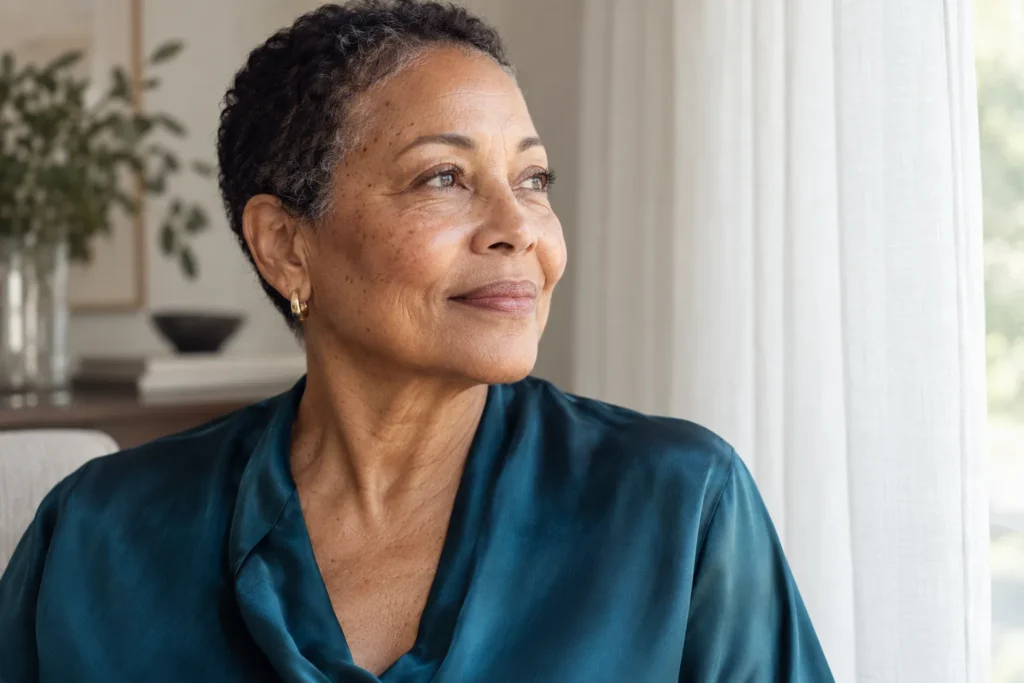
You may first notice it when you look at your face in natural daylight. The skin that once seemed fairly even now has areas that appear darker, duller or slightly blotchy. Perhaps there are brown spots around your cheeks, more noticeable pigmentation across your forehead, or patches on your hands and chest that seem to have become more obvious over the years. For many people, uneven looking skin tone becomes increasingly noticeable after 50.
It is easy to assume this is simply another unavoidable part of getting older, but the picture is more complicated. Ageing itself can influence the appearance of the skin, while decades of sun exposure can gradually become visible as pigmentation changes, age spots and a more mottled complexion. Hormonal changes and previous inflammation can also influence pigmentation in some people.
The useful question is therefore not simply, “How do I get rid of these spots?” It is better to understand why your skin tone may be changing, what skincare can realistically help with, and when a changing spot deserves professional attention rather than another cosmetic product.
Why Can Skin Tone Become Less Even After 50?
Skin colour comes partly from melanin, the pigment produced by specialised cells called melanocytes. Pigmentation is not necessarily distributed perfectly evenly across the skin, and years of ultraviolet exposure can influence the way pigment appears. Over time, areas that have received substantial sun exposure may develop darker spots and more irregular looking pigmentation.
This is one reason the changes often appear most noticeably on the face, hands, forearms, neck and upper chest. These are also the parts of the body that may have accumulated decades of incidental sun exposure from walking, driving, gardening, working outdoors or simply living everyday life. Age spots, dryness, wrinkling and other visible changes are common features of ageing skin, with sun exposed areas particularly prone to pigmentation changes.
Years of Sun Exposure Can Eventually Show Up on Your Skin
One of the interesting things about sun related skin changes is that what you see today may reflect exposure accumulated over many years. You do not necessarily need to have spent every summer deliberately sunbathing. Regular everyday exposure can add up over decades. Ultraviolet radiation can affect pigmentation, collagen and other components of the skin.
The result may include wrinkles, brown spots, uneven pigmentation and a blotchy complexion. These accumulated visible changes are often described as photoageing. This matters particularly in Australia, where sun protection needs to remain part of mature skincare. Starting good sun habits at 50, 60 or 70 is not pointless simply because earlier exposure has already occurred.
Protecting the skin now can help reduce additional ultraviolet damage.
What Are Age Spots?
Age spots are flat areas of increased pigmentation that commonly develop on skin that has received repeated sun exposure. They are often tan or brown and can appear on the face, backs of the hands, shoulders and arms. They become particularly common after 50, although younger people with substantial sun exposure can develop them too.
The name can be slightly misleading because age alone is not the whole explanation. These marks are strongly associated with cumulative ultraviolet exposure, which is why they frequently appear on parts of the body that have spent years exposed to sunlight. For cosmetic purposes, genuine age spots can sometimes be lightened with appropriate treatments. But before trying to fade a new or changing dark spot yourself, it is important to know what you are actually looking at.
Not Every Brown Spot Is an Age Spot
This is one area where cosmetic skincare needs to know its boundaries. Different skin changes can look surprisingly similar to an untrained eye. A spot that appears to be ordinary pigmentation could potentially be something requiring medical assessment. Attempting to fade a suspicious lesion cosmetically could delay proper diagnosis.
If you notice a new spot that concerns you, or an existing spot changes in size, shape, colour or appearance, have it checked by an appropriate health professional. This is particularly important in Australia, where skin cancer awareness should be part of sensible lifelong skin care. Cosmetic skincare should never be used as a substitute for appropriate assessment of a suspicious skin change.
Menopause Can Also Influence the Way Skin Looks
For many women, the years after 50 also coincide with menopause. Falling oestrogen levels can contribute to skin becoming drier, thinner and less resilient. At the same time, years of previous sun exposure may become increasingly visible. This combination can make the complexion look different even when pigmentation itself has not changed dramatically.
Dry skin can appear duller, rougher and less reflective of light, while changes in texture can make differences in tone seem more obvious. We explored these wider changes in Menopause and Dry Skin: Why Your Old Moisturiser May Suddenly Feel Too Light. Menopause is a useful reminder that mature skin concerns rarely occur completely independently of one another.
Dryness Can Make Your Complexion Look Duller
Not every complaint about uneven looking skin tone is purely a pigmentation problem. Sometimes what people describe as unevenness is partly a combination of dryness, rough texture and reduced surface smoothness. When the skin is well hydrated and conditioned, its surface can appear smoother and more supple. When it is very dry, light reflects from that surface differently, which can make the complexion appear dull or less uniform.
Fine lines and rough areas may also become more visually prominent. This is why moisturising still has a role even though moisturiser cannot simply erase established pigmentation. Improving dryness can help the overall surface of mature skin look healthier and better cared for, while specific pigmentation concerns may require a different approach.
Irritation Can Sometimes Make Pigmentation More Complicated
Another mistake is trying to scrub uneven colour away. If you see dark patches or dull looking skin, it can be tempting to exfoliate more aggressively in the hope of revealing brighter skin underneath. That approach can backfire. Products that repeatedly irritate the skin can create additional problems, and inflammation can contribute to pigmentation changes in some skin tones.
This does not mean exfoliation has no place in skincare. It means exfoliation should have a purpose and be used according to what your skin tolerates. Mature skin does not necessarily benefit from being scrubbed harder simply because its tone has become less even. A gentler and more consistent approach is often more sensible.
Sun Protection Is One of the Most Important Steps
If uneven looking pigmentation is connected with years of ultraviolet exposure, continuing to expose the skin without protection makes little sense. Sun protection therefore becomes one of the foundations of caring for uneven looking mature skin. Broad spectrum sunscreen should be applied to exposed skin as appropriate, and clothing, hats and shade can provide additional protection.
Do not stop at the face. The hands, forearms, neck and chest are common places for visible sun related changes precisely because they are frequently exposed. Think of this as defending the progress you are trying to make. There is little point concentrating entirely on correcting the appearance of yesterday’s sun exposure while ignoring today’s.
What About Vitamin C?
Vitamin C has become one of the best known ingredients in skincare discussions about brightness and uneven looking tone. However, as with most skincare ingredients, the important question is not simply whether a formula contains vitamin C. The form of the ingredient, concentration, formulation and the other ingredients surrounding it all matter. Reno Cream contains a vitamin C derivative rather than building the entire product around vitamin C as a hero ingredient.
This reflects our broader formulation philosophy. We do not expect one ingredient to carry every function within a product. For dry mature skin, pigmentation may be only one concern among several. The same person may also be dealing with dryness, crepey looking texture, roughness and changing barrier needs.
That is why we prefer to think about the whole skin rather than isolate one visible concern from everything else happening around it.
Why We Do Not Build Our Philosophy Around One Brightening Ingredient
Skincare marketing often encourages us to look for one ingredient associated with one problem. Pigmentation means one serum. Dryness means another product. Fine lines mean something else again.
Our approach at Reno begins differently. We ask what dry and mature skin needs as a whole and then consider ingredients that can perform complementary jobs within the finished formulation. In Reno Cream, glycerin and hyaluronic acid contribute to hydration. Black seed oil provides an oil based component, while MSM and allantoin form part of the broader formulation.
Vitamin E, a vitamin C derivative and selected botanical extracts contribute additional complementary functions. The philosophy is simple: skin needs first, ingredient jobs second, formulation as a whole third. No ingredient needs to be presented as a miracle because the purpose of the formula is to bring several useful functions together.
What Role Do Botanicals Play?
Our botanical blend follows the same principle. Rather than including one fashionable plant extract simply so it can appear prominently on a label, Reno Cream brings together selected botanicals including centella, chamomile, licorice, green tea, rosemary and ginger among the wider formulation. Botanical ingredients should not be treated as magical solutions simply because they come from plants.
Their value depends on how they are selected, formulated and used alongside everything else in the product. For us, the botanical blend is part of the overall ingredient system. It sits alongside hydration ingredients, oils, vitamins, MSM and allantoin rather than replacing them. That is another example of ingredient synergy in practice.
Can Reno Cream Remove Age Spots?
This is where realistic cosmetic claims matter. Reno Cream is not a medical treatment for pigmentation disorders and we do not position it as a product that removes age spots. Its role is broader. Reno Cream is designed to support the hydration, conditioning, appearance and feel of dry and mature skin through a multifunctional formulation.
When dryness and roughness are making the complexion look dull or less smooth, better moisturising and conditioning can contribute to a healthier looking surface. Established pigmentation may require targeted cosmetic or professional approaches depending on its cause. A dermatologist can also assess whether a particular spot is appropriate for cosmetic treatment and discuss suitable options when necessary. That distinction allows skincare to remain useful without promising something it cannot reasonably deliver.
Your Neck, Chest and Hands Need Attention Too
Uneven looking skin tone is not limited to the face. In fact, your hands, forearms, neck and chest can reveal years of cumulative sun exposure very clearly. These areas are frequently exposed but often receive far less skincare attention. Someone may carefully apply facial moisturiser and sunscreen every morning while leaving the chest and hands completely unprotected.
Over many years, that difference can become increasingly visible. When building your mature skincare routine, think beyond your face. Moisturising exposed areas and using appropriate sun protection can help you care for the skin more consistently. This broader approach becomes particularly useful after 50 because several visible changes often occur across the same areas at once.
Do Not Chase Perfectly Uniform Skin
Human skin is not naturally one perfectly uniform colour. Freckles, subtle pigmentation differences and variations in tone are normal. Mature skin also carries evidence of decades of life and environmental exposure. The goal of skincare should not be to create an artificially flawless surface.
A more useful goal is skin that appears healthy, comfortable, hydrated and well cared for while addressing particular concerns realistically. This becomes especially important when looking at advertising images. Perfectly smooth, completely uniform mature skin is often the result of lighting, makeup, image processing or a combination of all three. Comparing real skin with that standard creates expectations no jar of cream can satisfy.
Repair, Nourish and Defend Uneven Looking Mature Skin
Uneven looking skin tone provides another useful example of The Skin Trifecta Method™. Repair means supporting dry, rough or stressed skin and paying attention to the skin barrier. Improving surface hydration and conditioning can help mature skin appear smoother and better cared for even when established pigmentation remains.
Nourish means thinking about hydration, oils, vitamins, conditioning ingredients and botanicals as complementary parts of a complete formulation. This is where our ingredient synergy philosophy becomes particularly relevant. Defend may be the most important part when pigmentation is connected with sun exposure. Protecting your skin from ongoing ultraviolet exposure helps reduce additional sun damage and supports whatever cosmetic routine you choose to follow.
We explore this approach more fully in The Skin Trifecta Method™. The book was written to help people see mature skincare as a connected system rather than a collection of isolated problems.
A Simple Routine for Uneven Looking Skin After 50
Start with gentle cleansing and avoid leaving your skin feeling stripped. Follow with moisturising support appropriate for your skin’s current level of dryness, then use suitable broad spectrum sun protection during the day. If you decide to introduce a targeted product for pigmentation or another active ingredient, add it thoughtfully rather than changing your entire routine at once.
Pay attention to irritation, particularly if your mature skin has become drier or more reactive. Remember the areas beyond your face. The neck, chest, forearms and hands may benefit from the same consistency you give your facial routine. And if a particular dark spot concerns you, do not simply cover it with another cosmetic product and hope for the best.
Get it properly assessed.
Better Looking Skin Tone Begins With Understanding What You Are Seeing
Uneven looking skin after 50 can have more than one contributing factor. Years of sun exposure can become visible as brown spots and irregular pigmentation. Menopause and ageing can change the texture and hydration of the skin, while dryness can make the overall complexion appear duller and less smooth. That is why the answer is rarely one miracle brightening ingredient.
Good mature skincare begins by understanding what you are actually trying to improve. Protect the skin from further sun exposure, keep dry mature skin comfortably moisturised, avoid unnecessarily irritating it, seek professional advice for suspicious or persistent pigmentation concerns, and choose products according to the jobs your skin actually needs them to perform.
That is also the thinking behind Reno Cream and The Skin Trifecta Method™. We begin with the needs of mature skin, choose ingredients for complementary purposes and bring those functions together through Repair, Nourish and Defend.