
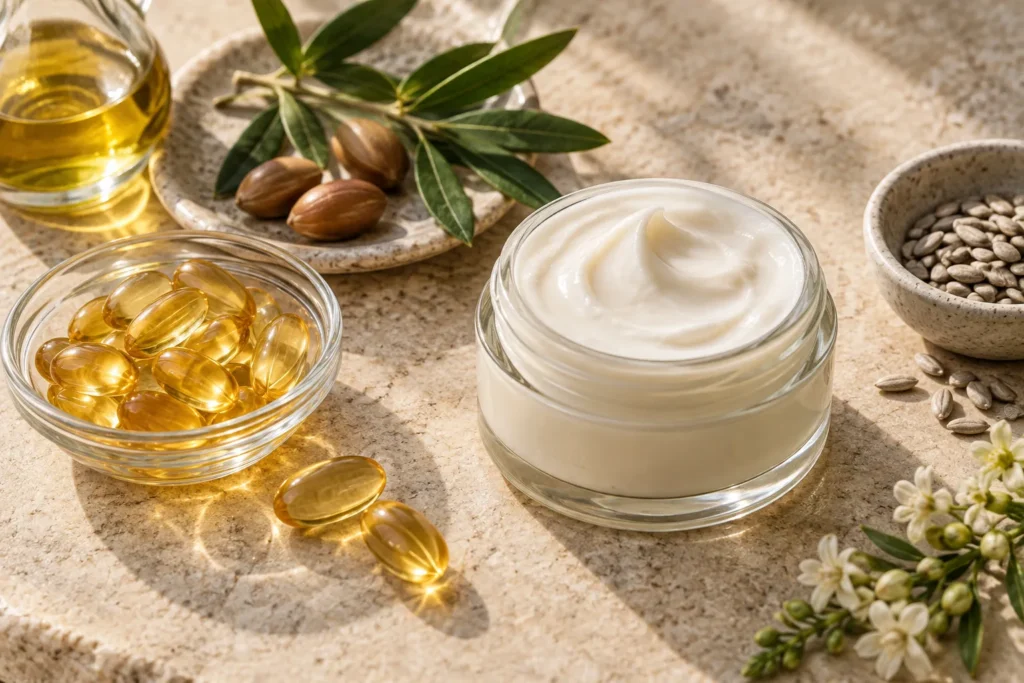
Vitamin E has been part of skincare for so long that it can almost disappear into the background. It does not have the novelty of many newer actives, yet it continues to appear in moisturisers, oils, serums and products designed for dry and mature skin. That longevity is not accidental. Vitamin E has characteristics that continue to make it useful to cosmetic formulators.
When we developed Reno Cream, however, we did not include vitamin E simply because consumers recognise its name. We were building a formula around several overlapping needs of mature, dry and problem skin, and we wanted ingredients with complementary roles. Vitamin E became part of that wider formulation rather than the ingredient around which everything else was built. That distinction is central to understanding why it is in Reno Cream.
What Is Vitamin E?
Vitamin E is the name given to a family of fat-soluble compounds that includes tocopherols and tocotrienols. In skincare, forms of vitamin E are widely used in cosmetic formulations, including tocopherol, which is the form relevant to Reno Cream. Vitamin E is particularly well known for its antioxidant properties. It is also naturally associated with the lipid-rich environment of the skin.
Calling vitamin E an antioxidant sounds impressive, but the word should still be understood properly. Antioxidants are compounds capable of interacting with oxidative processes, and this has made them important subjects of skincare research. That does not mean every product containing an antioxidant automatically reverses visible ageing. The finished formulation and the evidence supporting a particular claim still matter.
Why Antioxidants Matter to the Skin
The skin exists at the boundary between the body and the outside world. Every day it encounters ultraviolet radiation, pollution and other environmental factors capable of contributing to oxidative stress. The body has its own antioxidant defence systems, but environmental exposure remains an important part of the visible ageing conversation. This is one reason antioxidants have become common ingredients in modern skincare.
Vitamin E is interesting in this context because of its established antioxidant activity. Researchers have studied its biological roles extensively, and cosmetic formulators have used it for many years. But responsible skincare communication should distinguish between an ingredient having antioxidant properties and a cosmetic product being able to reverse years of environmental damage. Those are not the same claim.
What Is Oxidative Stress?
Oxidative stress occurs when there is an imbalance between reactive molecules and the systems available to manage them. In the skin, environmental exposures can contribute to oxidative processes involving cellular components and lipids. This is part of the reason sun exposure is so closely connected with visible changes in the skin over time. Antioxidant research therefore has a logical place in skincare science.
However, oxidative stress is a complex biological process. Applying one antioxidant does not create an invisible shield that makes the skin immune to environmental exposure. It certainly does not replace sunscreen or sensible sun protection. Antioxidants should be considered one part of a wider skincare strategy.
Why Vitamin E Makes Sense for Mature Skin
Mature skin has already accumulated years of environmental exposure. At the same time, many people find that the skin becomes drier and less supple with age. A fat-soluble antioxidant therefore has an interesting place within formulations designed around the broader needs of mature skin. This is where vitamin E became relevant to Reno Cream.
We were not looking for an ingredient that could supposedly make the skin young again. We wanted to build several layers into the formula, including hydration, conditioning, vitamins and botanicals. Vitamin E contributed naturally to the vitamin and antioxidant side of that architecture. Its role made sense alongside the other ingredients rather than instead of them.
Vitamin E Is Not Sunscreen
This distinction is particularly important. Because vitamin E is an antioxidant, consumers can sometimes assume that using a vitamin E product means they are protected from the sun. That is not the case. Vitamin E in a cosmetic moisturiser is not a substitute for an appropriately formulated sunscreen.
Ultraviolet exposure is one of the major environmental contributors to visible changes in the skin. A mature-skin routine should therefore include appropriate sun protection regardless of whether the moisturiser contains vitamin E. Reno Cream and sunscreen have different jobs. One should not be used as an excuse to neglect the other.
Can Vitamin E Reverse Sun Damage?
This is another area where skincare claims can become exaggerated. Years of ultraviolet exposure can contribute to complex changes in pigmentation, texture and the deeper structure of the skin. It would be unrealistic to suggest that applying vitamin E can simply undo all of those changes. A cosmetic ingredient should not be given a job it cannot reasonably perform.
What vitamin E can do is contribute its antioxidant characteristics within a well-designed cosmetic formulation. That is useful without needing to promise reversal of established sun damage. If someone has a changing, unusual or concerning pigmented lesion, skincare products are not the appropriate answer. Such changes deserve professional assessment.
Vitamin E and Dry Skin
Vitamin E is also relevant because it is oil-soluble and fits naturally within richer skincare formulations. This makes it particularly compatible with products designed for the skin that feels dry or depleted. Mature skin often needs more than lightweight hydration, especially when dryness becomes persistent. Vitamin E therefore sits comfortably within a formula that also contains oil-based and conditioning ingredients.
This does not mean vitamin E alone is a complete moisturiser. Hydration requires other formulation components as well. Reno Cream contains glycerin and hyaluronic acid for the hydration side of the formula, while black seed oil contributes to richer conditioning. Vitamin E adds another layer rather than replacing those ingredients.
Why Vitamin E and Humectants Have Different Jobs
Glycerin and hyaluronic acid are humectants, meaning they are used to support water content within the outer layers of the skin. Vitamin E is not included in Reno Cream to perform the same job. Its characteristics and place within the formula are different. That difference is useful.
This illustrates why mature skincare becomes difficult to explain when everything is reduced to one “best ingredient.” If the skin needs hydration, conditioning and broader formulation support, different ingredients can address different parts of that picture. Vitamin E does not need to compete with hyaluronic acid. They can coexist because they are not being asked to do exactly the same thing.
Why Vitamin E and Black Seed Oil Make Sense Together
Black seed oil is one of the three core ingredients in Reno Cream and contributes to the oil-based conditioning character of the product. Vitamin E is also compatible with the lipid side of cosmetic formulations. Their presence together therefore fits naturally within the wider architecture of the cream. But once again, we do not present either ingredient as the sole reason for using Reno Cream.
Black seed oil brings its own fatty-acid profile and naturally occurring constituents. Vitamin E brings its own established characteristics. The point is not to decide which one is superior. The point is to build a formula in which their different characteristics can coexist with hydration, conditioning and botanical ingredients.
What About Vitamin C?
Reno Cream also contains ascorbyl palmitate, a vitamin C derivative. Vitamin C and vitamin E are frequently discussed together in skincare because both are associated with antioxidant research, although their chemistry and behaviour are different. We include them as part of the broader vitamin architecture of Reno Cream. Neither is expected to perform every job within the formula.
This is important because consumers are often encouraged to search for one definitive antioxidant. Formulation does not necessarily require such a winner. Different antioxidants can have different characteristics and formulation requirements. What matters is whether their inclusion makes sense within the finished product.
Does Vitamin E Boost Collagen?
Vitamin E is sometimes surrounded by claims suggesting that it directly rebuilds collagen or restores youthful skin structure. Those claims need to be treated carefully. Collagen biology is complex, and visible ageing reflects far more than the presence or absence of one cosmetic ingredient. A moisturiser containing vitamin E should not be described as though it reconstructs the deeper architecture of mature skin.
This does not diminish vitamin E’s value. Antioxidant support and compatibility with richer skincare formulations are useful characteristics in their own right. We would rather explain those benefits accurately than attach an extraordinary claim to the ingredient. Mature-skin consumers deserve that distinction.
Can Vitamin E Remove Wrinkles?
Vitamin E should not be treated as a wrinkle eraser. Wrinkles develop through structural ageing, repeated movement, genetics, ultraviolet exposure and other influences that accumulate over time. No single cosmetic vitamin can simply reverse all of those factors. That is not the role we give vitamin E in Reno Cream.
A well-moisturised surface can certainly look smoother than very dry skin. Fine lines associated with dehydration may appear less noticeable when hydration and conditioning improve. But that effect comes from the broader moisturising system rather than vitamin E magically removing wrinkles. The distinction matters.
What About Vitamin E and Scars?
One of the most persistent beliefs surrounding vitamin E is that applying it will reliably remove scars. This idea has circulated for decades, but it should not be treated as a guaranteed outcome from a cosmetic containing vitamin E. Scar biology is complex, and different scars behave differently. A general moisturiser is not a substitute for professional advice when scar treatment is the objective.
This is another example of why familiar ingredients can accumulate claims far beyond their appropriate cosmetic role. We include vitamin E because it makes sense within Reno Cream’s formulation architecture. We do not need to claim that it erases scars to justify its presence. Its actual role is sufficient.
Why Formulation Matters More Than the Words “Vitamin E”
Two products can both contain vitamin E and still be very different products. The form of vitamin E, the concentration, the surrounding ingredients and the overall formulation all matter. Simply seeing the words “vitamin E” on the front of a package tells you very little about the complete product. This principle applies to almost every skincare ingredient.
The skin ultimately encounters the finished formula rather than the marketing headline. That is why we repeatedly return to ingredient synergy in this article series. An individual ingredient may be scientifically interesting, but consumers apply combinations of ingredients. Those combinations deserve just as much attention.
Why More Vitamin E Is Not Automatically Better
The idea that more must be better is deeply embedded in skincare marketing. Higher percentages sound more powerful, but cosmetic formulation involves balance. Increasing one ingredient can affect texture, stability, sensory feel and the behaviour of the overall product. There is no universal rule saying that the product advertising the highest amount of an ingredient must be superior.
We therefore do not build Reno Cream around percentage competitions. Our priority is how ingredients fit together within the complete formulation. Vitamin E needs to perform its role alongside humectants, oils, conditioning ingredients and botanicals. That broader balance is more important than turning one ingredient into a numerical marketing contest.
Why Mature Skin Needs More Than Antioxidants
Antioxidants are valuable, but mature skin often has immediate practical needs that have little to do with antioxidant terminology. The skin may feel tight after bathing, rough on the arms or legs, dry around the hands or less comfortable during winter. These experiences call for hydration and conditioning as well. An antioxidant alone cannot provide an entire skincare routine.
That is why Reno Cream combines vitamin E with other ingredient groups. Glycerin and hyaluronic acid contribute to hydration, while black seed oil, MSM and allantoin form the core of the wider formula. Vitamins and botanicals add further dimensions. The intention is to address overlapping needs rather than one fashionable category.
Why Allantoin Still Matters Beside Vitamin E
Allantoin illustrates this point particularly well. It does not receive the same antioxidant attention as vitamin E, but it has an established role as a skin-conditioning ingredient. For dry, rough or stressed-looking skin, that contribution can be highly relevant. There is no reason to force vitamin E and allantoin into competition.
The same applies to MSM and black seed oil. Each ingredient has different characteristics and a different reason for being included. Mature skin does not benefit from marketing arguments about which ingredient deserves all the credit. It benefits from a formula that makes sense as a whole.
Botanicals Add Another Layer
Reno Cream also contains a botanical complex including Centella asiatica, chamomile, licorice, green tea, rosemary and ginger. Several botanical ingredients have their own histories of antioxidant or skin-conditioning research. Their inclusion broadens the formulation further. They are not there to make vitamin E unnecessary.
This is the principle of complementary jobs again. The presence of several ingredients associated with antioxidant research does not mean they are identical. Nor does it mean we should add up their names and claim the product provides some extraordinary level of protection. The formulation should be discussed responsibly as a cosmetic system.
Why Reno Was Formulated This Way
We began Reno Cream with the needs of mature, dry and problem skin rather than with a list of fashionable ingredients. Hydration was one need, conditioning was another, and we also wanted vitamins and selected botanicals to broaden the formulation. Only then did individual ingredients take their places. Vitamin E was chosen as part of that architecture.
This is the opposite of building a product around a marketing trend. We did not decide to create a “vitamin E cream” and then add enough supporting ingredients to fill the label. We created a multi-functional formula and gave vitamin E a defined role within it. The skin came first and the ingredient story followed.
Repair. Nourish. Defend.
This philosophy eventually became The Skin Trifecta Method™: Repair, Nourish and Defend. It gives us a way to think about the skin more broadly than hydration, wrinkles or one individual ingredient. Vitamin E contributes within that framework, particularly through the vitamin and antioxidant dimension of the formula. It does not represent the entire method.
Repair reflects our barrier-conscious approach and the importance of supporting the conditions that help the skin retain moisture and remain comfortable. Nourish includes hydration, conditioning ingredients, oils, vitamins and botanicals. Defend recognises the everyday environmental stresses the skin encounters and the importance of sensible protection within a complete skincare routine. Vitamin E makes sense within this wider system.
Defend Does Not Mean Sunscreen
Because vitamin E is an antioxidant, this point is worth repeating. The Defend part of the Skin Trifecta Method™ does not mean Reno Cream replaces sunscreen. Sunscreen remains one of the most important ways to protect the skin from ultraviolet exposure. A moisturiser and a sunscreen have different functions.
For daytime use, Reno Cream can therefore sit within a routine that also includes appropriate sun protection. That is a more realistic way to think about mature skincare. Good products should work together rather than one product pretending to replace every other step. Our formulation philosophy is built around that practicality.
Why We Do Not Call Vitamin E a Miracle Ingredient
Vitamin E has enough genuine scientific interest that it does not need an exaggerated story. It is an established antioxidant used widely in cosmetic formulation and has characteristics that make sense in products for mature dry skin. Those facts already provide a reasonable basis for including it. Claims of miraculous transformation add very little except confusion.
This is the same standard we apply to black seed oil, MSM, allantoin, hyaluronic acid and glycerin. An ingredient can be useful without becoming magical. It can perform one or several sensible jobs without performing every job. The complete formula should remain more important than the individual ingredient.
What Should You Look for in Vitamin E Skincare?
If you are considering a product containing vitamin E, look beyond the front label. Ask what the complete formula is designed to do and what other ingredients support those goals. For mature dry skin, hydration and conditioning may be just as important as antioxidant ingredients. A balanced formula can therefore make more sense than a product built around one headline vitamin.
You should also consider how the product fits into your routine. Vitamin E does not eliminate the need for sunscreen, gentle cleansing or regular moisturising. Nor does it make professional assessment unnecessary when the skin develops a concerning change. Ingredients work best when expectations remain realistic.
A Familiar Vitamin Can Still Have a Modern Role
Vitamin E has been used in skincare for many years, but age does not make an ingredient obsolete. In fact, established ingredients often remain in modern formulas because formulators understand their characteristics well. Novelty can be exciting, but familiarity has advantages too. There is room for both.
Reno Cream combines established ingredients such as vitamin E, glycerin and allantoin with a broader ingredient system that includes black seed oil, MSM, hyaluronic acid and selected botanicals. We do not see that mixture as old versus new. We see it as a collection of ingredients chosen for complementary jobs. That is a much more useful way to formulate for the skin.
Why Vitamin E Earned Its Place in Reno Cream
Vitamin E earned its place because it contributes something different to the complete formula. It sits within the vitamin and antioxidant side of Reno Cream while other ingredients concentrate more directly on hydration, conditioning and other aspects of the formulation. This division of labour is deliberate. We do not want every ingredient trying to tell the same story.
For mature, dry and problem skin, that broader approach makes sense to us. The skin can have several needs at once, and a multi-functional cream should acknowledge them. Vitamin E is therefore important to Reno Cream without needing to dominate Reno Cream. Its value comes from the job it performs and the ingredients it works beside.
The Formula Is Still the Hero
This ingredient series has examined black seed oil, MSM, allantoin, hyaluronic acid and glycerin individually because understanding each ingredient can be useful. Vitamin E deserves the same attention. But looking at ingredients one at a time should eventually bring us back to the finished formula. That is what actually goes onto the skin.
Vitamin E contributes antioxidant characteristics, glycerin and hyaluronic acid support hydration, black seed oil contributes conditioning, while MSM, allantoin, vitamins and botanicals add other complementary dimensions. None of them needs to win. They need to work together. That is the philosophy behind Reno Cream.
You can explore Reno Cream and its complete formulation here to see how vitamin E fits alongside the wider ingredient system. You can also get The Skin Trifecta Method™ here to explore our Repair, Nourish and Defend approach to mature, dry and problem skin. The principle remains simple: begin with what the skin needs, then choose ingredients capable of performing complementary jobs.