
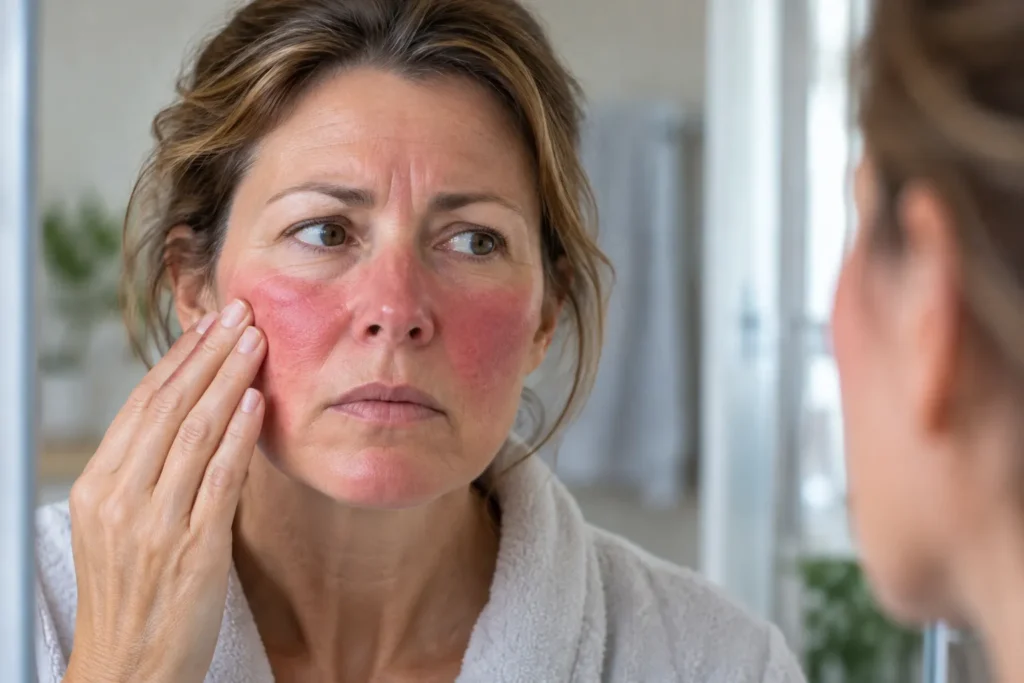
You look in the mirror and your cheeks are red again. Perhaps your face feels unusually warm, tight or uncomfortable, or maybe the redness seems to appear after a shower, exercise, a stressful day or seemingly for no reason at all. For some people it disappears within minutes, while for others the redness seems to linger in the background every day. And when skin also becomes dry, sensitive or starts stinging when skincare is applied, the question naturally becomes: what is happening to my skin?
Facial redness is not one single condition. It can be temporary flushing, irritation, dryness, sensitivity, environmental exposure, a reaction to skincare or part of a recognised skin condition such as rosacea, eczema or contact dermatitis. Sometimes several factors overlap, which helps explain why simply buying something labelled “for redness” doesn’t necessarily solve the problem. Understanding why your skin is becoming red is therefore a much better place to begin.
Facial Redness Is a Sign, Not a Diagnosis
Redness occurs when blood flow close to the surface of the skin becomes more visible. Blood vessels can temporarily dilate in response to heat, exercise, emotion and numerous other triggers, producing the familiar flushed-cheek appearance. Inflammation and irritation can also make redness more persistent, particularly when skin has become sensitive or its protective barrier is not functioning optimally. The underlying reason can therefore be quite different from one person to another.
That distinction matters because facial redness can range from an entirely normal response to exercise or heat to something that deserves medical assessment. Rosacea, for example, is a chronic inflammatory skin condition commonly affecting the central face and may involve persistent redness, flushing, visible blood vessels, bumps or pustules. Some people also develop eye symptoms. A moisturiser may support comfort and barrier function, but persistent redness should not automatically be self-diagnosed as either “dry skin” or rosacea.
Why Are My Cheeks Always Red?
The cheeks contain an extensive network of small blood vessels close to the skin surface, making changes in blood flow particularly noticeable there. Temperature changes, sun exposure, exercise, embarrassment, stress and alcohol can all temporarily increase facial flushing. In people with reactive or rosacea-prone skin, the response may be stronger or last considerably longer.
Dryness and irritation can make the situation more complicated. When skin becomes rough, tight and sensitive, environmental exposure and ordinary skincare products may feel much more noticeable. Someone may therefore experience redness, dryness, tightness and sensitivity simultaneously, even though these symptoms do not necessarily share one single cause.
Why Does My Face Feel Hot and Red?
One of the more striking descriptions people use for facial redness is that their cheeks feel as though they are burning or radiating heat. Heat itself is a well-recognised flushing trigger, but the sensation can also accompany irritated, reactive or inflamed skin. Hot showers, warm rooms, strenuous exercise, emotional stress and rapid changes in temperature are common situations in which people notice it.
The National Rosacea Society has reported heat, sun exposure, emotional stress, exercise, hot baths, alcohol, spicy foods and certain skincare products among commonly reported rosacea triggers. Importantly, triggers vary greatly between individuals. Keeping a simple diary of when redness occurs, what you were doing, what you ate or drank and what products you applied can sometimes reveal patterns that are otherwise difficult to notice.
The Skin Barrier: An Important Part of the Redness Conversation
Your outermost skin is much more than a covering. The stratum corneum, often described as part of the skin barrier, helps limit excessive water loss while protecting the tissues underneath from environmental exposure. Lipids between the outer skin cells play an important role in maintaining that protective structure.
When barrier function is disturbed, water can escape more readily and skin may become dry, tight, rough and increasingly sensitive. Substances that previously caused no problem may suddenly sting or feel uncomfortable. Research into rosacea has also identified altered barrier function and increased transepidermal water loss in affected skin, which is one reason gentle moisturisation and barrier-supportive skincare frequently appear in dermatological recommendations.
This does not mean that every red face has a “damaged skin barrier.” Nor does repairing barrier function treat every cause of facial redness. It does mean that when redness occurs alongside dryness, tightness, sensitivity and stinging, the condition of the skin barrier deserves attention.
“Why Does Everything I Put on My Face Burn?”
This is one of the most revealing questions people with reactive skin ask. A moisturiser goes on and stings. Sunscreen burns. A cleanser that was previously fine suddenly feels uncomfortable. The natural response is often to keep changing products, adding soothing serums and experimenting with more ingredients in the hope that something will finally calm the skin.
Sometimes that experimentation creates an even more complicated routine. When skin is already irritated, simplicity can be valuable. Dermatologists commonly recommend gentle cleansing, moisturisation, sun protection and avoidance of products that individually trigger irritation in people with sensitive or rosacea-prone skin. Strong exfoliation, fragranced products and unnecessarily aggressive routines may be poorly tolerated by some people.
If everything suddenly burns, however, don’t assume that purchasing another cosmetic is automatically the answer. Persistent burning, significant inflammation or a sudden unexplained change in your skin deserves professional assessment.
Could Your Skincare Routine Be Contributing?
Modern skincare has given consumers access to extraordinarily effective ingredients. Retinoids, exfoliating acids, vitamin C preparations and other active products can be valuable when appropriately selected and tolerated. Problems can arise when several potent products are layered together, used too frequently or continued despite obvious irritation.
The result can be skin that feels tight, dry, tender and unusually reactive. A person may then mistake the resulting irritation for another skincare problem and add still more products. In those circumstances, simplifying the routine and concentrating on gentle cleansing, moisturisation and protection may be more sensible than continually escalating the number of active ingredients.
Reno Cream’s formulation philosophy grew from a similar idea: skin that is struggling may need support rather than an endless succession of aggressive interventions. That philosophy eventually became the three-part approach we call Repair • Nourish • Defend.
15 Common Things That Can Trigger or Worsen Facial Redness
- Sun exposure
- Hot weather
- Cold or windy weather
- Hot showers and baths
- Exercise
- Emotional stress
- Rapid temperature changes
- Alcohol
- Spicy foods
- Hot beverages
- Harsh or irritating skincare
- Excessive exfoliation
- Fragrance or other personally irritating ingredients
- Dryness and barrier disruption
- Underlying conditions such as rosacea, eczema or contact dermatitis
The purpose of identifying triggers isn’t to create a life in which everything must be avoided. It is to discover your particular pattern. Someone whose face consistently becomes red after a very hot shower may require a completely different approach from someone with persistent central facial redness and visible blood vessels.
Facial Redness, Ageing Skin and Menopause
Skin changes with age. Natural lipid composition, hydration, epidermal structure and barrier recovery can change over time, while cumulative sun exposure becomes increasingly visible. Mature skin can consequently become drier and sometimes more sensitive than it was earlier in life.
For women around menopause, another factor can enter the picture: vasomotor flushing. A menopausal hot flush can produce sudden warmth and visible facial flushing, while rosacea can independently cause flushing and persistent facial redness. They are not the same condition, although a person can potentially experience both.
This distinction is particularly relevant to women who say, “My skincare hasn’t changed, but suddenly my skin behaves differently.” Rather than treating mature skin as simply younger skin with wrinkles, skincare needs to recognise changing hydration, barrier and sensitivity requirements.
What Does Moisturiser Actually Do for Red, Dry Skin?
A moisturiser cannot diagnose the reason your face is red, and it cannot be expected to treat every underlying cause. Its job is more fundamental. Humectants can help attract and retain water within the outer skin layers, while emollient and occlusive components can improve softness and help reduce excessive moisture loss. For dry and sensitive skin, this can improve comfort and support the environment required for normal barrier function.
This is why the better question isn’t necessarily: “What cream removes redness?” It may be: “What does my dry, sensitive and reactive skin need in order to function and feel better?” That change in thinking is important.
A Different Philosophy: Repair • Nourish • Defend
At Reno Cream, we call our approach The Skin Trifecta Method™.
Repair
The first priority is supporting dry, stressed and compromised-feeling skin rather than continually challenging it. Hydration and appropriate moisturising ingredients can help create a more comfortable environment for the skin barrier.
Nourish
Skin needs more than water alone. Reno Cream combines moisturising ingredients with carefully selected skin-conditioning ingredients and botanical components as part of a broader formulation rather than relying on one fashionable “hero” ingredient.
Defend
The final part is helping maintain the skin’s protective surface and reducing unnecessary exposure to things that repeatedly leave it dry or irritated. In everyday practice, defending skin also means sensible habits: gentle cleansing, avoiding known personal triggers and using appropriate sun protection.
The objective isn’t to suppress every biological response of the skin. It is to support skin that has become dry, sensitive and difficult to manage.
Where Reno Cream Fits
Reno Cream was developed as a multi-functional skin repair moisturiser for adult and mature skin that needs more support than basic moisturisation alone. Its formulation includes humectants such as glycerin and hyaluronic acid, skin-conditioning ingredients including allantoin, antioxidant vitamins and a carefully selected botanical complex alongside Black Seed Oil and MSM.
For someone whose facial redness occurs alongside dryness, sensitivity or a compromised-feeling skin barrier, this kind of moisturising and barrier-supportive approach may be useful as part of a gentle skincare routine. Individual skin responses differ, particularly when skin is highly reactive, so introducing any unfamiliar product cautiously and patch testing first is sensible.
Reno Cream is not a medicine or a treatment for rosacea, and we don’t position it as one. If rosacea or another dermatological condition is responsible for your redness, appropriate diagnosis and treatment should come from a qualified healthcare professional. Reno Cream’s role is skincare: supporting moisturisation, comfort and the condition of dry, sensitive and reactive-looking skin.
When Facial Redness Needs More Than Skincare
Occasional flushing after exercise or walking into a hot room is very different from persistent unexplained facial redness. Consider speaking with a GP or dermatologist if redness persists, repeatedly worsens, causes substantial burning or pain, develops bumps or pustules, or is accompanied by visible blood vessels that are becoming increasingly prominent.
Eye symptoms deserve particular attention. Rosacea can affect the eyes and eyelids, producing dryness, irritation, redness or a gritty sensation. Sudden facial swelling, breathing difficulty or other signs of a serious allergic reaction require urgent medical attention rather than skincare experimentation.
A professional diagnosis can also distinguish rosacea from conditions that sometimes resemble it. That is considerably safer than attempting to diagnose yourself from photographs or social-media posts.
Start by Listening to Your Skin
A red face doesn’t automatically mean rosacea. It doesn’t automatically mean a damaged barrier either. Facial redness is better thought of as a signal—one that needs to be interpreted alongside when it happens, how long it lasts, what it feels like and what else is happening to your skin.
If your skin is simultaneously dry, tight, sensitive and reactive, supporting hydration and barrier function is a logical part of caring for it. Simplifying an overloaded routine, identifying personal triggers, moisturising consistently and protecting skin from excessive sun and environmental stress may accomplish more than continually searching for the next aggressive active.
And that is ultimately the philosophy behind Reno Cream and The Skin Trifecta Method™: don’t look only at the symptom you can see in the mirror. Consider what the skin underneath may need to Repair, Nourish and Defend itself more effectively.
You can learn more about Reno Cream or read our free guide, The Skin Trifecta Method™, for a deeper look at our approach to adult and mature skin.
References and Further Reading
American Academy of Dermatology Association. 7 Rosacea Skin Care Tips Dermatologists Recommend.
National Rosacea Society. Rosacea Triggers Survey.
National Rosacea Society. Moisturizer for Rosacea.
DermNet. Rosacea.
Draelos ZD. The effect of a daily facial moisturizer for rosacea-prone skin on barrier function and the appearance of redness.