
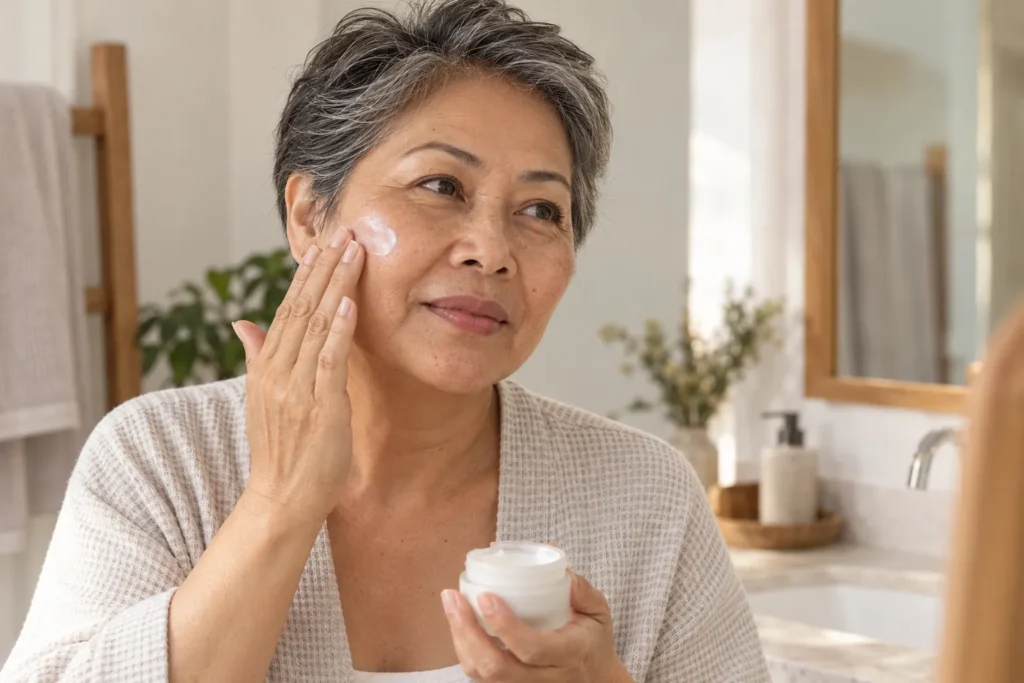
You moisturise every morning, and perhaps you moisturise again before bed. You may even keep a tube of cream nearby because your skin starts feeling dry again only a few hours after you have applied it. Yet despite all that effort, your skin can still feel tight, rough, flaky or simply uncomfortable, leaving you wondering why something as basic as moisturising does not seem to be doing what it once did. It is frustrating, especially when you feel as though you are already following the advice you have heard for years. But persistent dryness does not necessarily mean that you need to keep applying more and more moisturiser. Sometimes the more useful question is whether your skincare routine is giving your skin everything it actually needs, and that question becomes particularly important as skin gets older.
Why Moisturising and Fixing Dryness Aren’t Always the Same Thing
A moisturiser can make dry skin feel better by adding water, oils or ingredients that help reduce moisture loss, and that can produce an immediate improvement in softness and comfort. But if the factors contributing to dryness are still present, that improvement may not last very long. Think about what happens when you wash your hands repeatedly throughout the day: you can apply hand cream afterwards, but another round of soap and hot water may leave them feeling dry again. Something similar can happen elsewhere on the body when cleansing habits, weather, heating, air conditioning, age and other everyday factors continually work against the skin. This is one reason a moisturiser can seem to work beautifully when you first apply it, only for you to wonder a few hours later where all that moisture went. The product may be adding moisture while the skin is struggling to retain it, which means the answer may involve looking beyond moisturising alone.
Your Skin Barrier Has a Lot to Do With It
The outermost part of your skin acts as a protective barrier between your body and the outside world, and one of its important jobs is helping to limit excessive water loss. When that barrier is functioning well, the skin is generally better able to hold onto the hydration it needs. When it becomes stressed or compromised, however, water can escape more readily and the skin may begin feeling dry, tight, rough or uncomfortable. Applying moisturiser can temporarily improve how it feels, but repeated exposure to things that stress the barrier can quickly bring that dry feeling back. Hot showers, harsh cleansers, frequent washing, over-exfoliation and dry environmental conditions can all be part of the picture, and often several of these factors are happening at the same time. This is why understanding how to repair a damaged skin barrier can be just as important as deciding which moisturiser to put on top of it.
Mature Skin Can Make the Problem More Noticeable
Age adds another layer to the story because skin naturally changes over time, and some of those changes can affect the way it retains moisture and how soft, supple and comfortable it feels. This helps explain why skin can become so dry as you age, even when you have moisturised faithfully for years. A lotion that seemed perfectly adequate at 35 may therefore feel surprisingly light at 55, 65 or 75; the product has not necessarily changed, but your skin has. Dryness can also make other visible signs of ageing appear more pronounced, so fine lines can look deeper, texture can appear rougher and areas such as the arms, legs, neck and chest may take on a more crepey or papery appearance. That is why mature skincare should not simply be about chasing wrinkles. Keeping older skin hydrated, conditioned, comfortable and well supported can make a considerable difference to how it looks and feels from day to day.
You May Be Adding Water Without Helping Your Skin Hold Onto It
Not all moisturisers work in exactly the same way. Some formulations are very light and primarily focus on hydration, while richer creams may combine humectants, emollients, oils and other skin-conditioning ingredients. Humectants such as glycerin and hyaluronic acid help attract and retain water within the upper layers of the skin, while oils and emollient ingredients can help soften the skin and improve the feel of rough, dry areas. A well-designed formulation can bring these functions together rather than expecting one ingredient to do everything. This distinction matters when choosing the best moisturiser for dry mature skin, because the question should not simply be, “Does this contain moisturising ingredients?” A more useful question is, “What different jobs is this formula designed to perform, and do those jobs match what my skin now needs?”
Your Shower Could Be Undoing Some of Your Good Work
There is another common culprit hiding in many bathrooms: hot water. A long, steaming shower can feel wonderful, particularly during a Melbourne winter, but very hot water and prolonged washing can leave already-dry skin feeling even tighter. Combine that with a strong cleanser, vigorous scrubbing and towel rubbing, and the skin can emerge from the shower needing considerably more support than when it went in. You do not have to give up enjoyable showers altogether, but using comfortably warm rather than very hot water and avoiding unnecessarily long showers can be a useful change. Choose gentle cleansing products, pat rather than aggressively rub your skin dry, and try applying moisturiser while the skin is still slightly damp. These are small adjustments, but together they can help your moisturiser support hydration more effectively instead of asking it to compensate for an unnecessarily drying routine.
Sometimes We Simply Clean Our Skin Too Aggressively
Modern skincare has encouraged many of us to believe that skin needs to feel extremely clean, but squeaky-clean skin is not necessarily healthy-looking or comfortable skin. Strong cleansers, frequent exfoliating acids, scrubs and layers of active products can become too much, particularly when dry or mature skin is involved. If your face feels tight immediately after cleansing, pay attention to what it may be telling you rather than assuming that the tight feeling means the cleanser has done an especially good job. More products are not automatically better either. When skin feels persistently dry or stressed, simplifying your routine for a while can sometimes make more sense than introducing yet another serum, acid or active ingredient. Your cleanser should clean your skin without leaving it feeling as though everything useful has been stripped away.
Why Reno Was Formulated This Way
This persistent-dryness problem is an important part of the thinking behind Reno Cream. Rather than starting with one fashionable ingredient and building a marketing story around it, Reno Cream was developed by starting with the needs of dry, mature and problem-prone skin. The question was simple: if skin can have several overlapping needs at the same time, why should a cream be designed to address only one of them? That thinking led to a formulation combining ingredients with complementary jobs. Black seed oil, MSM and allantoin form part of the core formulation, while glycerin and hyaluronic acid contribute to its hydration system, and vitamin E, a vitamin C derivative and a blend of selected botanical extracts provide additional complementary support within the formula. No single ingredient is expected to carry the entire cream. The idea is ingredient synergy—different ingredients doing different jobs within one carefully considered formulation, rather than relying on a single fashionable “hero” ingredient to tell the whole story.
Repair • Nourish • Defend
That formulation philosophy eventually became the basis of The Skin Trifecta Method™: Repair • Nourish • Defend. Repair is about supporting skin that feels dry, stressed, rough or depleted rather than simply covering it temporarily with moisture. Nourish means giving the skin a thoughtful combination of hydration, oils, vitamins and conditioning ingredients instead of relying on one ingredient to do everything. Defend recognises that skin is continually exposed to washing, weather, environmental stress and moisture loss, so everyday skincare should also help support its protective function. These three needs are not isolated from one another; they overlap, and that is precisely the point of the method. You can explore the philosophy in more detail in The Skin Trifecta Method™, our guide to thinking beyond basic moisturising and approaching adult and mature skincare through the interconnected needs of Repair, Nourish and Defend.
Reno Cream Is More Than a Basic Moisturiser
Reno Cream was created as a multi-functional cosmetic skin cream for people whose skin may be dealing with more than one concern at a time. Dryness rarely arrives neatly by itself; the same person might notice roughness on the hands, crepey-looking skin on the arms, dryness on the legs, fine lines on the face and depleted-looking skin around the neck and chest. Buying a completely different moisturiser for every one of those areas does not always make sense, particularly when some of those concerns share overlapping skin needs. Reno’s approach is to start with what the skin needs, select ingredients that perform complementary jobs, and bring those functions together within one formulation. It is not intended to diagnose, treat or cure skin disease. It is skincare designed to support the appearance and feel of dry, mature and problem-prone skin while offering a more considered alternative to simply adding another basic moisturiser to the bathroom shelf.
What Should You Do If You Moisturise Every Day and Your Skin Is Still Dry?
Start by looking beyond the jar of moisturiser and consider the whole routine surrounding it. Think about how hot your showers are, how often you cleanse, what type of cleanser you use and whether you are exfoliating more than your skin comfortably tolerates. Environmental factors matter too, because heating, air conditioning, cold weather, wind and low humidity can all influence how dry your skin feels. Then look carefully at your moisturiser itself. If a very lightweight lotion disappears almost immediately and your skin feels dry again soon afterwards, it may be worth considering a richer, more multi-functional formulation that offers more than a brief feeling of moisture. Apply your moisturiser consistently rather than waiting until the skin becomes extremely dry, and try applying it after bathing or showering while the skin is still slightly damp. Finally, do not stop at your face: your neck, chest, hands, arms, elbows, legs and feet deserve regular attention too, especially as the skin in these areas becomes drier with age.
The Bigger Lesson: Listen to What Your Skin Is Telling You
If you moisturise every day but remain persistently dry, your skin is not necessarily asking you to apply the same product more often. It may simply be telling you that its needs have changed, and that becomes increasingly relevant as we get older. Skin that once tolerated harsh cleansing, hot showers and lightweight lotions may eventually need a gentler and more comprehensive approach. The goal does not have to be complicated: support the barrier, provide lasting hydration, nourish the skin with complementary ingredients and reduce the everyday things that continually strip moisture away. In other words, think in terms of Repair. Nourish. Defend. Sometimes the answer to dry skin is not simply more moisturiser; it is understanding what is making the skin dry in the first place and giving it better support for what it actually needs.