
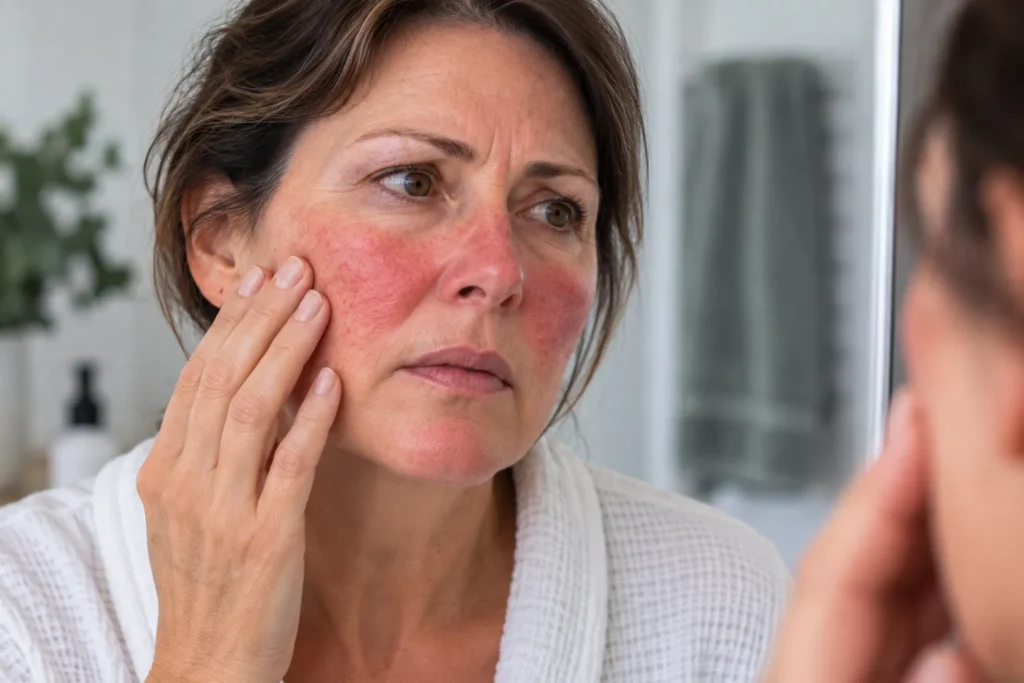
Your face is red. Your cheeks feel hot. The moisturiser you have used for months suddenly stings, and products labelled “gentle” don’t seem particularly gentle anymore. You search online and quickly encounter three explanations again and again: rosacea, sensitive skin and a damaged skin barrier.
The confusing part is that they can look remarkably similar. Redness, dryness, burning, stinging and sensitivity can occur in all three situations, and more than one can exist at the same time. That makes diagnosing yourself from a photograph, social-media post or symptom checklist unreliable. Understanding the differences, however, can help you make better decisions about your skincare and recognise when it is time to see a healthcare professional.
If you’re beginning with the broader question of why your face is red, our guide to facial redness, flushing, burning and sensitive skin explains the major possibilities in more detail.
First, They Aren’t Three Versions of the Same Problem
Rosacea is a chronic inflammatory skin condition that predominantly affects the central face. It can cause persistent redness, recurrent flushing, visible small blood vessels and, in some people, inflammatory bumps and pustules. Rosacea can also affect the eyes.
Sensitive skin is generally used to describe skin that reacts more readily to stimuli that would not normally produce unpleasant sensations. People commonly describe burning, stinging, itching, tightness or discomfort after exposure to skincare products, weather or other triggers.
A damaged or disrupted skin barrier refers more specifically to impaired function of the skin’s protective outer layers. When barrier function is compromised, the skin may lose water more readily and become dry, rough, tight and increasingly vulnerable to irritation. The complication is obvious: rosacea can involve sensitive skin and impaired barrier function.
What Does Rosacea Usually Look and Feel Like?
Rosacea most commonly involves the central face—the cheeks, nose, chin and forehead. For some people the earliest sign is repeated flushing that lasts longer than expected. Over time, redness may become more persistent and small surface blood vessels can become visible.
Other people develop papules and pustules that can resemble acne. Burning, stinging, dryness and swelling may occur as well. Importantly, rosacea can also involve the eyes and eyelids, causing redness, irritation, watering, dryness or a gritty sensation.
Rosacea isn’t simply “having red cheeks.” A person can have facial redness without rosacea, and that distinction is one reason persistent unexplained redness is worth discussing with a GP or dermatologist rather than diagnosing it yourself.
What Does Sensitive Skin Feel Like?
Sensitive skin is often defined more by sensation and reactivity than by one particular appearance. Someone may say: “My moisturiser burns.” “My face stings after washing.” “My skin reacts to everything.” “My cheeks feel hot whenever I try a new product.” “My skin feels tight even though I’m moisturising.”
Another person may have similar sensitivity but very little visible redness. This helps explain why “sensitive skin” and “red skin” aren’t interchangeable terms. Environmental conditions, skincare ingredients, over-cleansing, underlying dermatological conditions and barrier dysfunction can all influence how reactive the skin feels.
What Does a Struggling Skin Barrier Look Like?
Think of the outer skin barrier as part of the body’s system for keeping necessary moisture in while limiting penetration by environmental irritants. When this barrier is functioning well, the outer layers of skin help control water loss and maintain a relatively stable environment. When it becomes disrupted, transepidermal water loss can increase.
Skin may consequently become dry, rough, flaky, tight, uncomfortable or unusually sensitive. One particularly telling experience is a change in tolerance: a cleanser that never bothered you begins to sting, your usual moisturiser suddenly feels uncomfortable, or products you once layered without thinking now leave your face tight and irritated.
That doesn’t prove you have barrier damage, but it is a reasonable signal to reconsider what is happening to your skin rather than simply adding another active ingredient.
Rosacea vs Sensitive Skin vs Barrier Dysfunction
| Feature | Rosacea | Sensitive Skin | Barrier Dysfunction |
|---|---|---|---|
| Facial redness | Common | Can occur | Can occur |
| Flushing | Very common | Possible | Not necessarily |
| Burning/stinging | Common | Very common | Common |
| Dryness/tightness | Common in some people | Common | Very common |
| Visible small blood vessels | Can occur | Not characteristic | Not characteristic |
| Acne-like bumps/pustules | Can occur | Not characteristic | Not characteristic |
| Products suddenly sting | Common | Common | Common |
| Flaking/roughness | Can occur | Possible | Common |
| Eye involvement | Can occur | Not characteristic | Not characteristic |
| Chronic central facial pattern | Characteristic | Not necessarily | Not necessarily |
This table is a guide rather than a diagnostic test. Real skin rarely follows textbook categories perfectly.
Can You Have Rosacea and a Damaged Skin Barrier at the Same Time?
Yes—and this is one of the most important points in the entire discussion. Research has identified abnormalities in epidermal barrier function in rosacea, including increased transepidermal water loss in affected skin. That helps explain why dryness, sensitivity, burning and stinging are frequently part of the rosacea experience even though rosacea itself is more than a barrier problem.
This also explains why dermatological rosacea guidance doesn’t focus exclusively on prescription treatment. Gentle cleansing, moisturisation, sunscreen and avoidance of personally irritating products are commonly recommended alongside appropriate medical management.
Supporting the barrier therefore doesn’t mean you are treating the underlying rosacea. It means you are addressing an important skincare need that can coexist with it.
Could Your Skincare Routine Be Creating Rosacea-Like Symptoms?
It can certainly create some symptoms that resemble aspects of rosacea. Consider a routine containing a retinoid, exfoliating acid, strong cleanser and several other active products. Each product may be perfectly reasonable when appropriately used, yet the combined routine may become too much for an individual’s skin.
The result can be redness, dryness, tightness, peeling, burning and stinging. A person then searches “rosacea” because the face has become red and reactive. But irritation caused by skincare is not automatically rosacea.
The reverse mistake is also possible. Someone with genuine rosacea may assume they have merely “damaged their barrier” and spend months changing moisturisers while an untreated medical condition continues. That is why persistent redness deserves more than guesswork.
Why Does Moisturiser Suddenly Sting?
People often assume that if moisturiser stings, the moisturiser must contain a bad ingredient. Sometimes a particular formulation or ingredient genuinely doesn’t suit that person. But the condition of the skin at the time of application also matters.
When skin is irritated or its barrier is compromised, substances may produce sensations that wouldn’t normally occur. Even products that previously felt comfortable may suddenly sting. This is why repeatedly buying stronger serums or adding more “repair” products can sometimes become counterproductive.
When skin is already overwhelmed, a simpler and more consistent routine may be preferable. If burning is substantial, persistent or worsening, however, stop experimenting and seek professional advice.
The Clue Hidden in the Words “My Skin Reacts to Everything”
This phrase appears constantly in discussions about facial sensitivity. Skin becomes uncomfortable, so another product is purchased. That product doesn’t solve everything, so another serum is added. Then an exfoliant is stopped, a new barrier product begins, another cleanser is tried and several soothing ingredients are layered together.
Soon it becomes almost impossible to know which product is helping and which is contributing to the problem. For highly reactive skin, more skincare isn’t necessarily better skincare.
A useful reset can involve discussing the problem with a dermatologist, eliminating obvious personal irritants and returning to the essentials: gentle cleansing, moisturisation and appropriate sun protection.
Where Moisturisation Fits
Whether the underlying issue is sensitive skin, barrier disruption or medically diagnosed rosacea, moisturisation can have an important supportive role when dryness is present. Humectants help increase water within the outer skin layers. Emollient components improve softness and smoothness, while appropriate occlusive ingredients can help reduce excessive moisture loss.
The objective is not to “switch off” facial redness. It is to help create a better moisturised, more comfortable environment for skin whose protective surface is struggling. This distinction is central to how we think about skincare at Reno Cream.
Repair • Nourish • Defend
The philosophy behind Reno Cream is called The Skin Trifecta Method™: Repair • Nourish • Defend.
Repair means beginning with the condition of dry, stressed and compromised-feeling skin rather than simply covering the visible symptom. Nourish means providing hydration and carefully selected skin-conditioning ingredients as part of a complete formulation rather than chasing whichever single ingredient happens to be fashionable. Defend means supporting the skin’s protective surface while reducing repeated exposure to things that personally leave it dry, uncomfortable or irritated.
That approach is particularly relevant when someone says: “My skin isn’t behaving the way it used to.”
Reno Cream and Red, Dry, Reactive Skin
Reno Cream was developed as a multi-functional moisturising skin repair cream for adult and mature skin that needs more than basic moisturisation. Its formulation includes glycerin and hyaluronic acid to support hydration, together with allantoin, antioxidant vitamins, Black Seed Oil, MSM and a selected botanical complex.
Rather than asking one “hero ingredient” to solve every skincare concern, the formulation reflects our broader philosophy of supporting skin through several complementary pathways. For facial skin that is dry, sensitive and red-looking, Reno Cream can therefore be considered as a moisturising and skin-conditioning option within a gentle routine.
Reno Cream is not a treatment or cure for rosacea. If you have rosacea, your dermatologist’s treatment plan takes priority. Reno Cream’s potential role is supportive skincare for dryness, moisturisation and barrier care—not replacement medical therapy. Because highly reactive skin can respond unpredictably to almost any unfamiliar cosmetic, patch testing first is sensible.
When Should You Suspect Rosacea Rather Than Simply Sensitive Skin?
There is no home checklist that can diagnose rosacea reliably, but certain patterns deserve professional assessment. Persistent redness concentrated across the cheeks, nose, forehead or chin is one. Repeated episodes of significant flushing are another.
Visible small facial blood vessels, inflammatory bumps or pustules, thickening skin around the nose, or recurring eye irritation strengthen the reason to seek medical advice. A dermatologist can also distinguish rosacea from acne, eczema, seborrhoeic dermatitis, contact dermatitis, lupus and other conditions that may sometimes produce overlapping appearances.
This is particularly important before spending large amounts of money trying to “repair” something that hasn’t actually been diagnosed.
What About Sudden Facial Redness?
A face that has gradually become more sensitive over months is different from sudden severe redness. Seek medical advice when facial redness is unexplained, persistent, painful, rapidly worsening or accompanied by significant swelling. Eye pain, visual disturbance or substantial ocular symptoms also require appropriate assessment.
Sudden swelling of the face or lips, difficulty breathing, throat tightness, faintness or other signs of a severe allergic reaction require urgent medical attention. Skincare should never delay emergency care.
So Which One Do You Have?
If your main problem is recurring central facial flushing, persistent redness, visible blood vessels or rosacea-like bumps, rosacea deserves consideration and professional assessment. If your main experience is burning, stinging and unusual reactions to products or environmental conditions, skin sensitivity may be an important part of the picture.
If your skin has recently become extremely dry, rough, tight, flaky and intolerant of products—particularly following aggressive skincare or over-exfoliation—barrier disruption may be contributing. And if you recognise characteristics from all three columns, that isn’t necessarily contradictory. They can overlap.
Don’t Treat the Label—Understand the Skin
The internet encourages us to give every skin problem a name. Sometimes that is useful, but sometimes it leads people to force complex skin behaviour into a single category. Your red cheeks may not be rosacea. Your sensitive skin may not simply have a “broken barrier.” And restoring moisture to dry skin doesn’t mean an underlying inflammatory skin condition has been treated.
A better approach begins with understanding the pattern. When does the redness appear? Does your face flush? Does it burn or sting? Has your skincare tolerance changed? Is the skin dry or flaky? Are blood vessels becoming visible? Are your eyes affected?
Those questions tell us far more than the word “redness” alone. And if dryness, sensitivity and compromised-feeling skin are part of that picture, a gentle moisturising strategy focused on Repair • Nourish • Defend can become one component of caring for the skin—while medical conditions such as rosacea remain where they belong: in the hands of appropriately qualified healthcare professionals.
Learn more about Reno Cream and explore the free Skin Trifecta Method™ guide to understand our approach to supporting adult and mature skin.
References and Further Reading
American Academy of Dermatology Association. Rosacea: Diagnosis and Treatment and 7 Rosacea Skin Care Tips Dermatologists Recommend.
DermNet New Zealand. Rosacea.
National Rosacea Society. All About Rosacea and skincare guidance for people with rosacea.
Schaller M, Almeida LMC, Bewley A, et al. Recommendations for rosacea diagnosis, classification and management incorporating phenotype-based approaches.