
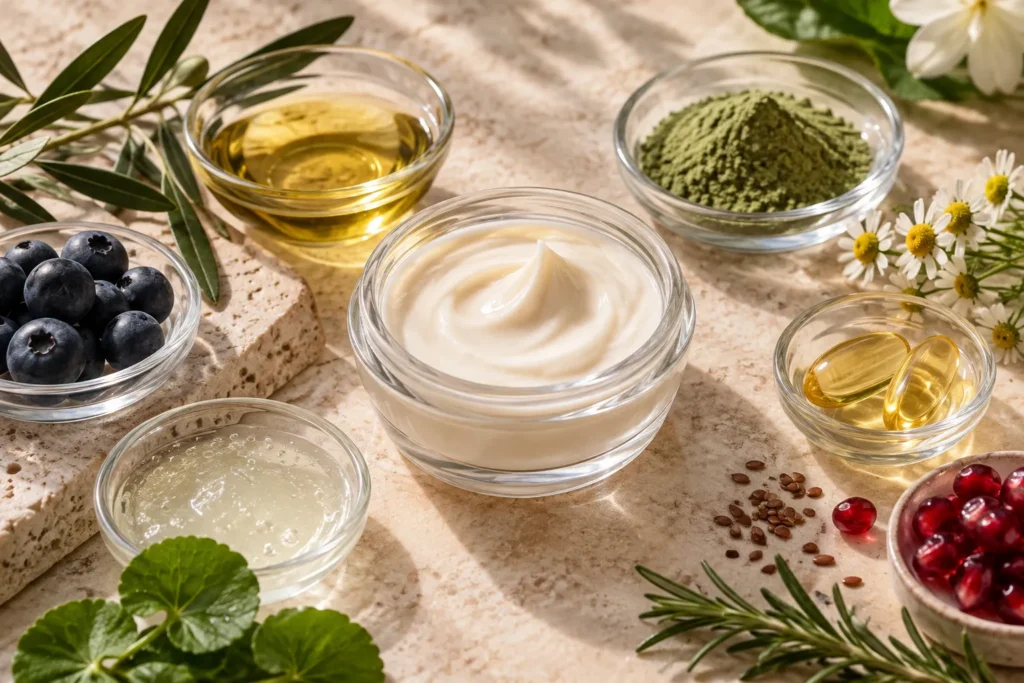
Skincare has become very good at making us fall in love with individual ingredients. One year everyone is talking about hyaluronic acid, then vitamin C takes centre stage, followed by peptides, ceramides or the latest botanical extract. Before long, it can feel as though finding the right ingredient is the secret to solving every concern we have about the skin. But the skin is far more complicated than that.
A useful ingredient can certainly make a difference within a well-designed product. The problem begins when we expect one ingredient to perform jobs it was never designed to perform. Mature, dry and problem skin can have several overlapping needs at the same time, from hydration and conditioning to barrier support and protection. That is why we believe the conversation should move beyond the latest hero ingredient and towards something more important: how ingredients work together.
What Is a Hero Ingredient?
A hero ingredient is usually the ingredient a skincare brand places at the centre of a product’s story. It may appear in large letters on the front of the packaging and dominate the advertising, even though the finished product contains many other ingredients. There is nothing inherently wrong with highlighting a useful ingredient. It can help consumers understand one of the main features of a formulation.
The difficulty is that marketing can make that ingredient sound more powerful than the complete formula around it. A moisturiser containing hyaluronic acid can gradually become known simply as “a hyaluronic acid moisturiser,” even though its performance depends on far more than hyaluronic acid alone. Oils, humectants, emollients and many less glamorous formulation ingredients can all influence the finished product. The ingredient receiving the most attention is not necessarily the ingredient doing all the work.
The Skin Rarely Has Only One Need
This becomes particularly important as the skin matures. Someone may describe their main concern as dryness, but look more closely and there may also be roughness, tightness, reduced suppleness or a dull, depleted appearance. Fine lines can appear more obvious when the skin is dehydrated, while areas such as the arms, legs, hands, neck and chest may develop their own changes. What looks like one problem can actually involve several overlapping needs.
That is why we think mature skincare should begin with the skin rather than with an ingredient trend. If the skin needs hydration, we should consider ingredients capable of supporting hydration. If it also needs conditioning and barrier-conscious care, the formulation should take those needs into account as well. The question becomes less about finding one extraordinary ingredient and more about assembling the right combination of complementary ones.
What Does Ingredient Synergy Mean?
Ingredient synergy sounds complicated, but the basic idea is very simple. Different ingredients can perform different jobs within the same formulation, allowing the finished product to address more than one skincare need. Instead of asking one ingredient to do everything, the formula gives several ingredients appropriate roles. Their value comes partly from how those roles complement one another.
Think about preparing a meal. Salt may be important, but you would never judge the entire meal by the quality of the salt alone. The ingredients, proportions and way everything is brought together determine the finished result. We believe skincare formulations deserve to be viewed in much the same way.
Hydration Is a Good Example
Consider hyaluronic acid, one of the most recognisable ingredients in modern skincare. It is widely used as a humectant and can play a useful role in supporting hydration within the outer layers of the skin. That makes it a valuable ingredient for products intended for dry and mature skin. But hydration is only one part of what dry mature skin may need.
A humectant does not automatically replace the conditioning role of oils and emollients. Nor does it mean every other part of the formulation becomes unnecessary. If the skin feels dry, rough and less supple at the same time, there may be value in combining hydration with ingredients that contribute different functions. This is where formulation begins to matter more than the headline on the jar.
Why Glycerin Still Deserves Attention
Glycerin provides another useful example of the difference between ingredient popularity and ingredient usefulness. It has been used in skincare for a very long time, which means it does not always generate the excitement of a newer or more fashionable ingredient. Yet glycerin remains a highly useful humectant in moisturising formulations. An ingredient does not stop being valuable simply because it is familiar.
In Reno Cream, glycerin and hyaluronic acid belong to the hydration side of the formula. We do not see them as competitors where one must be declared better than the other. They are included because hydration is one of the jobs the formulation needs to perform. Neither ingredient needs to become the entire identity of the cream.
Oils Perform a Different Job
Now consider an oil such as black seed oil, one of Reno Cream’s core ingredients. Its role within the formulation is different from that of a humectant such as glycerin or hyaluronic acid. Black seed oil contributes to the conditioning side of the formula, which is particularly relevant when the skin becomes dry and less supple. Comparing the two as though only one can be useful misses the point.
The question should not be whether black seed oil is “better” than hyaluronic acid. They are different ingredients performing different jobs. One does not have to defeat the other for both to contribute to a useful formulation. That is ingredient synergy in practice.
Why Reno Cream Uses Black Seed Oil, MSM and Allantoin Together
At the centre of Reno Cream are black seed oil, MSM and allantoin. We deliberately chose ingredients that were not simply copies of one another. The purpose was to create a core in which different components could contribute different characteristics to a formula for mature, dry and stressed-looking skin. That is very different from placing one ingredient on a pedestal and expecting the rest of the formula to revolve around it.
Black seed oil contributes to the richer conditioning side of the formulation, while MSM and allantoin occupy their own places within the broader formula. We do not claim that any one of them is a miracle ingredient. Their importance comes from being part of a carefully considered combination. The formula is designed around the jobs they perform together.
Vitamins Add Another Layer
Reno Cream also contains vitamin E and ascorbyl palmitate, a vitamin C derivative. These ingredients contribute another layer to the formulation rather than replacing the hydration or conditioning system. This matters because vitamins are sometimes marketed as though adding one to a product suddenly makes every other ingredient secondary. We do not think about them that way.
Vitamin E and the vitamin C derivative sit alongside the other components of the formula as part of the broader vitamin and antioxidant-supporting architecture. They have their jobs, just as the humectants and oils have theirs. None needs to carry the whole product story. Their value is understood within the finished formulation.
Botanicals Should Work the Same Way
Botanical skincare is especially vulnerable to hero-ingredient marketing. A single plant extract can suddenly become the answer to dryness, ageing, dullness and almost every other concern imaginable. Plants can contain interesting compounds and have legitimate roles in cosmetic formulations, but that does not mean one botanical needs to become a miracle ingredient. We prefer to treat botanicals as another complementary part of the formula.
Reno Cream contains a botanical complex that includes Centella asiatica, chamomile, licorice, green tea, rosemary and ginger, alongside other selected extracts. We do not expect Centella to do the job of green tea, or chamomile to replace the rest of the formulation. Their differences are one reason we chose a broader botanical approach. Each ingredient contributes within a system rather than trying to become the system.
Why Reno Was Formulated This Way
When we developed Reno Cream, we started with the needs of the skin first. We looked at mature, dry and problem skin and considered the different needs that can overlap: hydration, conditioning, barrier-conscious care, nourishment and protection. Only then did we consider which ingredients could contribute to those jobs. This problem-first approach shaped the formula.
That is why Reno Cream contains ingredients from several different functional groups. Glycerin and hyaluronic acid contribute to the hydration system, while black seed oil, MSM and allantoin form the core around which the formulation philosophy was built. Vitamins and botanicals add further complementary support. The point is not how many ingredients we can put on the label, but why those ingredients are together.
The Formula Is More Important Than the Trend
Ingredient trends are not necessarily bad. They can introduce consumers to useful ingredients and encourage people to learn more about what is inside the products they use. Problems arise when the trend becomes more important than the formulation. A familiar ingredient in a thoughtful formula can be far more useful than the latest fashionable ingredient in a product that does not suit the needs of your skin.
This is why we resist changing the Reno Cream story every time a new ingredient becomes popular online. The needs of mature skin do not suddenly change because social media has discovered a new trend. Dry skin still needs appropriate hydration and conditioning, while the skin barrier still deserves thoughtful care. Good formulation should begin with those needs rather than chasing whatever ingredient happens to be fashionable.
More Ingredients Do Not Automatically Mean More Synergy
There is another side to this conversation. If one ingredient is not enough, it might seem logical to assume that adding dozens of ingredients must make a product better. That is not what ingredient synergy means. A crowded ingredient list is not automatically evidence of thoughtful formulation.
Synergy depends on purpose. Ingredients should be included because they perform useful roles, complement other components or are necessary to create a stable and usable finished product. Adding ingredients simply so they can appear in marketing copy does not make a formula more sophisticated. The relationship between the ingredients matters more than the number of names on the label.
Repair. Nourish. Defend.
Our ingredient-synergy philosophy eventually became part of the thinking behind The Skin Trifecta Method™: Repair, Nourish and Defend. These three ideas allow us to talk about the needs of mature, dry and problem skin without pretending that one ingredient can solve everything. They also help explain why Reno Cream contains ingredients performing several different roles. The framework belongs to the whole formulation.
Repair reflects a barrier-conscious approach and the importance of helping the skin remain comfortable and better able to retain moisture. Nourish reflects the combination of hydration, conditioning ingredients, oils, vitamins and botanicals within the formula. Defend recognises the everyday environmental stresses that the skin encounters and the importance of supporting and protecting it as part of a sensible skincare routine. Each part makes more sense when considered alongside the others.
One Product Cannot Do Everything Either
There is an important limit to ingredient synergy that should not be overlooked. Combining useful ingredients does not turn a cosmetic cream into a medical treatment or make it capable of reversing every change associated with ageing. Reno Cream cannot stop biological ageing, and it does not replace sunscreen or appropriate medical care. Ingredient synergy should never become another way of making impossible skincare promises.
What a thoughtfully formulated cosmetic cream can do is support several ordinary but important skincare needs at the same time. It can provide hydration, conditioning and other supportive ingredients within one practical formulation. For people whose mature skin is experiencing several overlapping concerns, that can make a routine simpler. Simpler does not mean simplistic when the formula itself has been thoughtfully designed.
How to Shop Beyond the Hero Ingredient
The next time a skincare product catches your attention because of one ingredient, look beyond the front of the packaging. Ask what the complete product appears to be designed to do and whether that matches what your skin actually needs. Think about hydration, conditioning and the overall formulation rather than focusing exclusively on one fashionable name. You may discover that the less glamorous ingredients are doing some very important work.
It is also worth asking whether the product fits naturally into your routine. A sophisticated ingredient list is not very useful if the product is unpleasant to apply or so complicated that you rarely use it. Consistency remains one of the most important parts of skincare. A thoughtful formulation still needs to become part of a thoughtful routine.
Stop Looking for the One Ingredient That Does Everything
There probably will always be another hero ingredient. Skincare is an innovative industry, and new research will continue to improve our understanding of ingredients and formulation. That is a good thing, but innovation does not mean everything useful from yesterday suddenly stops working. Nor does it mean the newest ingredient should automatically become the centre of your skincare routine.
For Reno Cream, the philosophy is deliberately different. We start with what the skin needs, choose ingredients capable of performing complementary jobs and then bring those ingredients together into one coherent formulation. The formula, rather than one fashionable ingredient, is the hero. That is what ingredient synergy means to us.
You can explore Reno Cream and its multi-functional formulation here and see how its different ingredient groups come together. You can also get The Skin Trifecta Method™ here to explore the Repair, Nourish and Defend philosophy behind our approach. Both begin with the same idea: understand what the skin needs first, then choose ingredients that can work together to support those needs.