
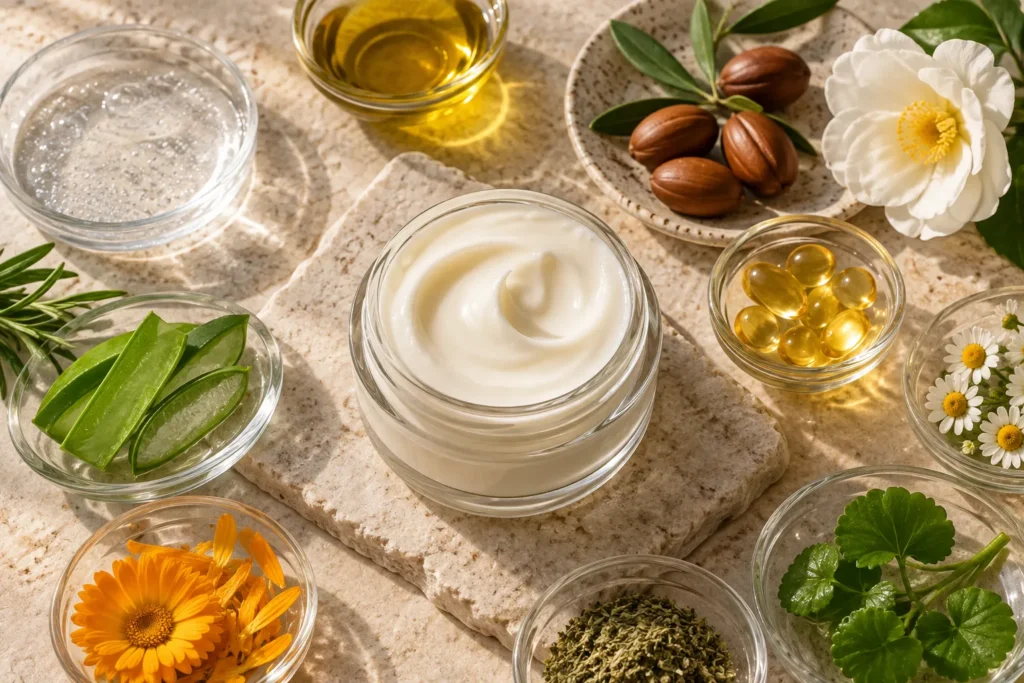
Look at almost any skincare advertisement and you will probably be introduced to a star ingredient. It might be hyaluronic acid, vitamin C, a botanical extract or the latest ingredient to become popular on social media. The message is often simple: this is the ingredient your skin has been missing. But when we began developing Reno Cream, we started somewhere very different.
We started with the skin. More specifically, we looked at the overlapping needs that can become increasingly noticeable when the skin is mature, dry or no longer responding well to basic moisturising. Hydration matters, but so do conditioning, comfort, the skin barrier and the effects of everyday environmental exposure. That is why Reno Cream combines humectants, oils, vitamins, conditioning ingredients and botanicals rather than asking one ingredient to do everything.
Mature Skin Rarely Has Just One Need
Skincare becomes much easier to market when every problem is reduced to one cause. Dryness needs hydration. Wrinkles need an anti-ageing active. Dullness needs an antioxidant. Roughness needs exfoliation. Real skin is rarely that simple.
A person with mature skin may experience dryness, tightness, rough texture and a depleted appearance at the same time. The skin may feel comfortable immediately after moisturising but become dry again later in the day. Areas such as the hands, arms, legs, elbows, neck and chest may behave differently from the face. Several needs can exist at once, which is why we believe the formulation should be capable of doing more than one job.
We Did Not Start With a Hero Ingredient
One of the most important decisions behind Reno Cream was deciding what not to do. We did not begin with black seed oil and ask how we could build an entire product story around it. We did not begin with hyaluronic acid because it was fashionable, and we did not begin with a long list of botanicals because natural-sounding ingredients are easy to market. We began by asking what the skin needed.
Once those needs were clearer, ingredient selection became more logical. Hydration required one type of formulation support, while richer conditioning required another. Vitamins and botanicals could add further dimensions, while ingredients such as allantoin had their own established cosmetic roles. The ingredients followed the needs of the skin rather than the skin being forced into an ingredient story.
The First Layer: Humectants for Hydration
Water content matters enormously to how the outer layers of the skin feel and appear. When the skin becomes dehydrated, it can feel tight and less flexible, while fine surface lines and roughness may become more noticeable. This is where humectants become useful. Humectants help attract and retain water within the outer layers of the skin.
Reno Cream contains glycerin and hyaluronic acid as part of its hydration system. Hyaluronic acid has become one of modern skincare’s most recognisable ingredients, while glycerin has quietly performed a similar broad hydration-related job in cosmetic formulations for generations. We include both because formulation is not a competition between old and new ingredients. What matters is whether they contribute something useful.
Why We Use Both Glycerin and Hyaluronic Acid
It would have been easier from a marketing perspective to put hyaluronic acid at the centre of Reno Cream’s hydration story. Consumers recognise the name and already associate it with hydrated, plumper-looking skin. But popularity does not make every other humectant unnecessary. Glycerin remains one of skincare’s most established hydration ingredients.
Using both reflects the philosophy behind Reno Cream. We do not eliminate an ingredient simply because another ingredient performs a related job. Different ingredients have different formulation characteristics, and they can complement one another. Our question is not which humectant wins, but whether the hydration system makes sense as part of the complete cream.
Hydration Alone Is Not Enough
If mature dry skin needed nothing except water, skincare formulation would be considerably simpler. A lightweight hydrating serum might be sufficient for everyone. Yet many people find that a hydrating product can make the skin feel better temporarily while still leaving them wanting more comfort or richness. This is because hydration is only one part of moisturising skincare.
The skin may also benefit from ingredients that contribute to softness, conditioning and the overall feel of the formula. This becomes particularly relevant when the skin feels persistently dry, rough or depleted. Humectants therefore form one layer of Reno Cream, not the whole product. Other ingredient groups are there because the skin has other needs.
The Second Layer: Oils and Conditioning
Oil-based ingredients perform different jobs from water-attracting humectants. They can contribute richness, conditioning and a softer feel to the finished formulation. This is one reason creams designed for persistently dry skin often feel very different from lightweight hydrating gels. Their ingredient architecture is different.
Black seed oil, or Nigella sativa oil, is one of the three core ingredients in Reno Cream. We chose it as part of the conditioning side of the formula rather than expecting it to replace humectants. Glycerin and hyaluronic acid contribute to hydration, while black seed oil contributes different characteristics. The value lies partly in bringing those differences together.
Why Black Seed Oil Is Not the Whole Formula
Black seed oil has an interesting composition and a long history of traditional use, and research into Nigella sativa and its constituents continues. It would therefore be easy to turn Reno Cream into a “black seed oil cream” and make that ingredient responsible for the entire story. We deliberately chose not to do that. No oil can reasonably address every need of mature, dry and problem skin by itself.
Black seed oil works within Reno Cream rather than above it. It sits beside humectants, MSM, allantoin, vitamins and botanical ingredients. That allows us to use its characteristics without pretending that every benefit of the finished product comes from one oil. Black seed oil is important, but the formula remains the hero.
The Third Layer: MSM and Allantoin
Reno Cream’s core is built around black seed oil, MSM and allantoin. These are not three versions of the same ingredient. They have different chemical characteristics and different reasons for being included. That was deliberate because we wanted the core itself to reflect complementary formulation.
Allantoin is a well-established skin-conditioning ingredient commonly used in products for dry and rough-feeling skin. MSM, or methylsulfonylmethane, is an organosulfur compound that brings another dimension to the formulation. Neither needs to imitate black seed oil. The point of the trio is not similarity but complementary jobs.
Why Allantoin Matters in a Multi-Functional Cream
Allantoin illustrates our formulation philosophy particularly well because it is not a fashionable ingredient. It does not usually dominate skincare advertisements and is unlikely to generate the excitement associated with the latest active. Yet it has remained relevant in cosmetic formulation because of its established skin-conditioning role. That makes sense in a cream designed for dry and stressed-looking skin.
We did not reject allantoin because it lacked novelty. We included it because its role fitted what we wanted the formula to accomplish. This is an important distinction in modern skincare. An ingredient should not have to become fashionable before it becomes useful.
The Fourth Layer: Vitamins
Reno Cream also contains vitamin E and ascorbyl palmitate, a vitamin C derivative. These ingredients broaden the formulation beyond hydration and basic conditioning. Vitamins E and C are widely discussed in skincare because of their relationship with antioxidant research, although different forms have different chemical characteristics and formulation requirements. We include them as part of the wider ingredient architecture.
We do not claim that adding vitamins suddenly makes a moisturiser capable of reversing biological ageing. Nor do vitamins replace sunscreen or sensible sun protection. Their role is more measured than that. They contribute another layer to a formula designed around several needs of the skin.
Why Vitamin E Fits Beside Oils
Vitamin E is fat-soluble, making it naturally relevant to the lipid side of cosmetic formulation. Reno Cream already contains black seed oil and other conditioning components, so vitamin E sits comfortably within that broader architecture. It adds its own characteristics without having to perform the same job as the oil. Again, difference is useful.
This is why looking at ingredients in isolation can be misleading. Vitamin E beside a humectant tells a different formulation story from vitamin E alone. Black seed oil beside glycerin creates a different system from either ingredient on its own. The relationships between ingredient groups matter.
The Fifth Layer: Botanicals
Botanical ingredients have a strong emotional appeal in skincare. People recognise names such as chamomile, green tea and rosemary and often associate them with gentleness or traditional use. But we did not want Reno Cream to contain botanicals simply to create a long and impressive-looking ingredient list. They needed to fit the wider formulation.
The Reno Cream botanical complex includes ingredients such as Centella asiatica, chamomile, licorice, green tea, rosemary and ginger. These botanicals bring different characteristics and histories of cosmetic use and research. They form another supporting layer within the cream rather than replacing the core ingredients. The intention is a broader formula, not botanical decoration.
Why More Ingredients Are Not Automatically Better
At this point it would be easy to conclude that if several ingredient groups are useful, adding dozens more must make a product even better. That is not our philosophy. A longer ingredient list does not automatically mean a better formula. Every additional ingredient introduces formulation considerations and should have a reason for being present.
Ingredient quantity and formulation quality are not the same thing. A product containing fifty fashionable extracts is not necessarily more thoughtful than one containing ten carefully chosen ingredients. What matters is whether the ingredients have sensible jobs and whether the finished formulation works as a coherent system. More is only better when more actually contributes something useful.
Ingredient Synergy Is About Complementary Jobs
The word “synergy” can become vague marketing language if it is not explained. For us, ingredient synergy begins with something quite practical: different ingredients performing complementary jobs within the same formula. Humectants support hydration, oils contribute conditioning, vitamins bring other characteristics, and botanicals broaden the formulation further. The finished cream brings those layers together.
This does not mean every ingredient chemically multiplies the effect of every other ingredient. We should not make that assumption without evidence. Instead, the synergy we emphasise is formulation synergy: a product designed so that different ingredient categories address different aspects of the skincare experience. That is a much more realistic way to understand a multi-functional cream.
Why One Hero Ingredient Can Oversimplify Skincare
Hero-ingredient marketing works because it is easy to understand. One ingredient is given a memorable story, a list of benefits and often a dramatic percentage. Consumers can quickly decide whether they want it. But simplicity in advertising can create unrealistic expectations about formulation.
If someone has mature skin that is dry, rough, tight and depleted-looking, which single ingredient should be the hero? Hyaluronic acid might help with hydration, but hydration is not the entire problem. Black seed oil can contribute conditioning, but it is not a humectant. Vitamin E has antioxidant characteristics, but it is not a complete moisturising system. The needs of the skin are broader than the story of one ingredient.
Why Mature Skin Makes This Especially Important
The skin changes with age in ways that can influence moisture, texture, resilience and appearance. At the same time, decades of environmental exposure become increasingly visible. Many people also find that products they used earlier in life no longer provide the same comfort. This can make mature skincare feel unnecessarily complicated.
Our response was not to create ten different creams for ten different concerns. We wanted to see how many of those overlapping needs could sensibly be considered within one well-designed cosmetic formulation. That thinking eventually became central to Reno Cream. Multi-functional skincare made more sense to us than a shelf full of narrowly defined products.
Why We Do Not Claim One Cream Does Everything
Multi-functional does not mean magical. Reno Cream is not sunscreen, it is not a prescription treatment, and it cannot reverse biological ageing. It should not be used as a substitute for professional assessment when someone has a persistent or concerning skin condition. A responsible skincare product needs boundaries.
What multi-functional means is that the formulation has been designed with several cosmetic needs in mind rather than one. Hydration, conditioning, nourishment and barrier-conscious care can reasonably coexist within a moisturising cream. Vitamins and botanicals can broaden that formulation further. Doing several sensible jobs is very different from claiming to do every possible job.
The Skin Barrier Connects Many of These Needs
The outermost layers of the skin help limit excessive water loss and form an important interface with the outside environment. When the skin is dry or repeatedly stripped by harsh cleansing, comfort can become harder to maintain. This is why hydration and barrier-conscious skincare should not be treated as completely separate subjects. They influence the same everyday experience of the skin.
Humectants can support hydration, while the wider moisturising formulation contributes to comfort and conditioning. Gentle cleansing, sensible shower temperatures and consistent moisturising also matter. A cream works within a routine rather than replacing one. The skin barrier is another reason we prefer a systems approach.
Why Reno Was Formulated This Way
The formulation process behind Reno Cream can be summarised quite simply. We started with the skin problem, identified what the skin might need, chose ingredients capable of performing complementary jobs, and then built those ingredients into a coherent formula. We did not begin with a trending ingredient and invent a problem for it to solve.
That sequence shaped everything. Glycerin and hyaluronic acid support hydration. Black seed oil contributes oil-based conditioning, while MSM and allantoin complete the core ingredient trio. Vitamins and selected botanicals broaden the formulation. Each layer exists because the skin has more than one need.
From Formulation Philosophy to the Skin Trifecta Method™
As the formula developed, a broader philosophy became increasingly clear. We kept returning to three ideas: support the skin barrier and the conditions needed for comfort, provide hydration and nourishing ingredients, and consider the environmental challenges the skin encounters every day. Those ideas eventually became The Skin Trifecta Method™: Repair, Nourish and Defend.
The method is not an attempt to assign every ingredient to one rigid category. Many ingredients and formulation choices can contribute across more than one aspect of the skincare experience. Instead, Repair, Nourish and Defend gives us a practical framework for thinking about the skin as a system. It moves the conversation beyond simply asking which ingredient is fashionable.
Repair: A Barrier-Conscious Approach
Repair does not mean Reno Cream reconstructs damaged tissue or treats wounds. In our framework, Repair reflects a barrier-conscious approach to skincare. It recognises that dry, mature skin benefits from routines that do not continually strip it and from moisturising support that helps maintain comfort. The wording describes a skincare philosophy rather than a medical treatment claim.
This is where the formulation architecture becomes important. Hydration cannot be separated completely from moisture retention and conditioning. A well-designed cream needs to consider how the different elements fit together. Repair therefore begins with respecting the skin rather than attacking it.
Nourish: More Than Adding Water
Nourish is where the diversity of Reno Cream’s ingredients becomes particularly visible. Glycerin and hyaluronic acid contribute to hydration, while black seed oil and other conditioning components contribute richness and softness. Vitamins and botanicals add further dimensions. Allantoin has its own established conditioning role.
This is why we use the word nourish more broadly than moisturise. The intention is not simply to wet the outer surface of the skin. It is to provide a thoughtfully designed combination of ingredients with different functions. Nourishment, in the Reno philosophy, is about complementary formulation.
Defend: Recognising the Outside World
The skin does not exist in isolation. It encounters ultraviolet radiation, climate, cleansing, pollution and other everyday environmental influences. Defend recognises this reality and encourages a skincare approach that considers those exposures. Antioxidant ingredients within the formula sit naturally within this conversation.
But Defend does not mean Reno Cream replaces sunscreen. Appropriate sun protection remains essential, particularly because ultraviolet exposure contributes significantly to visible changes in the skin over time. A moisturising cream and sunscreen have different jobs. Good skincare comes from understanding those differences.
Why a Multi-Functional Cream Can Simplify a Routine
One of the unintended consequences of ingredient-focused skincare marketing is that routines can become extremely complicated. A person may buy a hyaluronic acid serum for hydration, an antioxidant serum for environmental concerns, an oil for dryness and another product for roughness. Before long, a simple skincare routine contains six or seven layers. Some people enjoy that process, but not everyone wants it.
A multi-functional cream offers another approach. It cannot replace every specialised skincare product, but it can bring several useful ingredient categories together in one step. For people who prefer a simpler routine, that can be appealing. Reno Cream was designed around the idea that sophisticated skincare does not necessarily require a complicated bathroom shelf.
Why Simpler Does Not Have to Mean Basic
There is sometimes an assumption that a simple routine must rely on simple formulations. We see it differently. A routine can contain relatively few products while those products themselves are thoughtfully formulated. Complexity can exist inside the formulation rather than across ten separate bottles.
This was one of the ideas behind Reno Cream. Instead of asking consumers to assemble the formulation themselves by layering multiple single-ingredient products, we wanted to bring complementary ingredient categories together. That does not make additional skincare unnecessary for everyone. It simply provides another way to approach mature, dry and problem skin.
The Formula Matters More Than the Ingredient List
Ingredient lists are useful, but they have limitations. They tell you what is present, yet they do not tell the complete story of formulation quality, ingredient interactions, texture, stability or how the finished product feels on the skin. Two creams can contain many of the same ingredients and still be very different products. Formulation is more than assembling a list.
This is why we encourage people to look beyond individual names. Ask what the product is designed to accomplish and whether the ingredient groups make sense for that purpose. Ask whether the texture suits the skin and whether the product is comfortable enough to use consistently. The skin experiences the finished formula, not the marketing bullet points.
The Formula Is the Hero
Articles about individual ingredients are useful because they help explain why black seed oil, MSM, allantoin, hyaluronic acid, glycerin and vitamin E are present in Reno Cream. But there is a danger in discussing them separately. It can accidentally reinforce the same hero-ingredient thinking we are trying to move beyond. Article by article, we eventually have to put the formula back together.
That is what Reno Cream is: the formula put back together. The humectants support hydration, oils contribute conditioning, the core ingredients bring complementary characteristics, and vitamins and botanicals broaden the formulation. No ingredient needs to win because the finished formula is the hero.
Start With the Skin, Not the Trend
Skincare trends will continue to change. New ingredients will become popular, old ingredients will be rediscovered and familiar ingredients will sometimes receive new marketing names. That is part of an innovative and competitive industry. But the fundamental needs of dry mature skin do not change every time social media discovers a new ingredient.
Our formulation philosophy therefore remains simple: start with the skin, understand what it needs, and choose ingredients for complementary jobs. That is why Reno Cream contains humectants, oils, vitamins, conditioning ingredients and botanicals in one formula. Not because a long ingredient list sounds impressive, but because mature, dry and problem skin can have more than one need at the same time.
You can explore Reno Cream and its complete formulation here to see how these ingredient groups come together in the finished cream. You can also get The Skin Trifecta Method™ here to explore the Repair, Nourish and Defend philosophy behind the formulation. Reno Cream was designed around the needs of the skin first, with the ingredients selected afterwards for the complementary jobs they could perform together.