
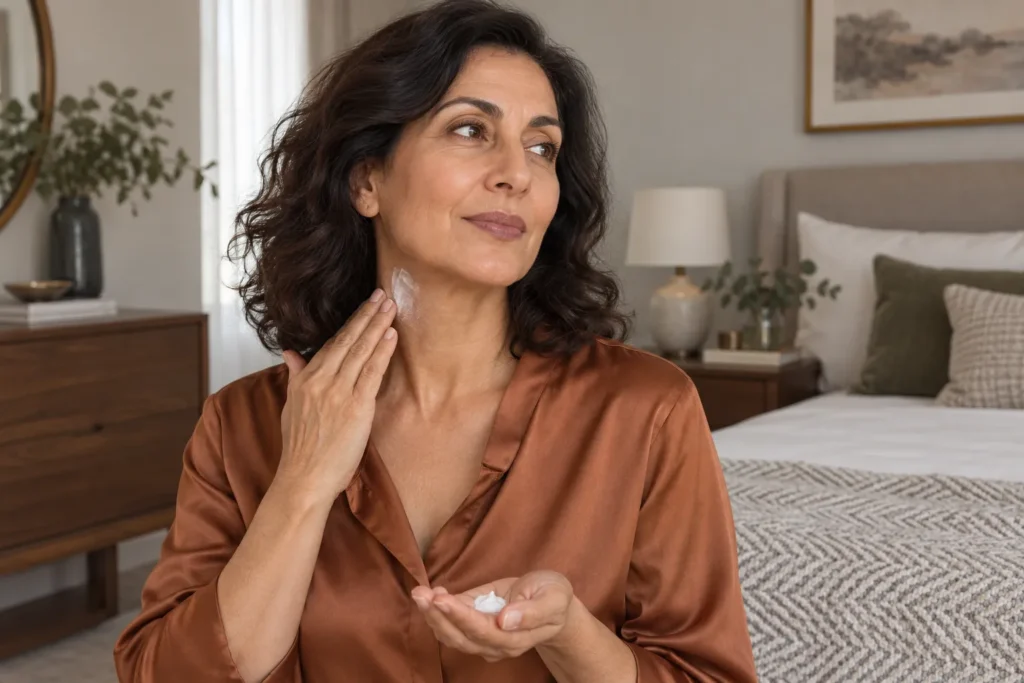
There can be a frustrating moment in your sixties when a moisturiser you have used happily for years suddenly seems to stop doing enough. You apply it in the morning, your skin feels comfortable for a while, and then the dryness starts creeping back. Your cheeks may feel tight, your arms can look more crepey, and your neck may seem drier even though you are moisturising every day. It can leave you wondering whether you simply need to use more cream.
Often, the more useful question is whether your skin’s needs have changed. Skin after 60 can become drier, thinner and more vulnerable to the effects of years of sun exposure and everyday environmental stress. What once felt like enough moisture may no longer provide the same level of comfort. This does not necessarily mean there is something wrong with your skin or your moisturiser.
What Changes in Your Skin After 60?
Skin ageing does not suddenly begin on your sixtieth birthday. Changes have been developing gradually for decades, but some become much more noticeable in later life. The skin can retain moisture less effectively, natural oil production may decline, and the surface may feel rougher or more fragile. Fine lines, wrinkles and uneven looking pigmentation can also become increasingly visible.
You may already have noticed several of these changes at the same time. Perhaps your face feels drier, your hands look older, your neck has developed a crepey appearance and your lower legs need moisturising far more often. That combination is important because it tells us that mature skin should not always be approached as though dryness were an isolated concern. We explored these wider changes in What Happens to Your Skin After 50? 12 Changes You May Notice.
Moisturising Is Still Important
Before we go any further, moisturiser has not suddenly become unnecessary after 60. In fact, moisturising can become increasingly important as skin becomes naturally drier with age. A suitable moisturiser can help hydrate and condition the outer skin, reduce the uncomfortable feeling of dryness and make rough texture feel softer. Those are valuable benefits.
The problem is the assumption that all moisturisers perform exactly the same job in exactly the same way. A lightweight lotion that was perfect for your skin at 40 may not feel substantial enough at 65. You may also be dealing with several overlapping concerns rather than dryness alone. The question is therefore not whether you should stop moisturising, but whether the way you moisturise still suits the skin you have today.
Why Does Skin Become Drier With Age?
The outer layers of your skin have the difficult job of keeping useful moisture in while helping protect you from the outside environment. As skin ages, changes in oil production, barrier function and the skin’s ability to hold water can contribute to increasing dryness. Environmental conditions, medications, health conditions and personal skincare habits can add further complexity. That is why two people of exactly the same age can have very different skin.
Your routine matters as well. Long hot showers, harsh soaps, frequent exfoliation and very dry indoor environments can make already dry mature skin more difficult to manage. Sometimes the moisturiser is being asked to compensate for habits that repeatedly remove moisture or irritate the skin. Improving those habits can therefore be just as important as changing the cream itself.
Why Your Old Moisturiser May Suddenly Feel Too Light
There is nothing inherently wrong with lightweight moisturisers. They can feel pleasant, absorb quickly and work beautifully for people whose skin does not need something richer. But a formula that disappears immediately may not provide enough lasting comfort for increasingly dry mature skin. You may notice yourself reapplying repeatedly because the skin feels dry again shortly afterwards.
This is exactly the problem we explored in Why Does My Skin Feel Dry Again Two Hours After Moisturising?. Hydration is important, but the complete moisturising system also matters. Mature skin may benefit from a formula that considers water, oils and conditioning rather than concentrating on one aspect alone. Sometimes the solution is not more moisturiser, but a moisturiser that better matches your current needs.
Hydration and Oil Are Not the Same Job
This distinction is easy to miss because we often use the word moisture to describe everything. Humectants such as glycerin and hyaluronic acid contribute to hydration by helping attract and retain water within the outer skin. Oils and emollient ingredients perform different roles within a formulation, including helping the surface feel softer and smoother. A good formulation can bring several of these functions together.
That is one reason mature skin can sometimes feel temporarily hydrated yet become uncomfortable again quite quickly. The product may provide one part of what the skin needs without giving you the overall feel you were hoping for. Our article Dry Skin vs Dehydrated Skin: What’s the Difference? explains this distinction in more detail. Understanding it can change the way you shop for moisturiser.
Your Skin Barrier Becomes Part of the Conversation
When dryness keeps returning, it is worth thinking about the skin barrier rather than concentrating entirely on the amount of cream you apply. The outer barrier helps reduce excessive water loss while protecting the living tissues beneath it from the environment. If your skincare routine repeatedly leaves the skin tight, irritated or uncomfortable, adding moisturiser without changing those habits may not completely solve the problem. Your entire routine needs to make sense together.
This does not mean you need a complicated barrier repair programme. Gentle cleansing, avoiding unnecessary irritation and using an appropriate moisturiser can provide a sensible foundation. If your skin has become particularly reactive, Skin Barrier Repair: What Actually Helps and What Can Make It Worse? is a useful place to continue. Sometimes the most helpful thing you can do is stop repeatedly working against your own skin.
Be Careful With the Desire to Scrub Away Ageing Skin
Rough, dull or flaky skin can make exfoliation feel irresistible. If the surface looks old, the natural reaction is to imagine that removing it will reveal younger skin underneath. Used appropriately, exfoliation can have a place in some routines. But mature skin does not necessarily benefit from being scrubbed more aggressively simply because it is older.
Excessive exfoliation can leave the skin dry, tight, red or unexpectedly sensitive. If moisturiser suddenly begins to sting, that can be a sign that your routine deserves another look. We discuss this problem in Over Exfoliated Skin: Signs You’ve Gone Too Far and How to Simplify Your Routine. Smoother looking skin should not require a constant cycle of irritation and recovery.
Menopause Can Still Be Part of the Picture After 60
For many women, some of the skin changes noticed after 60 have roots in the hormonal transition that began years earlier. Reduced oestrogen around and after menopause can be associated with increased dryness and changes in skin thickness, elasticity and overall appearance. Those changes do not necessarily finish when hot flushes stop. Your skincare needs may therefore remain different from what they were before menopause.
This is why an old favourite moisturiser can suddenly feel inadequate even though the product itself has not changed. The skin receiving it has changed. Our guide to The Best Skincare Routine During Menopause looks at how cleansing, moisturising, actives and sun protection can be reconsidered during this stage of life. Adapting your routine is often more useful than repeatedly trying to force your old routine to work.
Years of Australian Sun Exposure Begin to Show
By your sixties, your skin has accumulated decades of ultraviolet exposure. The effects can become visible as wrinkles, changes in texture, uneven looking pigmentation and loss of some of the smoothness you remember from earlier years. Moisturiser can improve dryness related texture, but it cannot erase the structural effects of decades of sun exposure. That distinction is important when deciding what a cream can realistically achieve.
Sun protection still matters after 60. There is no age at which your skin becomes too old to benefit from sensible protection from excessive ultraviolet exposure. Broad spectrum sunscreen, shade, hats and protective clothing should remain part of your approach where appropriate. Defending mature skin today is worthwhile even if you were less careful with the sun forty years ago.
Your Neck May Need More Attention Than It Used to
Many people carefully moisturise their face but stop at the jawline. Then, sometime after 60, the neck suddenly seems to develop dryness, wrinkles and a finely crinkled appearance that is difficult to ignore. The neck has also experienced decades of movement and sun exposure, and its skin can be surprisingly sensitive. It deserves thoughtful care rather than aggressive attempts to tighten it with cosmetic products.
Moisturising can improve dryness and make the surface feel softer, but a cream cannot permanently tighten significant loose skin. We explore realistic options in Crepey Skin on the Neck After 60: What Actually Helps?. Extending gentle moisturising and sun protection from your face to your neck and upper chest is a simple place to begin. There is rarely a good reason for your skincare routine to stop at your chin.
Your Arms and Legs Can Become Noticeably Drier Too
The face receives most of the attention in skincare advertising, but some of the most troublesome mature skin dryness occurs elsewhere. The lower legs, forearms and upper arms can become particularly dry and may develop a rough or crepey looking texture. If you only moisturise your face, you may be ignoring a much larger area of skin asking for attention. Body moisturising can become increasingly important with age.
Try applying moisturiser after bathing while the skin is still comfortable rather than waiting until it becomes extremely dry. Avoid unnecessarily hot showers if they consistently leave your skin tight or itchy. If crepey texture on your arms is a concern, read Crepey Skin on the Arms: Why It Happens and What Can Make It Look Better. Sometimes a simple change in consistency makes more difference than buying another specialist product.
Do Not Forget Your Hands
Your hands may actually show visible ageing before some parts of your face. They receive years of sunlight, repeated washing, detergents, weather and everyday physical exposure. At the same time, most people give their hands only a fraction of the skincare attention they give their faces. By 60 and beyond, that difference can become very obvious.
Moisturising after washing whenever practical can make hand care much more consistent. Gloves for cleaning and gardening can reduce unnecessary exposure, while sunscreen on the backs of the hands helps address another frequently forgotten area. We explored this in Why Your Hands Can Start Looking Older Before Your Face. Your hands deserve to be included in mature skincare rather than treated as an afterthought.
Does Skin After 60 Need More Products?
Not necessarily. One of the biggest mistakes in mature skincare is assuming that every new concern requires another bottle. Dryness gets one product, wrinkles another, dullness another, crepey skin another and uneven looking tone yet another. Before long, a simple routine has become difficult to understand and expensive to maintain.
A better question is whether some of those concerns share underlying skin needs. Dryness can make fine lines look more pronounced, rough texture can make skin appear dull, and poor moisturising can make crepey looking areas more noticeable. Addressing overlapping needs may therefore influence several cosmetic concerns at once. More products and better skincare are not automatically the same thing.
This Is the Thinking Behind Reno Cream
When we developed Reno Cream, we did not begin by asking which fashionable ingredient we could build an advertising story around. We started with the overlapping needs commonly seen in dry, mature and problem prone skin. Hydration is one job, providing an oil based component is another, and conditioning the skin is another. Different jobs naturally led us to consider different ingredients working within one formulation.
This is the philosophy behind The Multi-Functional Skincare Idea Behind Reno Cream. We are not suggesting that one cream can solve every visible sign of ageing or replace every other skincare product. The idea is that one thoughtfully formulated moisturiser can address several related cosmetic skin needs at the same time. That is very different from claiming one miracle ingredient can do everything.
Why Our Ingredient Philosophy Matters More After 60
Skin after 60 is a good example of why we prefer to think in terms of ingredient jobs rather than hero ingredients. Glycerin and hyaluronic acid contribute to the hydration side of Reno Cream, while black seed oil contributes an oil based component within the formula. MSM and allantoin sit within the wider formulation alongside vitamin E, a vitamin C derivative and selected botanical extracts. Each component is considered as part of a system rather than expected to carry the whole product.
That philosophy can be summarised quite simply. Understand the skin needs first, decide which ingredient jobs may help meet those needs, and then consider how the complete formulation works together. It is less dramatic than promising that one exotic ingredient will make mature skin young again. But it is a much more sensible way to think about a multifunctional moisturising cream.
What Reno Cream Can and Cannot Do for Skin After 60
Reno Cream is designed as a multifunctional cosmetic moisturising cream for dry, mature and problem prone skin. It can help hydrate and condition dry skin and support a softer, smoother and more comfortable feeling surface. Where dryness is making fine texture or crepey looking skin more noticeable, better moisturising may also improve the way the surface looks. Those are meaningful cosmetic benefits.
Reno Cream cannot turn 65 year old skin back into 35 year old skin. It cannot permanently tighten significant loose skin, erase every wrinkle, remove suspicious lesions or replace medical treatment for a diagnosed skin condition. It also cannot replace sunscreen. We would rather be clear about those limitations than turn normal cosmetic moisturising into an unrealistic promise.
What About Dull Skin After 60?
Dullness often becomes part of the same conversation because dry, rough skin can reflect light differently from a smoother moisturised surface. A complexion may therefore look less fresh even when there is no single obvious problem. Hydration, gentle skincare and sun protection can all contribute to a healthier looking surface. You do not necessarily need to attack dullness with increasingly strong products.
Our previous article, Dull Mature Skin: 8 Reasons Your Complexion Has Lost Its Glow, explores the different factors that may be involved. Dryness, dehydration, sun exposure, menopause and an overly complicated routine can overlap. That is another example of why mature skin rarely presents with one isolated concern. Looking for the connections between concerns can make your routine much easier to understand.
A Simple Morning Routine for Skin After 60
Your morning routine does not have to involve a bathroom shelf full of products. Cleanse gently if cleansing is necessary, avoiding the feeling that your face needs to be stripped completely clean. Apply any targeted product you genuinely need and comfortably tolerate, followed by an appropriate moisturiser. Finish with broad spectrum sun protection on exposed skin.
Remember that your face is not the only area ageing. Extend suitable care to your neck, upper chest and hands where appropriate. If your arms and legs are dry, body moisturising may also deserve a regular place in your routine. A simple routine that you actually follow is more useful than an elaborate routine you abandon after two weeks.
A Simple Evening Routine for Skin After 60
In the evening, gently remove makeup, sunscreen and the day’s surface debris without turning cleansing into a scrubbing exercise. If you use retinoids, exfoliating acids or other active products, use them according to appropriate directions and your skin’s tolerance. Follow with moisturising suited to the level of dryness you are experiencing. Pay particular attention to areas that repeatedly feel tight or uncomfortable.
The evening is also a useful time to moisturise your hands, neck and other dry areas because the product is less likely to be immediately washed away. You do not need to keep adding layers until your skin disappears beneath skincare. Give each product a clear reason for being in your routine. If you cannot explain what a product is doing there, consider whether you really need it.
Repair, Nourish and Defend After 60
This stage of life is exactly why we developed The Skin Trifecta Method™ around three straightforward ideas. Repair means looking at the habits and routines that may be leaving mature skin dry or stressed and reducing unnecessary irritation. That can include gentler cleansing, sensible exfoliation and paying attention to the skin barrier. Repair is not a promise that a cosmetic product can reverse every structural change associated with ageing.
Nourish means giving dry mature skin the hydration, oils and conditioning support it increasingly needs. Defend means protecting that skin from avoidable irritation and excessive ultraviolet exposure rather than continually trying to correct the visible consequences afterwards. These three ideas are deliberately simple enough to guide an everyday routine. Repair, Nourish and Defend is a way of thinking about your skin, not an instruction to buy ten more products.
When Dry Skin After 60 Needs Professional Attention
Increasing dryness can be common with age, but not every dry, itchy or irritated patch should automatically be blamed on getting older. Persistent redness, severe itching, pain, bleeding, significant cracking, a non healing sore or a new or changing lesion deserves appropriate assessment. Existing skin conditions can also change over time. A cosmetic moisturiser cannot diagnose what is happening.
If your skin suddenly behaves very differently from normal, particularly after starting a new medication or skincare product, it is sensible to investigate the reason. Sometimes the answer may be as straightforward as changing a product or routine, but sometimes professional assessment is appropriate. Mature skincare should include knowing when something falls outside the cosmetic realm. Good judgement is part of good skincare.
Your Skin After 60 Does Not Need to Become a Project
There is a danger that once visible ageing becomes more obvious, skincare begins to feel like a battle. Every wrinkle becomes something to correct, every brown spot becomes a failure and every dry patch triggers another purchase. That can turn an ordinary daily routine into a source of frustration. Your skin deserves better than being treated as a collection of defects.
The goal can simply be skin that feels comfortable, adequately moisturised and well cared for. You can improve dryness, support a softer surface and protect your skin without pretending you can erase six decades of living. A good mature skincare routine should fit into your life rather than dominate it. Ageing is not something a moisturiser needs to defeat.
Moisturiser Is Still the Foundation, But Think Beyond Moisture
So does skin after 60 really need more than moisturiser? In one sense, yes, because healthy mature skin care also involves gentle cleansing, sensible use of active products, protection from ultraviolet exposure and attention to habits that may be increasing dryness. But that does not necessarily mean you need more bottles. It means you need a more complete way of thinking about what your skin requires.
Your moisturiser can still sit at the centre of that routine. The difference is choosing and using it as part of a broader approach to hydration, conditioning, barrier friendly care and protection rather than expecting it to perform miracles by itself. That is the thinking behind Reno Cream and the Skin Trifecta Method. For skin after 60, sometimes the most useful approach remains surprisingly simple: Repair, Nourish and Defend.