
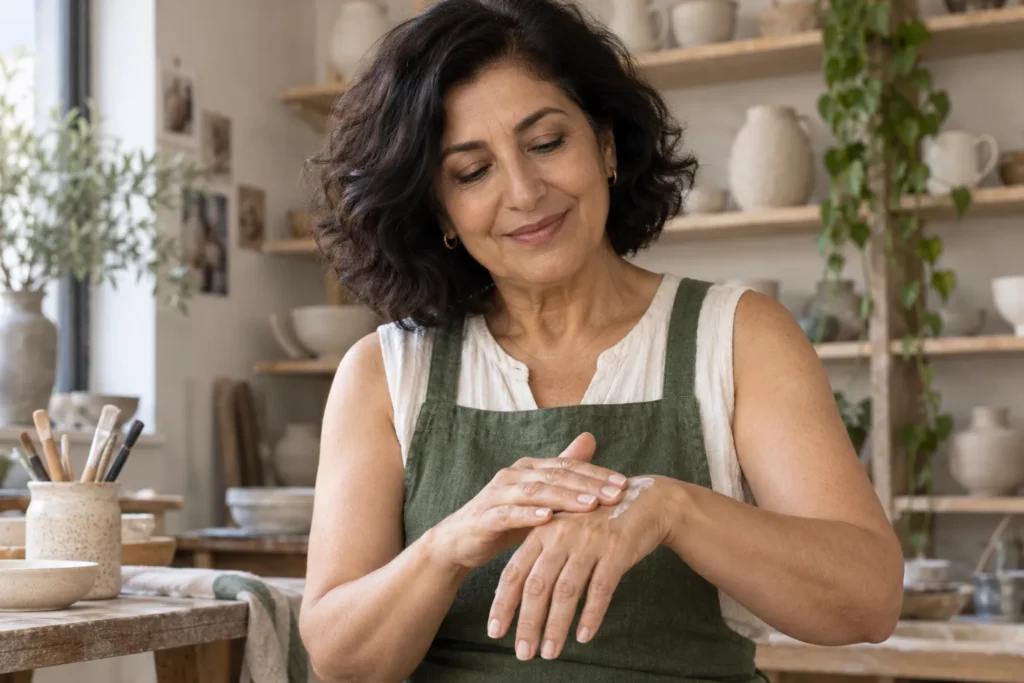
It can happen surprisingly quickly. You catch your forearm against the edge of a cupboard, brush past a garden branch or remove an adhesive dressing and suddenly notice that the skin has torn. The contact may have been minor, yet the damage looks far greater than you would have expected from such a small incident.
For many older adults, particularly those in their seventies and beyond, this increased fragility can become a frustrating part of everyday life. The skin that once tolerated bumps, rubbing and minor knocks may gradually become thinner and less resilient. Something that would once have produced little more than a temporary red mark can now cause a scrape or tear.
Understanding why this happens is important because mature skin often benefits from a different approach to everyday care. It needs less unnecessary friction, more attention to dryness and better physical protection from the small accidents that happen throughout the day.
Why Does the Skin Become More Fragile With Age?
The skin is not simply a covering stretched over the body. It is a complex organ made up of several layers and supporting structures, and those structures change throughout life. As we get older, the skin generally becomes thinner and some of the structural support that contributed to its strength and resilience in younger years changes as well.
Collagen and elastin change with age, while the fatty layer beneath the skin may also become thinner in some areas. Natural oil production can decline and maintaining hydration may become more difficult. Together, these changes can leave mature skin looking thinner, feeling drier and becoming less tolerant of friction and physical stress.
This does not mean that every older person will experience skin tears. It does help explain why relatively minor knocks can sometimes have a much greater effect later in life than they did several decades earlier.
Why Are the Forearms and Hands So Vulnerable?
The hands and forearms tend to receive a remarkable amount of punishment throughout a lifetime. They are exposed to sunlight, weather, repeated washing, household cleaning products, gardening, work and countless accidental bumps. Yet they are often given considerably less skincare attention than the face.
By the time someone reaches their seventies or eighties, the skin on the backs of the hands and forearms may look noticeably thinner. Veins and underlying structures can become more visible, and the surface may have the papery or crepey appearance many people associate with older skin. These areas also have relatively little cushioning compared with some other parts of the body.
Combine decades of exposure with thinner mature skin and everyday knocks become more important. The side of a doorway, the corner of a table or even a pet’s claw can sometimes cause considerably more damage than expected.
Dryness Can Make Fragile Skin Feel Even More Delicate
Dryness and skin tearing are not exactly the same problem, but they frequently occur together in mature skin. When the surface becomes extremely dry, it can feel rough, tight and less comfortable. Fine lines become more obvious and the skin may take on the thin, crinkled appearance we often describe as papery or crepey.
Proper moisturising cannot restore all of the deeper structural changes associated with ageing. However, improving hydration and conditioning can help the surface feel softer and more supple. That is particularly valuable when the skin is already dry and uncomfortable.
This is one reason mature skincare should not be judged entirely by whether a cream can erase wrinkles or reverse ageing. Helping the skin remain comfortable, hydrated and well conditioned is a worthwhile objective in itself.
The Problem With Waiting Until the Skin Is Extremely Dry
Many people moisturise reactively. They wait until their arms or legs become visibly flaky, itchy or uncomfortable and then apply a cream for a few days. Once the immediate dryness improves, moisturising gradually disappears from the routine until the next episode.
That approach may have been adequate when the skin produced more natural oil and recovered quickly from environmental stress. Mature skin can behave differently. If dryness returns repeatedly, consistent moisturising may make more sense than continually allowing the skin to move between comfortable and extremely dry.
Think of moisturising as routine maintenance rather than emergency treatment. The objective is to support the condition of the surface before it becomes severely parched.
Very Hot Showers Can Work Against You
A long, very hot shower can feel wonderful, particularly during a Melbourne winter, but dry mature skin may not appreciate it nearly as much. Hot water and prolonged bathing can contribute to the loss of natural oils from the surface and may leave the skin feeling tight soon afterwards.
You do not need to take cold showers to care for mature skin. Comfortably warm water is perfectly reasonable. The important point is to avoid unnecessarily extreme temperatures and very long showers when the skin is already persistently dry.
Pay attention to what happens afterwards. If your arms and legs feel tight before you have even finished drying yourself, your bathing routine may deserve some adjustment.
Vigorous Towel Drying Is Not Necessary
After bathing, many people rub themselves vigorously with a towel without thinking about it. For robust younger skin, that may cause no obvious problem. For very thin mature skin, the repeated friction is unnecessary.
Try gently patting rather than aggressively rubbing the driest or most fragile areas. Then apply your moisturising product while the skin remains slightly damp. This creates a convenient daily habit and may help you remember to moisturise consistently.
Small changes like these rarely sound impressive in skincare advertising, but mature skin often responds well when unnecessary physical stress is simply removed from the routine.
Be Careful With Scrubs and Exfoliating Gloves
When mature skin becomes rough or flaky, exfoliation can seem like the obvious answer. If there are visible flakes, it is tempting to scrub until the surface feels smooth again. But when the skin is already thin and fragile, aggressive exfoliation can add more friction to an area that may need gentler treatment instead.
That does not mean nobody with mature skin can ever exfoliate. It means exfoliation should be approached sensibly and according to how the skin responds. Rough gloves, stiff brushes and vigorous body scrubs should not automatically be regarded as essential steps in mature skincare.
Sometimes what looks like a surface that needs more scrubbing is actually a surface that needs more moisturising.
Everyday Household Activities Can Cause Skin Tears
Many skin tears happen during completely ordinary activities. Reaching into a cupboard, moving furniture, carrying shopping bags, gardening, playing with pets or brushing against a doorframe can be enough. Because the original contact seems so insignificant, people are often surprised by the amount of damage.
If you notice that your forearms are repeatedly being scraped or torn, consider the environment rather than focusing entirely on skincare products. Long sleeves can provide useful physical protection during gardening, housework or other activities where the arms are likely to be bumped.
The best protection for fragile skin is sometimes not another ingredient. It is simply putting something between the skin and the object that keeps hitting it.
Adhesive Dressings Need Extra Care
Adhesive tapes and dressings deserve particular attention when the skin is very thin. Removing strongly adhesive material can sometimes place considerable mechanical stress on fragile mature skin. This is especially relevant for people who frequently require dressings or medical procedures.
If you know your skin tears easily, mention this to the healthcare professional caring for you. They may be able to select appropriate dressings or removal techniques for fragile skin. Do not simply pull aggressively at something that feels firmly attached.
The condition of mature skin should be taken into account whenever adhesives are being used repeatedly.
Sun Exposure Has a Long Memory
Many of the areas where mature skin looks particularly thin are also areas that have accumulated years of sun exposure. The face usually receives the most attention, but the hands, forearms, neck and upper chest may have spent decades exposed during driving, gardening, walking, working or simply living in Australia’s climate.
Cumulative ultraviolet exposure contributes to visible changes in the structure and appearance of the skin. That history cannot be erased by applying a moisturiser later in life, but future exposure can still be managed.
Sun protection therefore remains relevant at 60, 70, 80 and beyond. Appropriate sunscreen, shade, protective clothing and sensible sun habits continue to have a place in mature skincare.
Repair: Reduce Unnecessary Stress on the Skin
The first part of the Skin Trifecta Method™ is Repair. For fragile mature skin, Repair begins with recognising the everyday habits that repeatedly leave the surface dry, stripped or physically stressed.
That may mean changing very hot showers to comfortably warm ones, replacing aggressive scrubbing with gentler cleansing and patting rather than rubbing the skin dry. It can also mean moisturising regularly instead of waiting until dryness becomes severe.
Repair in this context does not mean claiming that a cosmetic cream can rebuild the skin to the structure it had forty years ago. It means creating conditions that are more supportive of the mature skin you have now.
Nourish: Support Hydration and Conditioning
The second part of the Skin Trifecta Method™ is Nourish. Mature skin that looks thin and fragile is often dry at the same time, so hydration and conditioning become particularly important.
Humectant ingredients can help support hydration within the outer layers of the skin, while oils and emollient ingredients can contribute softness and conditioning. These ingredient types perform different jobs, which is why a well-designed moisturising formulation does not necessarily need to depend on one fashionable ingredient.
When the surface is better hydrated, it may feel softer and look less parched and crepey. That does not make the skin impossible to tear, but it improves something skincare can realistically influence: the condition of the surface.
Why Reno Was Formulated This Way
Fragile-looking mature skin is a good example of why Reno Cream was developed around multiple overlapping cosmetic needs. Someone with thin-looking skin may also be dealing with dryness, roughness, tightness, crepey texture and a loss of softness. Treating each concern as though it exists in isolation can quickly lead to an unnecessarily complicated routine.
At the centre of Reno Cream are black seed oil, MSM and allantoin. The formulation also includes glycerin and hyaluronic acid as part of its hydration system, alongside vitamin ingredients and a selected botanical blend. Different components have different cosmetic roles within the complete formulation.
The philosophy is straightforward: begin with the needs of the skin, choose ingredients that can perform complementary jobs, and allow the complete formulation to work as a system rather than expecting one hero ingredient to do everything.
You can learn more about Reno Cream Skin Repair Cream here.
Why Glycerin and Hyaluronic Acid Are Included
Glycerin and hyaluronic acid are humectant ingredients commonly used in skincare to support hydration. When mature skin becomes persistently dry, improving hydration in the outer surface can help it feel more comfortable and look less parched.
These ingredients perform a different job from oil-based and conditioning components. That difference is important because mature skin often benefits from both hydration and conditioning rather than treating them as though they are the same thing.
A formula can therefore approach dryness from several directions without pretending that any one ingredient is a miracle solution.
Why Black Seed Oil Is Part of the Formula
Black seed oil is one of the core ingredients in Reno Cream and contributes to the conditioning side of the formulation. Oils and emollient ingredients can help the surface feel softer, which complements the water-attracting role of humectants.
We do not position black seed oil as a magical solution for fragile skin. It is one component within a wider formulation designed around the overlapping cosmetic needs commonly seen in mature, dry and problem skin.
This distinction matters because ingredient synergy is central to the way Reno Cream was formulated. The finished product matters more than whichever ingredient happens to be receiving the most attention.
The Role of Allantoin and the Wider Formula
Allantoin also forms part of the core Reno Cream formulation and has a long history of use in cosmetic skincare. It sits alongside MSM, black seed oil, the hydration system, vitamin ingredients and the botanical blend rather than being expected to carry the entire formula on its own.
Reno Cream also includes botanical components such as Centella asiatica, chamomile, licorice, green tea, rosemary and ginger, together with other selected extracts. These ingredients are part of a wider formulation philosophy based on complementary roles.
The objective is not to create the longest ingredient story. It is to create a coherent formula designed around what dry, mature and problem skin commonly needs.
Defend: Physical Protection Matters
The third part of the Skin Trifecta Method™ is Defend, and fragile mature skin makes the importance of this step particularly obvious. Defend is not only about environmental exposure. It also means protecting the skin from physical damage when practical.
Wear long sleeves when gardening if your forearms tear easily. Be mindful of pets, furniture edges and other repeated sources of knocks. Continue appropriate sun protection and adjust the skincare routine when weather conditions leave the skin particularly dry.
A cream can support hydration and conditioning, but it cannot stop a sharp branch from scraping your arm. Good mature skincare therefore needs to include common sense alongside cosmetic products.
What Should You Do if the Skin Tears?
If a skin tear occurs, the immediate priority is appropriate wound care rather than cosmetic skincare. Do not put ordinary cosmetic cream directly into an open wound unless a healthcare professional has specifically advised you to use that product there.
Minor injuries may be manageable with basic first aid, but larger wounds, continued bleeding, significant pain, signs of infection or tears that do not appear to be healing properly should receive professional assessment. People with certain medical conditions or circulation problems may also need particular care.
Reno Cream is intended for cosmetic skincare. It should not be treated as a substitute for appropriate wound management.
When Fragile Skin Deserves Medical Attention
Increasing fragility can accompany ageing, but significant or sudden changes should not automatically be dismissed because someone is older. If the skin begins tearing frequently without obvious cause, wounds heal poorly, bruising becomes dramatically more common or you notice other unexplained changes, speak with your doctor or another appropriate healthcare professional.
Medicines and health conditions can influence the skin, and some factors cannot be identified simply by looking at the surface. A healthcare professional can consider the wider picture in a way that a skincare routine cannot.
There is an important difference between caring for mature skin cosmetically and assuming every change is merely cosmetic.
A Simple Daily Routine for Fragile Mature Skin
Keep cleansing gentle and avoid very hot water. After bathing, pat rather than aggressively rub the skin dry and apply a moisturising cream to dry areas while the surface retains a little moisture. Pay particular attention to the hands, forearms, lower legs, neck and chest if those are the areas where dryness is most noticeable.
Continue moisturising consistently rather than waiting until the skin becomes severely dry. Protect exposed areas from excessive sunlight and use clothing as a physical barrier during activities where the arms or legs are likely to be scraped.
Most importantly, do not make the routine unnecessarily aggressive. Fragile mature skin generally needs thoughtful care more than it needs another harsh treatment.
The Skin Has Changed, So the Routine Should Change Too
One of the biggest mistakes we can make with mature skincare is expecting the skin to behave exactly as it did decades earlier. The cleanser you tolerated at 30 may feel too drying at 70. The vigorous body scrub you once enjoyed may now leave the surface uncomfortable, and a light lotion that once seemed perfectly adequate may no longer provide enough conditioning.
There is nothing unusual about adjusting your routine as your needs change. We do it with almost every other part of life, yet skincare is often treated as though one routine should somehow remain appropriate forever.
Listen to what the skin is telling you now. If it has become thinner, drier and easier to damage, respond with more thoughtful care rather than simply adding stronger products.
Care for Fragile Mature Skin Without Impossible Promises
No cosmetic cream can make very mature skin physically indestructible, and good skincare does not need that kind of promise to have value. Hydration, conditioning, gentle cleansing, sun protection and reducing unnecessary friction can all form part of a sensible routine for skin that has become thinner and more delicate with age.
That is where the Skin Trifecta Method™ provides a useful framework. Repair by reducing habits that repeatedly strip or stress the skin. Nourish with consistent hydration and conditioning using ingredients with complementary roles. Defend by protecting fragile areas from excessive sun exposure and avoidable physical damage.
The skin may not have the same thickness or resilience it had decades ago, but that does not mean there is nothing you can do for it. Mature skincare is not about pretending ageing has not happened. It is about understanding what has changed and giving the skin the care that makes sense now.
For a deeper explanation of this approach, read The Skin Trifecta Method™: Repair, Nourish & Defend for Adult and Mature Skin.