
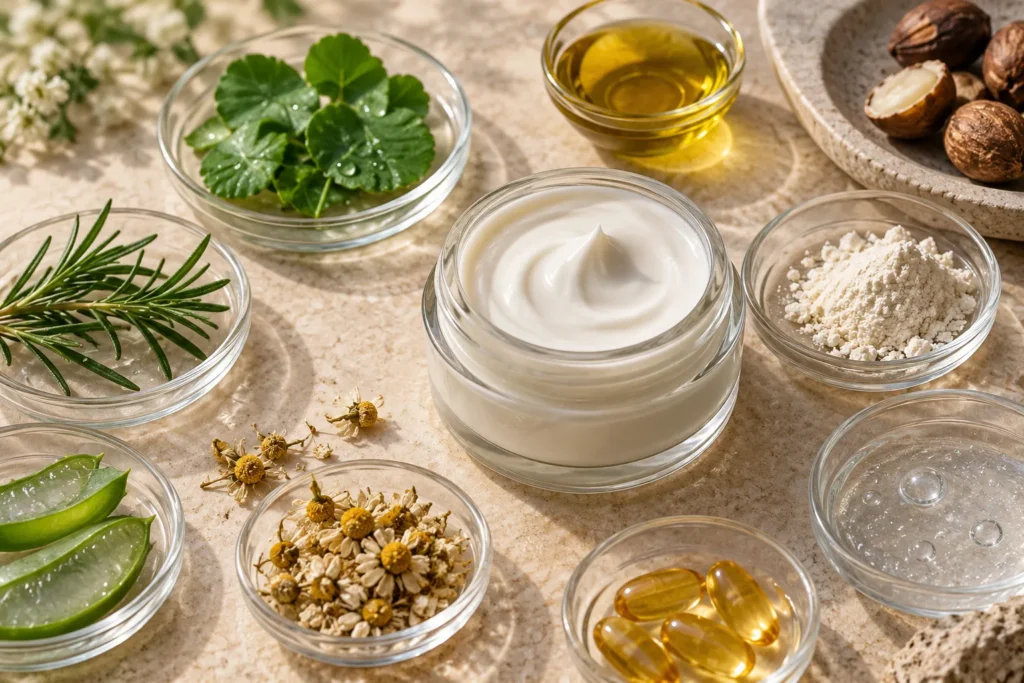
MSM is not the first ingredient most people think about when they hear the words mature skincare. It does not have the instant recognition of hyaluronic acid or vitamin C, and you are unlikely to see entire supermarket shelves built around it. Yet when we were developing Reno Cream, popularity was never the main test for whether an ingredient belonged in the formula. We were more interested in what different ingredients could contribute when brought together thoughtfully.
That is how MSM, or methylsulfonylmethane, became one of the three core ingredients in Reno Cream alongside black seed oil and allantoin. We did not include it because we wanted another impressive name on the label. Nor do we present MSM as a miracle ingredient capable of transforming mature skin by itself. Its place makes more sense when you understand the formulation philosophy behind Reno Cream.
What Exactly Is MSM?
MSM stands for methylsulfonylmethane, an organosulfur compound that contains sulfur as part of its chemical structure. It has attracted considerable interest over the years and is probably better known to many people as an ingredient used in dietary supplements. MSM can also be incorporated into topical formulations, which is the context that matters when discussing Reno Cream. Oral supplements and topical skincare should not be treated as though they are the same thing.
That distinction is important because information about MSM is often mixed together online. A study involving oral MSM does not automatically establish what will happen when MSM is applied to the skin in a cosmetic product. The route of administration, concentration and formulation all matter. When we talk about MSM in Reno Cream, we are talking specifically about its role within a topical cosmetic formulation.
Why Is Sulfur Interesting in Skincare?
Sulfur is naturally present throughout the body and forms part of many biological molecules. That fact can make MSM sound immediately impressive, but it is important not to turn basic biology into a skincare promise. Simply containing sulfur does not mean a cosmetic ingredient automatically rebuilds or transforms the structure of the skin. The scientific story is more complicated than that.
For us, MSM became interesting as one component within a broader formulation rather than as a stand-alone solution. Mature, dry and problem skin can have several overlapping needs, so we wanted ingredients with different characteristics and roles. MSM was therefore considered alongside oils, humectants, allantoin, vitamins and botanicals. Its usefulness had to make sense within that complete system.
What Does the Research Around MSM Suggest?
MSM has been investigated scientifically in several contexts, including research involving oxidative and inflammatory pathways. Some studies have also explored its use in relation to physical recovery, exercise and other areas that are quite separate from cosmetic skincare. This research makes MSM scientifically interesting. It does not mean every finding can be transferred directly to the skin.
This is where the same evidence rule we applied to black seed oil becomes important. We need to ask whether a study examined MSM orally or topically, what concentration was used, who participated and what outcome was actually measured. We also need to distinguish laboratory findings from human clinical evidence. Without those questions, it becomes very easy to turn an interesting ingredient into an exaggerated one.
Topical Evidence Deserves Particular Attention
If we want to know what MSM can do in skincare, research involving topical application is more directly relevant than research involving oral supplements. Even then, we need to look carefully at the actual formulation being tested. A product containing MSM alongside other ingredients cannot necessarily tell us how much of an observed result came from MSM alone. This is a common challenge in cosmetic ingredient research.
That does not make the research useless. It simply means the conclusions need to match what was actually studied. A formulation can perform well without proving that one ingredient deserves all the credit. This idea is particularly relevant to Reno Cream because we deliberately formulate around ingredient synergy rather than one hero ingredient.
Can MSM Reverse Skin Ageing?
This is where we need to be especially careful. Biological ageing involves changes in the structure and function of the skin that develop over many years. Sun exposure, genetics, hormonal changes, lifestyle and environmental factors can all influence how those changes become visible. It would therefore be unrealistic to claim that one cosmetic ingredient can simply reverse the entire process.
We do not describe MSM as an ingredient that makes the skin biologically young again. Nor do we claim that it can erase every wrinkle or permanently reverse structural changes associated with ageing. Reno Cream is a cosmetic product, and MSM is one component of that cosmetic formulation. We believe its story is more credible when we respect those boundaries.
Mature Skin Usually Needs More Than One Thing
The reason MSM became interesting to us begins with the way mature skin behaves rather than with a dramatic claim about MSM itself. As the skin changes, dryness may appear alongside roughness, reduced suppleness and a greater feeling of tightness or discomfort. Dehydration can make fine surface lines more noticeable, while the skin barrier may require more thoughtful care. These concerns often overlap.
If several needs are present at the same time, building a formula around one ingredient becomes difficult to justify. An ingredient that contributes to hydration may not perform the same job as an oil, while a conditioning ingredient cannot necessarily replace every other component of the formula. We therefore wanted Reno Cream to contain different ingredient groups with complementary roles. MSM became part of that wider architecture.
Why We Paired MSM With Black Seed Oil
MSM and black seed oil are very different ingredients. Black seed oil contributes to the richer, conditioning side of Reno Cream, making sense within a formula designed for the skin that can become increasingly dry and less supple. MSM is an organosulfur compound rather than an oil, so we do not expect the two ingredients to behave identically. Their differences are precisely the point.
We were never trying to create three core ingredients that simply repeated one another. We wanted ingredients capable of occupying different places within the same formulation. Black seed oil has its role, while MSM has its own. Bringing different roles together is one of the foundations of the Reno Cream formulation philosophy.
Why Allantoin Completes the Core Trio
The third core ingredient is allantoin, another ingredient with characteristics quite different from both MSM and black seed oil. Allantoin has a long history of use in cosmetic formulations intended to support the feel and condition of the skin. It may not be one of the loudest ingredients in modern skincare marketing, but that was never our criterion. We included it because it made sense within the type of cream we were trying to create.
Together, black seed oil, MSM and allantoin established the core of Reno Cream. We do not claim that these three ingredients alone account for everything the finished cream does. Instead, they form a foundation that works alongside the hydration, conditioning, vitamin and botanical parts of the formula. The wider formulation is what ultimately goes onto the skin.
MSM Does Not Replace Moisturisation
One point deserves particular emphasis because mature skin is so frequently affected by dryness. MSM does not remove the need for a proper moisturising system. Reno Cream therefore also contains ingredients such as glycerin and hyaluronic acid, which belong to the hydration side of the formulation. These humectants have jobs that are different from MSM.
This is why we prefer talking about ingredient roles rather than ingredient rankings. Asking whether MSM is “better” than hyaluronic acid does not tell us very much because the ingredients are not being asked to do exactly the same thing. A well-designed formula can benefit from ingredients performing different functions. The real question is whether those functions make sense together.
Why We Added Vitamins as Another Layer
Reno Cream also contains vitamin E and ascorbyl palmitate, a vitamin C derivative. These ingredients form part of the broader vitamin and antioxidant-supporting side of the formula. Again, their presence does not make MSM unnecessary, just as MSM does not make the vitamins unnecessary. Each belongs to a different part of the formulation architecture.
This layered approach is intentional. Mature, dry and problem skin does not always fit neatly into a single skincare category, so we did not want Reno Cream to fit neatly into a single ingredient story either. Hydration, conditioning, vitamins and selected botanicals can all contribute something different. MSM sits within that wider system.
Botanicals Have Their Own Jobs Too
Our botanical complex includes ingredients such as Centella asiatica, chamomile, licorice, green tea, rosemary and ginger, alongside other selected extracts. These ingredients were not included to create a long botanical list for marketing purposes. They form another complementary layer within the complete Reno Cream formula. Just like MSM, each needs to be understood in context.
This is an important part of the way we think about skincare. The presence of a botanical ingredient does not mean it should suddenly become the explanation for everything the cream does. Neither should MSM. The formula should be judged as a formula.
Why Reno Was Formulated This Way
When we began developing Reno Cream, we started with the needs of the skin rather than the popularity of particular ingredients. We considered what can happen as mature skin becomes drier, rougher or less supple and how several of those concerns can appear together. From there, we identified different formulation jobs. The ingredients were selected to help fill those jobs.
This is how MSM found its place within Reno Cream. It was not chosen because we wanted to create an “MSM cream,” just as black seed oil was not chosen because we wanted to create only a black seed oil product. We were developing a multi-functional cream for mature, dry and problem skin. MSM became one piece of that larger formulation puzzle.
Ingredient Synergy Matters Here
The previous article in this series explored why ingredient synergy matters more to us than chasing one trending hero ingredient. MSM is a good example of that philosophy in practice. On its own, it cannot explain Reno Cream. In combination with ingredients performing other jobs, however, it becomes part of something broader.
Think about a team in which every person has exactly the same skill. That team may perform one task extremely well but struggle as soon as the job becomes more complicated. A stronger team brings together people with complementary abilities. We applied much the same principle when choosing ingredients for Reno Cream.
Repair. Nourish. Defend.
The thinking behind the formulation eventually became The Skin Trifecta Method™: Repair, Nourish and Defend. This framework gives us a simpler way to talk about the overlapping needs of mature, dry and problem skin. It also prevents us from pretending that one ingredient represents the entire product. MSM is part of the formula, not the formula itself.
Repair reflects our barrier-conscious approach and the importance of supporting the conditions that help the skin remain comfortable and retain moisture. Nourish reflects the combination of hydration, oils, conditioning ingredients, vitamins and botanicals within Reno Cream. Defend recognises the everyday environmental stresses the skin encounters and the importance of sensible protection within a wider skincare routine. The ingredients work within these broader goals rather than operating as isolated marketing stories.
Why We Do Not Make MSM a Miracle Ingredient
Search online for long enough and you can find remarkable claims about almost any skincare ingredient. MSM is no exception. Some claims move far beyond what can reasonably be concluded from research on a particular preparation, population or route of administration. Repeating those claims might make an article sound exciting, but it would not make the formulation better.
We would rather say what MSM is and explain honestly why we included it. It is an interesting organosulfur ingredient that forms part of the core Reno Cream formulation. It works alongside black seed oil, allantoin, humectants, vitamins and botanicals rather than replacing them. That is enough reason for MSM to have a place in the formula without promising something extraordinary.
What MSM Cannot Tell You About a Finished Cream
Seeing MSM on an ingredient list does not automatically tell you how well a product will perform. The concentration matters, but so do the other ingredients, the delivery system, product stability and the overall quality of the formulation. The same principle applies to almost every cosmetic ingredient. A label gives useful information, but it does not tell the entire formulation story.
This is another reason we encourage people to look beyond hero ingredients. A product containing a fashionable ingredient is not automatically superior to one containing less fashionable ingredients. What matters is whether the finished product suits the needs of your skin and can be used consistently. Skincare happens through finished formulations, not isolated ingredient names.
What Should You Look for When Considering MSM Skincare?
Start by looking at the complete product rather than the letters “MSM” on the label. If your main concern is dry mature skin, ask where the hydration and conditioning are coming from as well. Look for ingredients that perform complementary functions rather than expecting MSM to cover every need. The wider formulation should make sense for what you are trying to achieve.
It is also worth being cautious when a cosmetic product makes medical-sounding promises based solely on MSM or any other individual ingredient. A cosmetic can support the appearance, feel and condition of the skin without claiming to treat disease. If you are dealing with a persistent, painful or concerning skin condition, appropriate professional advice is more important than chasing another ingredient trend. Good skincare should know where its role ends.
Why MSM Earned Its Place in Reno Cream
Ultimately, MSM earned its place in Reno Cream because it fitted the formulation philosophy we had already established. We wanted a core built from ingredients with different characteristics rather than three versions of the same thing. We wanted that core surrounded by a genuine hydration system, conditioning ingredients, vitamins and selected botanicals. Most importantly, we wanted the finished cream to make sense as a whole.
That is why MSM sits beside black seed oil and allantoin at the core of Reno Cream. It is important, but it is not expected to be miraculous. Its value comes partly from what it contributes and partly from what the ingredients around it contribute. The formula remains the hero.
A Thoughtful Ingredient Does Not Need an Exaggerated Story
MSM may never become as famous as hyaluronic acid or vitamin C, and that is perfectly fine. Skincare does not become more effective simply because an ingredient is trending. What matters is whether an ingredient has a sensible reason to be in the formula and whether the finished product is designed around the needs of the skin. That is the standard we used when considering MSM.
For Reno Cream, those needs came first. MSM then became one part of a broader system that includes black seed oil, allantoin, glycerin, hyaluronic acid, vitamins and botanicals with complementary roles. Together, they support our approach of Repair, Nourish and Defend. That is why MSM is in Reno Cream.
You can explore Reno Cream and its complete formulation here to see how MSM fits alongside the other ingredient groups. You can also get The Skin Trifecta Method™ here to explore our Repair, Nourish and Defend approach to mature, dry and problem skin. The principle remains simple: start with the skin, understand what it needs, and choose ingredients for the jobs they can contribute to the complete formula.