
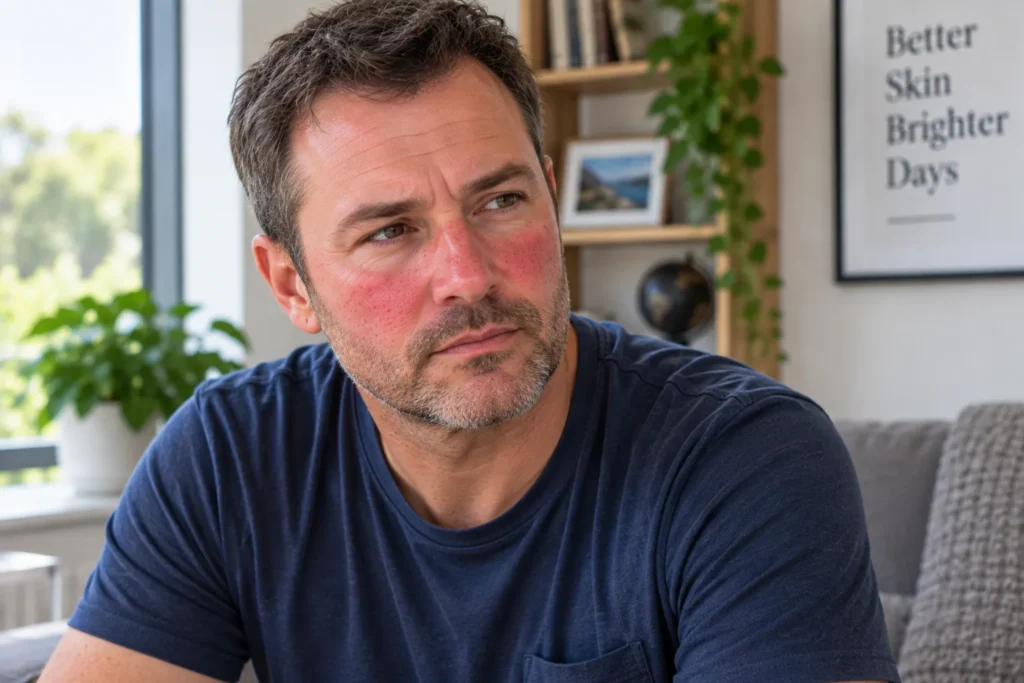
If your face is red, dry and sensitive, buying a moisturiser can become surprisingly difficult. The shelves are full of creams labelled calming, soothing, barrier repair, sensitive skin and anti-redness, yet your skin may still sting the moment you apply them. After several disappointing purchases, it is easy to start wondering whether your face simply dislikes moisturiser altogether.
Usually, the better question is not “What is the best moisturiser for facial redness?” but “Why is my face red, and what does the skin underneath that redness actually need?” A person whose cheeks temporarily flush after exercise has a different problem from someone whose face remains red, dry, tight and uncomfortable throughout the day. Moisturiser can be particularly useful in the second situation, but it still needs to be chosen carefully.
There is also an important limitation to understand from the beginning. A moisturiser does not diagnose or treat every cause of facial redness, and persistent redness may require assessment by a doctor or dermatologist. What a well-formulated moisturiser can do is support hydration, reduce excessive moisture loss and help dry, sensitive-feeling skin remain more comfortable.
Start With the Redness, Not the Moisturiser
Facial redness is a sign rather than a diagnosis. Heat, sun exposure, exercise, emotional stress, alcohol, spicy foods, hot showers, rosacea, dermatitis, allergies and irritating skincare can all contribute to a red face. Sometimes more than one factor is involved.
That is why buying a cream simply because the front of the jar says “redness relief” can be misleading. If your face becomes red because you are overheating during exercise, moisturiser isn’t going to stop the normal widening of blood vessels that helps your body release heat. If the redness accompanies dry, tight, flaky or easily irritated skin, however, moisturisation becomes much more relevant.
If you’re unsure what may be behind your redness, begin with our guide Why Is My Face Red?. It explains the differences between flushing, persistent redness, irritation and several conditions that can produce similar-looking symptoms. Understanding the problem first makes choosing skincare considerably easier.
Why Can Red Skin Also Feel So Dry?
The outermost layer of your skin is much more than a covering. It forms part of a sophisticated barrier that helps limit excessive water loss while protecting the living tissues underneath from the outside environment. When that barrier is functioning well, skin is generally better able to retain moisture and tolerate everyday exposures.
Barrier function can become disrupted for many reasons. Over-cleansing, excessive exfoliation, environmental exposure and irritating skincare routines can contribute, while inflammatory skin conditions can also be associated with barrier abnormalities. The result may be skin that feels dry, tight, rough or unusually sensitive.
Research into rosacea has also identified barrier abnormalities in some affected skin, including increased transepidermal water loss. This helps explain why dryness, burning and stinging can coexist with visible redness. It also explains why moisturisation forms part of dermatology guidance for rosacea-prone skin even though moisturiser itself is not a treatment for rosacea.
Why Does Moisturiser Sometimes Burn a Red Face?
This is one of the most frustrating experiences people describe. Your skin feels desperately dry, so you apply moisturiser—and the product you expected to soothe your face suddenly burns. Sometimes even products marketed specifically for sensitive skin can sting.
When skin is highly irritated or its barrier is struggling, substances applied to the surface may produce sensations that wouldn’t normally occur. Certain ingredients may also irritate sensitive skin independently of barrier condition. And occasionally the problem is not simple irritation at all, but allergic contact dermatitis or another condition requiring assessment.
If this sounds familiar, read Why Does Everything I Put on My Face Burn?. Persistent burning isn’t evidence that a moisturiser is “working.” Your skincare should not become an endurance test.
What Should a Moisturiser for Red, Dry and Sensitive Skin Actually Do?
Ignore the marketing claims for a moment and think about the fundamental job of the product. Dry skin needs water, but simply wetting the skin isn’t enough because that water can quickly evaporate. An effective moisturising formulation therefore usually approaches the problem from several directions.
This is why moisturisers commonly combine humectants, emollients and occlusive components. Humectants help attract and retain water, emollients help soften and smooth the skin, while occlusive ingredients can help reduce excessive water loss from the surface. The exact balance varies enormously between formulations.
For red, dry and reactive skin, there is another requirement: tolerability. The most impressive moisturiser in the world is not particularly useful if your face becomes painfully irritated every time you apply it. Comfort and consistency matter.
1. Look for Good Humectants
Humectants are ingredients that help support hydration by attracting or retaining water. Two familiar examples are glycerin and hyaluronic acid, both widely used in skincare. They can form valuable parts of a moisturising system.
Hyaluronic acid has become particularly fashionable, but it shouldn’t be viewed as a miracle ingredient. Glycerin is less glamorous from a marketing perspective, yet it is an extremely useful and well-established moisturising ingredient. A formulation containing both can use them as part of a broader hydration strategy.
This is also how we approach hydration in Reno Cream. Both glycerin and hyaluronic acid form part of the formulation, but neither is presented as the single reason the cream exists. Hydration works best as part of a complete formulation.
2. Don’t Forget Emollients
Dry skin doesn’t only need water. The surface can become rough and uncomfortable, and emollient ingredients help improve softness and smoothness. They can also make a moisturiser feel more substantial than a very lightweight hydrating serum.
This distinction becomes particularly relevant with mature skin. A watery product may provide an immediate feeling of hydration but still leave some people feeling tight again relatively quickly. A more complete moisturising cream can provide additional conditioning and comfort.
Reno Cream incorporates emollient components, including Black Seed Oil derived from Nigella sativa, within its broader formulation. We don’t position Black Seed Oil as a cure for facial redness or rosacea. Its place is within the cream’s overall moisturising and skin-conditioning system.
3. Consider How Well the Moisturiser Helps Reduce Water Loss
Your skin is continuously losing some water to the environment. This process is known as transepidermal water loss, or TEWL. Moisturisers can help reduce excessive water loss through the way their ingredients interact with the skin surface.
This does not mean everyone needs the heaviest possible ointment. Some people love rich creams, while others find heavily occlusive products uncomfortable or aggravating. The ideal texture depends on dryness, climate, skin condition and individual tolerance.
That is why “thicker is always better” is too simplistic. A moisturiser needs to provide enough support without creating another problem. Your own skin’s response remains an important part of the decision.
4. Consider Barrier Support
“Skin barrier repair” has become one of the biggest phrases in modern skincare. There is good science behind caring for barrier function, but the term is now used so loosely that almost every cream seems to claim it can rebuild your face. Consumers deserve a more realistic explanation.
Moisturisation can support the environment of the stratum corneum and help dry skin retain water more effectively. Some formulations use ceramides and other physiological lipids, while others use different combinations of humectants, emollients, occlusives and skin-conditioning ingredients. There isn’t only one legitimate formulation strategy.
If your redness occurs alongside tightness, flaking, roughness and sudden product sensitivity, our article Can a Damaged Skin Barrier Cause Facial Redness? goes much deeper into this subject. Barrier support is useful, but not every red face should automatically be diagnosed as a “damaged barrier.”
5. Don’t Judge a Moisturiser by Ceramides Alone
Ceramides are important lipids found naturally in the stratum corneum, and they can be valuable ingredients in barrier-supportive formulations. Their popularity is therefore understandable. But skincare marketing sometimes creates the impression that a moisturiser without ceramides cannot possibly support dry skin.
Human skin is considerably more complicated than one ingredient. The barrier includes corneocytes, cholesterol, ceramides, free fatty acids, natural moisturising factors and many other components operating within an organised structure. Moisturisers can support dry skin through different combinations of ingredients and mechanisms.
So ceramides can certainly be worth considering, but don’t buy a product solely because the word appears prominently on the packaging. Look at how your skin responds to the finished formulation. A theoretically impressive formula that you cannot comfortably use is not the best moisturiser for you.
6. Look for Ingredients With a Sensible Skin-Conditioning Role
Once the fundamental moisturising system is in place, additional ingredients can be included for skin-conditioning purposes. This is where ingredients such as allantoin and selected botanical extracts become interesting. The important word is additional.
Reno Cream includes allantoin as part of its wider formulation. It also contains a botanical complex that includes ingredients such as Centella asiatica, licorice and green tea. These ingredients were selected as parts of the overall formulation rather than added simply so their names could appear on a label.
We take the same approach to antioxidant vitamins and MSM within the cream. Individual ingredients may have interesting scientific literature behind them, but the consumer ultimately applies the complete product. Finished-formulation performance and tolerability matter more than creating the longest possible ingredient story.
7. Be Careful With Fragrance
Fragrance is not automatically harmful, and plenty of people tolerate fragranced skincare without difficulty. But fragrance is a recognised potential irritant or allergen for some individuals, which becomes particularly relevant when someone already has highly sensitive or reactive facial skin. Dermatology guidance for rosacea-prone skin commonly recommends fragrance-free products.
The same principle applies to essential oils. “Natural fragrance” does not automatically mean gentler fragrance. Plant origin doesn’t remove the possibility of irritation or allergy.
If your face already burns easily, this isn’t the ideal time to prioritise how beautiful your moisturiser smells. A product’s first job is to agree with your skin. Perfume is optional.
8. Watch for Ingredients That Consistently Make You Sting
The American Academy of Dermatology advises people with rosacea-prone skin to be cautious about several ingredients that may irritate, including alcohol, camphor, fragrance, glycolic acid, lactic acid, menthol, sodium lauryl sulfate and urea. This doesn’t mean every one of these ingredients is universally bad. Formulation, concentration and individual tolerance matter.
The National Rosacea Society has similarly reported that many people with rosacea identify skincare products as triggers. In its survey data, ingredients including alcohol, witch hazel, fragrance, menthol, peppermint and eucalyptus oil were among those reported as aggravating by some respondents. These are survey findings rather than a universal blacklist.
Your own repeated reaction matters enormously. If one particular product makes your face burn every time you apply it, you don’t need to win an argument with the ingredient list before stopping it. Your skin has already supplied useful information.
9. Be Careful With “Anti-Redness” Claims
The words anti-redness can mean many things in cosmetic marketing. A green-tinted product may make redness less visible immediately through colour correction. A moisturiser may improve dryness and irritation, making the skin appear calmer as its condition improves.
Neither is the same as treating the underlying cause of rosacea. A cosmetic also cannot reasonably promise to stop all flushing caused by heat, exercise, alcohol, menopause or medication. Those processes can involve blood-vessel and physiological mechanisms far beyond the reach of moisturiser.
Ask exactly what the product is claiming to do. Reduce the appearance of redness associated with dry, irritated skin is very different from claiming to treat a medical disorder. Responsible skincare should respect that difference.
10. Texture Matters More Than People Realise
The best moisturiser is partly the moisturiser you will actually use. Some people dislike rich creams so much that they apply too little, while others find lightweight lotions completely inadequate for their dryness. Skin type, age, climate and personal preference all influence this.
For mature, dry skin, a cream texture can often feel more supportive than an extremely lightweight gel. But rosacea-prone or reactive skin is highly individual, and some people dislike products that feel too occlusive. There is no universally perfect texture.
Pay attention to how your face feels an hour after application rather than only during the first thirty seconds. Does it still feel comfortable and moisturised, or has tightness already returned? That can tell you whether the formulation is doing enough for your skin.
11. Mature Skin May Need More Than a Basic Lightweight Moisturiser
Skin changes as we age. Sebum production, lipid composition, hydration and barrier characteristics can change, while cumulative environmental exposure becomes increasingly relevant. Many people discover that the moisturiser they used comfortably at 30 simply doesn’t feel sufficient at 50 or 60.
For women, menopause can add another layer. Hormonal changes can influence skin dryness and other characteristics, while vasomotor hot flushes may simultaneously make the face, neck and chest temporarily warm and red. Those are different processes even though they can happen to the same person.
We explored this in Facial Redness After 40 and 50. This is also one of the reasons Reno Cream is focused particularly on adult and mature skin. The objective isn’t to pretend ageing can be stopped, but to formulate for skin whose needs may have changed.
12. Rosacea-Prone Skin Needs a Little More Caution
Rosacea can involve persistent central facial redness, flushing, visible blood vessels and, in some people, bumps or pustules. Burning, stinging and dryness are also common complaints. Eye involvement can occur as well.
Moisturiser can be an important supportive part of rosacea skincare because dryness and barrier dysfunction may coexist with the condition. But moisturiser does not replace appropriate diagnosis or medical treatment. Different manifestations of rosacea may require different management.
If you’re trying to work out whether your symptoms sound more like rosacea, general sensitivity or barrier disruption, read Rosacea, Sensitive Skin or a Damaged Skin Barrier?. Don’t diagnose yourself from one photograph or social-media post. Persistent facial redness deserves proper assessment.
13. “Natural” Does Not Automatically Mean Gentle
This matters particularly to us because Reno Cream uses botanical ingredients. Plants contain biologically active compounds, which is one reason they are interesting in skincare. That same biological complexity means botanical ingredients should not be treated as incapable of causing reactions.
Someone can be sensitive or allergic to a natural ingredient just as they can react to a synthetic one. Concentration, extraction, purification, formulation and the combination of ingredients all matter. The finished product is more important than romantic language about where an ingredient came from.
Our ingredient philosophy is therefore botanical but evidence-aware. We value ingredients such as Centella, licorice, green tea and Black Seed Oil without pretending that “natural” guarantees universal tolerance. Sensitive skin deserves more respect than that.
14. Patch Testing Is Particularly Sensible for Reactive Skin
If your face has reached the stage where almost everything seems to burn, don’t cover your entire face with several unfamiliar products on the same evening. Introduce products carefully. This makes reactions easier to recognise.
A small-area trial can provide useful information about obvious intolerance, although it cannot guarantee that a reaction will never occur later. Formal patch testing performed by a dermatologist is something different and may be used when allergic contact dermatitis is suspected. Home product testing shouldn’t be confused with medical allergy testing.
The broader lesson is simple: change one thing at a time whenever practical. If your skin improves or deteriorates, you then have a much better chance of understanding why. Reactive skin benefits from fewer mysteries.
What About a Moisturiser for a Face That “Reacts to Everything”?
This phrase appears repeatedly in skincare communities because it captures genuine frustration. Someone has tried five creams, and each seems to sting, burn or make the face feel hotter. Eventually they stop trusting moisturisers altogether.
When this happens, adding increasingly complicated products may not be the best strategy. Simplify the routine, avoid obvious irritants, use gentle cleansing and consider whether exfoliation, retinoids or several simultaneous actives have pushed your skin beyond what it currently tolerates. Our dermatology-informed guide to calming red, dry and irritated skin provides a step-by-step approach.
If even very simple products consistently cause substantial burning, professional assessment becomes increasingly sensible. Rosacea, irritant dermatitis, allergic contact dermatitis and other conditions can all complicate the picture. “Sensitive skin” is sometimes the beginning of the investigation rather than the final diagnosis.
So, What Is the Best Moisturiser for Facial Redness?
There isn’t one universal product. The best moisturiser is one that addresses the dryness and condition of your skin, is appropriate for the rest of your skincare routine and can be used consistently without making your symptoms worse. That answer isn’t as dramatic as naming one miracle cream, but it is considerably more useful.
For dry, sensitive and reactive skin, look for a formulation that provides effective hydration, appropriate emollience and help reducing excessive moisture loss. Avoid unnecessary ingredients that you already know trigger you, and be cautious about aggressive actives while the skin is highly irritated. Then judge the finished formulation by how your skin responds.
And remember the limitation. If your redness is being driven primarily by rosacea, dermatitis, allergy, medication, infection, menopausal flushing or another medical issue, moisturiser is only one piece of the picture. Sometimes the “best moisturiser” question needs a dermatologist alongside it.
Where Reno Cream Fits
Reno Cream was created for adult and mature skin that can become dry, depleted, uncomfortable and no longer satisfied with basic moisturisation. That makes it particularly relevant when facial redness exists alongside dryness, tightness or sensitive-feeling skin. Its purpose is to support the condition of the skin rather than claim to eliminate every possible cause of redness.
The formulation combines glycerin and hyaluronic acid within its hydration system alongside emollient and skin-conditioning ingredients. It also incorporates allantoin, Black Seed Oil, MSM, antioxidant vitamins and a botanical complex containing ingredients such as Centella asiatica, licorice and green tea. We look at those ingredients as a coordinated formulation rather than a collection of individual miracle actives.
Importantly, Reno Cream is not a treatment or cure for rosacea, eczema, dermatitis or another medical condition. Nor can it prevent every heat-, exercise- or hormone-related flush. It is supportive cosmetic skincare for adult and mature skin where dryness, sensitivity and compromised-feeling barrier function are part of the problem.
Why We Don’t Call Reno Cream a “Rosacea Cream”
It would certainly make an attractive search phrase. People actively look for “rosacea cream,” “cream for red cheeks” and “best moisturiser for rosacea.” But there is an important difference between building skincare that may suit some dry, sensitive-feeling skin and claiming to treat rosacea.
Rosacea is a chronic inflammatory skin condition that can require professional diagnosis and medical treatment. A cosmetic moisturiser can support hydration and comfort without becoming a rosacea medication. That is where we deliberately draw the line.
We would rather explain where Reno Cream genuinely fits than make a bigger claim than the evidence allows. If you have diagnosed rosacea and want to introduce a new cosmetic, discuss it with your dermatologist when appropriate and introduce it cautiously. Good skincare should complement responsible medical care rather than compete with it.
The Repair • Nourish • Defend Approach
Choosing a moisturiser becomes easier when you stop looking at the jar in isolation. Your cleanser, active ingredients, sun exposure, environment and daily habits all affect the condition of your skin. That broader perspective is behind The Skin Trifecta Method™.
Repair means supporting dry, stressed and compromised-feeling skin while reducing the unnecessary practices that keep irritating it. Nourish means providing hydration and skin-conditioning support appropriate to adult and mature skin. Defend means protecting the skin from UV exposure and recognising environmental or skincare triggers that repeatedly cause problems.
You can explore this approach in our free guide, The Skin Trifecta Method™: Repair, Nourish & Defend. The framework doesn’t turn moisturiser into medicine. It simply places moisturisation inside a more complete approach to caring for skin whose needs have changed.
A Simple Moisturiser Checklist
Before buying another cream for facial redness, ignore the front label for a moment. Ask whether the product actually provides the hydration and skin-conditioning support your skin needs. Then consider whether its formulation is appropriate for your particular sensitivities.
Ask yourself how dry your skin really is, whether products regularly sting and whether you have identified any ingredients that consistently trigger you. Consider whether you are simultaneously using retinoids, exfoliating acids or other potentially irritating actives. Most importantly, think about whether your persistent redness needs professional assessment rather than another cosmetic experiment.
The goal isn’t to find the moisturiser with the longest ingredient list. It isn’t to collect every fashionable barrier ingredient either. The goal is to find a product your skin can comfortably live with.
How to Introduce a New Moisturiser
Start when your routine is relatively stable if possible. If you introduce a moisturiser, cleanser, serum and exfoliant on the same day, any subsequent reaction becomes difficult to interpret. One change at a time provides much clearer information.
Use the product according to its directions and pay attention to how your skin feels during and after application. Temporary awareness of a new texture is different from persistent burning, itching, swelling or worsening redness. Significant discomfort is a reason to stop rather than push through.
If your skin tolerates the moisturiser, consistency becomes more important than constantly searching for something newer. A product doesn’t need to create a dramatic sensation to be doing useful work. Comfortable skin can be a very good result.
Don’t Forget Sunscreen
No discussion about facial redness is complete without sun protection. Sun exposure is one of the most commonly reported rosacea triggers and is also a major contributor to cumulative skin damage and visible ageing. In Australia, UV protection deserves particular attention.
Use broad-spectrum sunscreen appropriate to Australian conditions and follow current Australian sun-protection guidance. Hats, shade and sensible avoidance of excessive UV exposure remain useful alongside sunscreen. For sensitive skin, finding a formulation you can tolerate may require some experimentation.
A moisturiser can support dry skin, but it cannot undo repeated unprotected UV exposure. Defend is part of the Skin Trifecta for a reason. Protection belongs alongside repair and nourishment.
When You Should Stop Shopping and See a Professional
If your face has been persistently red for weeks or months, particularly if the redness is worsening, it may be time to stop buying random creams and seek professional advice. The same applies if you develop recurrent bumps or pustules, obvious facial blood vessels, significant scaling, swelling, severe itching or substantial pain. These features can point toward conditions that require more than cosmetic care.
Eye symptoms deserve particular attention. Persistent eye redness, burning, grittiness, swollen eyelids or visual disturbance can occur with ocular rosacea and should be professionally assessed. Don’t keep treating the skin around the eyes while ignoring what the eyes themselves are telling you.
Sudden facial, lip or tongue swelling, breathing difficulty, throat tightness, faintness or symptoms suggesting a serious allergic reaction require urgent medical attention. Those are not situations for moisturiser troubleshooting. Seek appropriate emergency care.
The Best Moisturiser Is the One That Makes Sense for Your Skin
There is no shortage of creams promising to calm red skin. The difficult part is separating useful moisturising principles from marketing language. Once you understand what your skin actually needs, the decision becomes much less confusing.
For a dry, red and reactive face, prioritise hydration, skin conditioning, tolerability and a sensible overall formulation. Simplify an overloaded routine, be cautious with products that repeatedly sting and protect your skin from excessive sun exposure. If the redness persists or looks more like a medical condition, get it properly assessed.
For adult and mature skin that has become dry, depleted and increasingly demanding, Reno Cream offers our own Repair • Nourish • Defend approach to moisturisation and skin support. It doesn’t need to claim to cure every cause of facial redness to have a useful role. Sometimes the most sensible skincare begins by supporting the skin underneath the redness.
References and Further Reading
American Academy of Dermatology Association. 7 Rosacea Skin Care Tips Dermatologists Recommend. Dermatologist guidance includes gentle cleansing, moisturising, sun protection and avoiding products or ingredients that repeatedly irritate rosacea-prone skin. It also provides guidance on selecting skincare for sensitive facial skin.
American Academy of Dermatology Association. How to Prevent Rosacea Flare-Ups. AAD guidance discusses individual trigger identification, sun protection and other measures that can help people with diagnosed rosacea manage flare patterns. Triggers vary substantially between individuals.
National Rosacea Society. Rosacea Triggers Survey. In a survey of 1,066 rosacea patients, sun exposure, emotional stress, hot weather, wind, exercise and several other factors were frequently reported triggers. Skincare products were reported as aggravating factors by a substantial proportion of respondents.
National Rosacea Society. Skincare and moisturiser guidance for rosacea discusses dryness, sensitive skin and the importance of moisturisation. These recommendations support moisturiser as part of skin care rather than as a substitute for medical rosacea treatment.
DermNet New Zealand. Clinical resources on rosacea, sensitive skin, irritant contact dermatitis and allergic contact dermatitis describe several possible causes of facial redness, burning and sensitivity. These resources also highlight why similar-looking symptoms may have different underlying causes.
Peer-reviewed dermatological literature on rosacea and epidermal barrier function. Studies and reviews have described barrier abnormalities, altered transepidermal water loss and sensory symptoms such as burning and stinging in some rosacea-prone skin. These findings provide a scientific rationale for appropriate barrier-supportive skincare while not establishing moisturiser as a treatment for the disease itself.
Peer-reviewed dermatological literature on moisturisers and barrier support. Moisturiser research describes the complementary functions of humectants, emollients and occlusive ingredients in supporting hydration and reducing excessive water loss. Product performance depends on the finished formulation, application pattern and individual skin response.
This article provides general skincare information and is not intended to diagnose, prevent, treat or cure rosacea, eczema, dermatitis or another medical condition. Persistent or concerning facial redness should be assessed by an appropriate healthcare professional.