
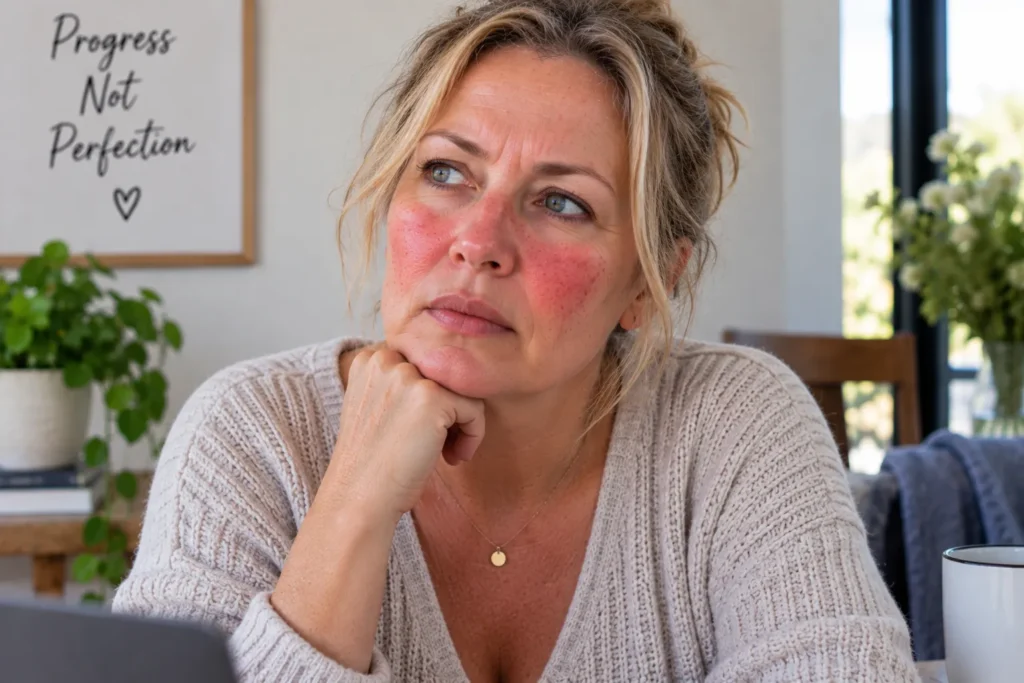
Perhaps your skin never used to be particularly sensitive.
Then somewhere in your 40s or 50s, things began to change. Your cheeks started looking red more often, your face felt drier after washing, products you had used for years suddenly seemed uncomfortable, and occasionally your entire face became unexpectedly hot.
For women approaching or going through menopause, another question naturally appears: Is this facial redness part of menopause, is my skin simply getting older, or could something else be happening?
There isn’t one answer that applies to everyone. Ageing skin, hormonal changes, menopausal hot flushes, dryness, irritation, sun exposure and conditions such as rosacea can overlap, sometimes producing very similar-looking symptoms.
Understanding those differences is far more useful than simply buying another product labelled “anti-redness.”
Why Can Skin Feel So Different After 40?
Skin doesn’t suddenly become “old” on your 40th birthday. Changes happen gradually.
As we age, the structure and function of skin change. Sebum production, epidermal lipids, hydration, collagen and other components involved in keeping skin comfortable and resilient can change over time.
For some people, the most obvious consequence isn’t initially a wrinkle. It’s dryness.
Skin that once tolerated long hot showers, foaming cleansers, exfoliation and several active products may become less forgiving. That can create a frustrating experience: “I’ve used this skincare for years. Why is it suddenly irritating me?”
Sometimes the product hasn’t changed. Your skin has.
Menopause Adds Another Layer
For women, the menopausal transition can make this story considerably more complicated. Oestrogen influences many aspects of skin biology. As oestrogen levels decline around menopause, changes can occur in collagen, skin thickness, hydration and other properties of the skin.
Dryness may become more noticeable. Skin can feel thinner or less supple. Some women also report increased sensitivity, itching or changes in how their skin responds to products.
At the same time, vasomotor symptoms—commonly called hot flushes or hot flashes—can cause sudden warmth and visible flushing across the face, neck and upper chest.
So a woman may simultaneously have drier skin and episodes of facial flushing. Those are related to the same stage of life, but they aren’t necessarily the same biological problem.
Menopausal Flushing and Facial Redness Aren’t Exactly the Same Thing
A menopausal hot flush typically involves a sudden sensation of heat, often affecting the face, neck and upper body. The skin may visibly redden and sweating can occur. The episode eventually subsides.
Persistent facial redness is different. If your cheeks remain red between hot flushes, or if you experience visible facial blood vessels, recurring bumps, pustules, burning or eye irritation, menopause alone may not explain everything.
Rosacea frequently affects adults in this age range, and menopausal flushing can coexist with it. That is why simply saying “it’s hormones” can sometimes be too simplistic.
Could It Be Rosacea?
Possibly—but redness alone cannot diagnose rosacea. Rosacea is a chronic inflammatory skin condition that commonly affects the central face. Depending on the individual, it can involve persistent redness, repeated flushing, visible small blood vessels, bumps or pustules, burning, stinging and sometimes eye symptoms.
Some people first become aware of these changes during midlife. That doesn’t mean menopause necessarily caused their rosacea. It means several things capable of producing facial redness can become noticeable during the same period of life.
If you’re unsure whether your symptoms fit rosacea, read our guide Rosacea, Sensitive Skin or a Damaged Skin Barrier?.
Could Dry Skin Make Redness Look Worse?
Yes, particularly when dryness is accompanied by irritation. Dry skin can become rough, flaky and uncomfortable. When the protective outer layer isn’t functioning optimally, water loss can increase and skin may become more susceptible to irritation.
That irritation can make redness more noticeable. This doesn’t mean every red face has a “damaged skin barrier.”
But if your face is red + dry + tight + flaky + stinging, looking at the condition of the skin barrier makes considerably more sense than focusing on redness alone.
We’ve explored those signs in detail in Can a Damaged Skin Barrier Cause Facial Redness?.
Why Does My Moisturiser Suddenly Sting?
This is one of the most revealing complaints in mature sensitive skin. A moisturiser you’ve happily used for years suddenly tingles. Your serum burns around your nose. Foundation makes your cheeks uncomfortable. Even water seems to sting on a particularly bad day.
When several previously tolerated products become uncomfortable at once, don’t automatically assume you have developed allergies to everything in the bathroom. Sometimes the condition of the skin itself has changed.
Dry, irritated or barrier-disrupted skin may be less tolerant of products that would otherwise cause little difficulty.
If this sounds familiar, our article Why Does Everything I Put on My Face Burn? explores this problem in much greater depth.
The Mature-Skin Mistake Nobody Talks About Enough
There is an understandable temptation when ageing becomes visible: Do more.
A stronger retinoid. More exfoliation. A concentrated acid. Another vitamin C serum. A resurfacing treatment. A peel. Then another product to repair the irritation created by all the other products.
Many of these ingredients and treatments can be useful when appropriately selected and tolerated. The problem isn’t that mature skin should never use active skincare.
The problem is assuming that more aggressive skincare automatically means better mature skincare. If your face is already dry, red, burning or highly reactive, repeatedly pushing it harder may be the opposite of what it needs.
Sometimes mature skin doesn’t need another battle. It needs support.
Why Facial Redness May Seem More Obvious as Skin Ages
Several factors can contribute. The accumulated effects of sun exposure become increasingly visible with age. Changes in skin structure can alter texture and appearance, while dryness may make irritation more noticeable.
Blood vessels and uneven pigmentation can also become more apparent. Then add heat, stress, exercise, alcohol, spicy foods, menopause, harsh skincare and environmental exposure.
The result can be a face that appears much less predictable than it did twenty years ago.
If your redness comes and goes, our guide to 15 common facial-redness triggers may help you identify patterns.
Sun Exposure Becomes Even More Important
Decades of Australian sun exposure matter. Ultraviolet radiation contributes to premature skin ageing and can aggravate rosacea-prone skin. Sun exposure is also one of the most frequently reported triggers among people with rosacea.
For mature skin, daily sun protection therefore isn’t merely about preventing wrinkles. It is part of protecting skin whose resilience may already be changing.
Use broad-spectrum sunscreen with at least SPF 30; in Australia, SPF 50 or 50+ is widely available and often a practical choice. Combine sunscreen with shade, hats and sensible sun avoidance when UV levels are high.
If your skin is highly sensitive, look for a sunscreen formulation you can tolerate rather than abandoning sunscreen altogether.
What About Facial Redness in Men After 40 and 50?
This isn’t exclusively a women’s issue. Men also experience age-related changes in skin hydration, structure and barrier function, and rosacea affects men as well as women.
Men may additionally irritate facial skin through shaving. A close shave, fragranced aftershave, harsh cleanser and hot shower can create a repeated cycle of dryness and irritation, particularly as skin becomes less tolerant.
Some men simply accept a permanently red or rough-looking face as part of ageing. It shouldn’t automatically be dismissed that way.
Persistent or changing facial redness deserves the same attention in men as it does in women.
A Simpler Approach to Mature, Reactive Skin
If your face has become increasingly dry and sensitive, simplifying your routine can be informative. Start with the essentials: Gentle cleansing. Appropriate moisturisation. Sun protection.
Then look critically at everything else. Does that exfoliating product leave your face tight? Does your serum consistently sting? Does the redness worsen on the evenings you combine several active ingredients? Do very hot showers leave your cheeks red for an hour?
Your skincare routine should be helping your skin—not becoming another trigger your skin has to recover from.
Moisturisation Becomes More Important, Not Less
One misconception about mature skincare is that moisturiser is somehow too basic. It isn’t.
Moisturisers can use different combinations of humectants, emollients and occlusive ingredients to increase hydration, improve skin feel and reduce water loss. For dry mature skin, this foundational role can become increasingly important.
A moisturiser isn’t going to reverse menopause. It isn’t going to eliminate vascular flushing. And it isn’t a medical treatment for rosacea.
But where dryness and barrier stress are contributing to tightness, roughness and sensitivity, appropriate moisturisation can be an important part of supportive care.
Beyond Basic Moisturising
This is where our philosophy at Reno Cream differs slightly from the idea of simply putting something oily on dry skin. Mature skin can have several needs at once.
It may need water. It may need ingredients that help retain that water. It may need conditioning and emollient support. And it may benefit from reducing repeated environmental and skincare stress.
That thinking led us to the Skin Trifecta Method™: Repair • Nourish • Defend. It isn’t a claim that one cream can fix every reason a face becomes red. It’s a framework for caring for skin whose needs have become more complex.
Repair
“Repair” begins by recognising when skin is struggling. If your face is constantly tight, flaky and uncomfortable, continuing to strip it with harsh cleansers and aggressive treatments makes little sense.
Support the skin’s moisture barrier. Reduce unnecessary irritation. Give the skin an opportunity to function more normally rather than repeatedly asking it to recover from the next intervention.
Repair doesn’t mean claiming to cure rosacea or another medical condition. It means caring for the condition of the skin itself.
Nourish
Mature skin doesn’t need a hundred ingredients. It needs a well-considered formulation.
Humectants such as glycerin and hyaluronic acid can help attract and retain water within the outer layers of skin. Skin-conditioning ingredients can complement that hydration.
This is also where our botanical philosophy becomes relevant. Rather than building Reno Cream around a single fashionable “hero ingredient,” we use a combination that includes ingredients such as allantoin, Black Seed Oil, Centella asiatica, licorice, green tea and antioxidant vitamins, alongside the moisturising system.
The purpose isn’t to claim that one botanical cures facial redness. It’s to formulate for the broader needs of dry, stressed and mature skin.
Defend
For mature skin, defence matters enormously. That means sensible sun protection. It means reducing repeated exposure to skincare that clearly irritates your face.
It means understanding personal triggers rather than following a generic list of everything somebody on the internet says you should avoid. And it means recognising that the skin you have at 55 may not tolerate exactly the same routine you had at 35.
Your skincare should evolve as your skin evolves.
Where Reno Cream Fits
Reno Cream was developed specifically around the idea that some adult and mature skin eventually needs more than basic moisturisation.
Its role in facial-redness care is important to define correctly. Reno Cream does not treat or cure rosacea, menopause or every medical cause of facial redness.
Where it becomes relevant is when redness exists alongside dryness, tightness, roughness, sensitivity or compromised-feeling skin.
The formulation combines glycerin and hyaluronic acid for hydration with allantoin, MSM, Black Seed Oil, antioxidant vitamins and a botanical complex selected as part of the wider formulation.
For adult and mature skin that has become drier and more reactive, Reno Cream can therefore be used as a supportive moisturising and skin-conditioning step. If your skin is extremely reactive, patch test first.
Why We Don’t Call Reno Cream an “Anti-Redness Cure”
Because redness has too many causes. A cream cannot reasonably claim to fix a menopausal hot flush. It cannot diagnose rosacea. It cannot correct every medication reaction or medical condition that produces facial flushing. And it shouldn’t pretend to.
The stronger proposition is also the more credible one: Support the dry, sensitive and stressed skin that may exist underneath the visible redness.
That is where skincare can genuinely play a useful role.
What About Licorice, Centella and Green Tea?
These botanicals are particularly interesting in the context of sensitive-looking skin because they have been investigated in dermatological and cosmetic research for various skin-conditioning, antioxidant and soothing properties.
However, research on an individual ingredient isn’t proof that a finished cosmetic product will treat rosacea. Formulation, concentration, delivery, interactions with other ingredients and individual tolerance all matter.
That distinction is important to us. We want Reno Cream’s ingredient philosophy to be informed by research without turning every promising laboratory finding into a miracle claim.
And remember: botanical doesn’t automatically mean irritation-free. Very reactive skin should always introduce new products carefully.
Menopause May Change More Than Your Face
Some women notice dryness beyond the cheeks. The neck and upper chest can become drier and more crepey, while the hands, arms and legs may also feel different.
This broader pattern is another clue that the issue isn’t simply “red cheeks.” Skin ageing and hormonal change affect the body more widely.
That is why mature skincare should not become obsessed with chasing one visible symptom. Look at what the skin is telling you as a whole.
Could Your Hot Flush Be Making Your Skin Feel Worse?
Possibly. Repeated episodes of warmth and sweating can be uncomfortable, especially when skin is already dry or sensitive.
Some people may then cleanse more frequently to feel fresh, inadvertently making dry skin feel even tighter. The answer isn’t to avoid cleansing altogether. It is to cleanse appropriately.
Use comfortably lukewarm rather than very hot water, avoid unnecessary scrubbing and choose products that don’t repeatedly leave your face feeling stripped. After cleansing, moisturise while the skin is comfortable rather than waiting until it feels extremely dry.
Don’t Diagnose Yourself From a Mirror
Midlife facial redness is particularly easy to misinterpret. A woman experiences hot flushes and assumes every patch of redness is menopause. Someone sees a visible vessel and decides they have rosacea. Another person watches a social-media video and concludes that their “barrier is destroyed.”
All three might be wrong. Appearance provides clues, but diagnosis requires context.
If the redness is persistent or troublesome, a GP or dermatologist can distinguish between possibilities much more reliably than a photograph and an internet checklist.
When Should You See a Doctor or Dermatologist?
Seek professional assessment when facial redness becomes persistent, significantly worsens or is accompanied by symptoms you cannot explain.
That is particularly important if you develop recurrent bumps or pustules, prominent facial blood vessels, significant pain, swelling, persistent scaling or substantial burning.
Pay attention to your eyes as well. Eye redness, grittiness, burning, swollen eyelids or other persistent eye symptoms can occur with ocular rosacea and deserve assessment.
Sudden facial swelling—especially swelling of the lips or tongue—together with breathing difficulty, throat tightness, faintness or other signs of a severe allergic reaction requires urgent medical attention.
A Better Question After 40 and 50
Instead of asking: “Why has my skin suddenly become terrible?” Try asking: “What has changed, and what does my skin need now?”
Has dryness increased? Have hot flushes begun? Are you using more active skincare than you did previously? Does your face react to heat or sun? Does it stay red between flushing episodes?
Has a familiar moisturiser suddenly begun to sting? Are there visible vessels or bumps that weren’t there before?
Those questions help separate ageing, menopause, irritation, barrier problems and possible skin conditions far better than the word “redness” alone.
Mature Skin Doesn’t Necessarily Need More Skincare
Sometimes it needs better-targeted skincare. This is an important distinction.
The beauty industry frequently encourages women to add another serum whenever something changes. Dryness? Add a serum. Redness? Add another serum. Wrinkles? Add an acid. Pigmentation? Add another active.
Suddenly a simple routine has become ten products competing for space on one increasingly reactive face.
There is nothing inherently wrong with sophisticated skincare. But sophistication should be measured by how intelligently a routine meets the skin’s needs—not by how many bottles sit beside the bathroom mirror.
Repair • Nourish • Defend as Skin Changes
Ageing is unavoidable. Neglect isn’t.
You cannot stop every hormonal change, prevent every hot flush or make 55-year-old skin biologically identical to 25-year-old skin. But you can change how you care for it.
Repair what you can by supporting dry and stressed skin. Nourish it with appropriate hydration and thoughtfully selected skin-conditioning ingredients. Defend it against excessive sun exposure, unnecessary irritation and the personal triggers you’ve learned make your skin uncomfortable.
That is the philosophy behind The Skin Trifecta Method™ and the way we think about Reno Cream.
Your Skin Hasn’t Failed You
Skin changes throughout life. The routine that worked beautifully at 30 may not be the routine your face needs at 50.
For women, menopause can add another layer of dryness, warmth and unpredictability. For men and women alike, accumulated environmental exposure and age-related skin changes can make sensitivity and dryness more noticeable.
The answer isn’t necessarily to attack every sign of ageing with increasingly aggressive products. Sometimes the smarter response is to understand what changed. Then support the skin you have now.
If facial redness is part of that change, begin with our cornerstone guide Why Is My Face Red?, explore the 15 common triggers that can make your face turn red, and learn why skin-barrier condition can matter when redness occurs with dryness and sensitivity.
Because after 40 and 50, good skincare isn’t about trying to force your skin backwards in time. It’s about understanding how its needs are changing—and caring for it accordingly.
References and Further Reading
American Academy of Dermatology Association (AAD). Dermatological guidance on rosacea diagnosis, treatment, flare prevention and skincare for rosacea-prone skin.
DermNet New Zealand. Rosacea. Clinical overview of rosacea presentation, triggers, differential diagnosis and management.
National Rosacea Society. Patient education and trigger research concerning flushing, sun exposure, heat, skincare and other commonly reported rosacea triggers.
Australasian Menopause Society. Clinical and patient information concerning menopause and vasomotor symptoms including hot flushes.
Peer-reviewed dermatological literature on menopause and skin ageing. Research describing the relationship between oestrogen decline and changes in collagen, skin thickness, hydration, elasticity and other characteristics of ageing skin.
Medical assessment should be sought for persistent or unexplained facial redness rather than relying on skincare information to diagnose a medical condition.