
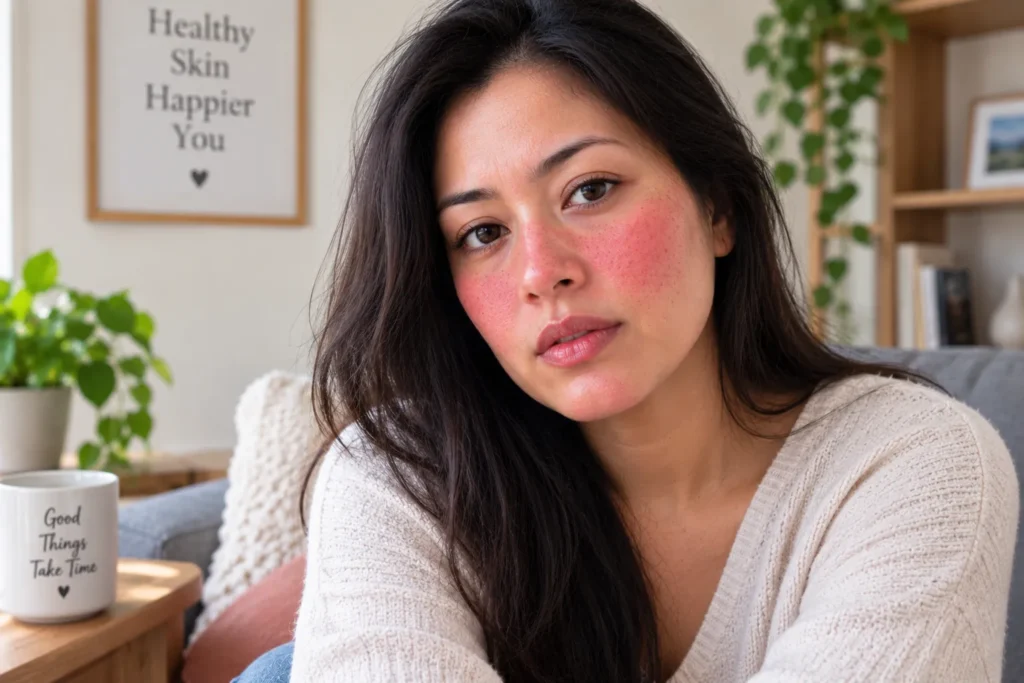
One moment your face looks completely normal. Twenty minutes later your cheeks are bright red and feel unusually warm.
Perhaps it happens after a hot shower. Maybe exercise does it, or walking into a heated room, drinking wine, eating something spicy or simply becoming embarrassed. For other people, facial redness seems almost permanent, with certain situations making it dramatically more noticeable.
So why does your face keep turning red?
The answer isn’t always one particular skin condition. Facial redness and flushing can have many triggers, and understanding your personal pattern can be one of the most useful steps towards managing it.
Why Does the Face Turn Red?
Your face contains an extensive network of small blood vessels close to the skin surface. When these vessels dilate and blood flow increases, the change can become visible as flushing or redness.
That is why perfectly healthy skin can temporarily turn red during exercise or when you become very hot. But some people flush much more easily than others.
Skin sensitivity, rosacea, environmental exposure, hormonal changes, certain medicines and other factors can influence facial redness. Dryness and irritation can also make skin look red, although that is not necessarily the same process as vascular flushing.
This distinction is important. A face that becomes red for ten minutes after strenuous exercise isn’t necessarily experiencing the same problem as cheeks that remain persistently red, dry and painful throughout the day.
Facial Redness Isn’t One Thing
People often use redness, flushing and irritation interchangeably, but they aren’t exactly the same.
Flushing generally describes a temporary increase in facial redness associated with increased blood flow. Persistent redness remains visible for much longer and can occur with conditions such as rosacea. Irritation-related redness may accompany dryness, burning, itching, scaling or reactions to skincare.
And sometimes more than one process is happening at the same time. That is why identifying the circumstances surrounding your redness can be more useful than simply staring at the colour in the mirror.
Here are 15 common possibilities.
1. Heat and Hot Weather
Heat is one of the best-known facial flushing triggers. When your body needs to release heat, blood vessels near the skin surface can dilate. For someone already prone to flushing, that normal physiological response may become particularly visible across the cheeks, nose, forehead or chin.
The National Rosacea Society’s survey of 1,066 people with rosacea found hot weather was reported as a trigger by 75% of respondents. That doesn’t mean everyone whose face becomes red in hot weather has rosacea.
It does show how strongly temperature can influence redness in susceptible people. If heat consistently triggers your face, practical measures such as seeking shade, avoiding unnecessary overheating and cooling down gradually may help.
2. Hot Showers and Baths
Does your face look dramatically redder immediately after showering? Water itself may not be the problem. Temperature can be.
Very hot showers expose the face to heat while warm, humid conditions can promote vasodilation. Hot water may also make already-dry or sensitive skin feel more uncomfortable.
The National Rosacea Society survey found hot baths triggered symptoms in 51% of respondents. Try reducing the water temperature to comfortably lukewarm and see whether your skin behaves differently.
For someone with dry or reactive skin, this simple change may also make washing more comfortable.
3. Exercise
A red face during exercise can be completely normal. Your body produces heat during physical activity and increases blood flow to the skin to help regulate temperature. Some people simply show that response more visibly than others.
However, exercise is also a commonly reported trigger among people with rosacea. In the National Rosacea Society survey, heavy exercise was reported by 56% of respondents.
That doesn’t mean you should stop exercising. Instead, if exercise consistently provokes uncomfortable flushing, strategies such as exercising in cooler conditions, taking sensible breaks, staying appropriately hydrated and avoiding unnecessary overheating may be worth considering.
Physical activity has enormous health benefits. The objective is to manage the trigger—not eliminate healthy movement from your life.
4. Sun Exposure
If there is one trigger people prone to facial redness shouldn’t underestimate, it is the sun. In the National Rosacea Society survey, sun exposure was the most commonly reported trigger, affecting 81% of respondents.
Ultraviolet radiation can also damage skin independently of rosacea. This makes sun protection particularly important for people who experience frequent facial redness. Dermatologists commonly recommend broad-spectrum SPF 30 or higher for rosacea-prone skin, alongside shade and protective clothing.
The challenge is that very sensitive skin may find some sunscreen formulations uncomfortable. Don’t use that as a reason to abandon sun protection. Instead, find a formulation your skin tolerates, and seek advice from a pharmacist or dermatologist if necessary.
5. Cold Weather and Wind
Facial redness isn’t only a summer problem. Cold weather was reported as a trigger by 46% of respondents in the National Rosacea Society survey, while wind affected 57%.
Wind can be particularly challenging for dry skin because it can increase the sensation of tightness and discomfort. Moving repeatedly between cold outdoor conditions and heated indoor environments may create another temperature challenge.
For mature or naturally dry skin, winter can therefore produce a combination of problems: cold + wind + low humidity + indoor heating + dryness. That combination can leave skin looking and feeling considerably more reactive.
6. Stress and Strong Emotions
Have you ever felt your face become hot during an uncomfortable conversation? Emotional flushing is very real.
Embarrassment, anxiety, anger, excitement and stress can influence the nervous system and blood vessels, causing visible changes in facial colour. Among people surveyed by the National Rosacea Society, emotional stress was one of the most frequently reported triggers, at 79%.
This can create an unpleasant feedback loop. You realise your face is becoming red. You become self-conscious about the redness. That anxiety makes you feel hotter. Your face becomes redder.
Understanding that this is a physiological response can at least remove some of the mystery from what is happening.
7. Alcohol
For some people, alcohol produces noticeable facial flushing. Alcohol can promote vasodilation, although the degree of flushing varies considerably between individuals and can also be influenced by alcohol metabolism and genetics.
Among respondents with rosacea in the National Rosacea Society trigger survey, alcohol was reported as a trigger by 52%.
Importantly, alcohol doesn’t cause every case of rosacea, and someone who flushes after drinking doesn’t automatically have the condition. But if your cheeks reliably turn red after particular alcoholic drinks, the association may be worth recording.
Sometimes your own repeated observations provide the clearest clue.
8. Spicy Foods
Hot curry. Chilli. Spicy noodles. For some people, the effect appears on the face before the meal is finished.
Spicy foods can activate sensory pathways and influence vascular responses, contributing to sweating, warmth and flushing in susceptible people. In the National Rosacea Society survey, 45% reported spicy foods as a trigger.
Again, individual responses matter. There is little value in removing ten foods from your diet because they appeared on somebody else’s rosacea list if none of them affects you.
Look for your pattern, not someone else’s.
9. Hot Drinks
Sometimes it may be the temperature of the drink rather than the drink itself that matters. Coffee, tea and other beverages consumed very hot can contribute to facial warmth and flushing in susceptible individuals.
Heated beverages were reported as triggers by 36% of respondents in the National Rosacea Society survey. This distinction can be useful.
If coffee seems to make your face red, try allowing it to cool somewhat and observe whether the reaction changes. You may discover that the issue isn’t necessarily “coffee.” It may be very hot coffee.
10. Skincare Products
This is where facial flushing and skin irritation begin to overlap. Certain skincare products were reported as aggravating factors by 41% of respondents in National Rosacea Society research.
Products containing fragrance, alcohol, menthol and other potentially irritating ingredients can be troublesome for some rosacea-prone or sensitive skin. Dermatologists also commonly advise caution with aggressive exfoliation and products that repeatedly sting or burn.
But even ingredients considered beneficial can cause individual reactions. This is why the question shouldn’t simply be: “Is this a good ingredient?” It should also be: “Does my skin tolerate this formulation?”
If almost every product suddenly seems to burn, read our guide Why Does Everything I Put on My Face Burn?.
11. Over-Exfoliation and Too Many Active Ingredients
Sometimes the trigger isn’t one ingredient. It is the entire routine.
Retinoids, alpha-hydroxy acids, beta-hydroxy acids, strong vitamin C formulations, benzoyl peroxide and other active products can have legitimate uses. Problems can arise when several are layered together, introduced too quickly or used more frequently than the skin can tolerate.
The result may be dryness, tightness, burning and visible irritation. Then another product gets added to “repair the barrier.”
Before buying more skincare, look at what you are already doing. If your skin has become red and reactive since your routine became more complicated, simplifying it may reveal more than adding product number twelve.
12. A Struggling Skin Barrier
A compromised skin barrier doesn’t explain every red face. But when facial redness occurs together with dryness, tightness, flaking, stinging and sudden sensitivity, barrier condition deserves consideration.
Barrier disruption can increase transepidermal water loss and make the skin more vulnerable to irritation. This is particularly relevant when your skin no longer tolerates products that previously caused no difficulty.
Our guide Can a Damaged Skin Barrier Cause Facial Redness? 10 Signs Your Skin Barrier Is Struggling explains the connection in greater depth.
The important point is not to label every irritated face a “damaged barrier.” It is to recognise when barrier support may be one part of the solution.
13. Ageing and Menopause
Facial redness can become confusing during midlife because several things may happen simultaneously. Skin commonly becomes drier with age, and hormonal changes around menopause can influence skin structure, hydration and comfort. At the same time, menopausal hot flushes can cause sudden warmth and visible facial flushing.
A hot flush isn’t automatically rosacea. And rosacea isn’t automatically menopause. But a person can experience both.
That overlap can make the face seem much more unpredictable than it once was: dry at breakfast, flushed in the afternoon and sensitive to skincare by evening. We will explore this specifically in Article 6 of this series because it deserves much more than a passing mention.
14. Medicines and Medical Conditions
Not every facial flush originates in the skincare routine. Certain medicines can contribute to flushing, and various medical conditions can produce facial redness or episodes of warmth.
This is one reason sudden, unexplained or persistent facial redness shouldn’t automatically be treated with another cosmetic. If the problem began around the time you started a medication, don’t stop prescribed medicine on your own. Speak with your doctor or pharmacist.
And if flushing is accompanied by other unexplained symptoms, medical assessment is more appropriate than internet self-diagnosis.
15. Rosacea and Other Skin Conditions
Sometimes the “trigger” isn’t the whole story. Rosacea commonly produces persistent central facial redness and recurrent flushing, and may also involve visible blood vessels, bumps, pustules, burning, stinging or eye symptoms.
Eczema, seborrhoeic dermatitis and contact dermatitis can also make parts of the face red and uncomfortable. That is why identifying triggers is useful but shouldn’t replace diagnosis.
If you continually avoid more and more triggers yet your face remains red, the next step may not be avoiding another food. It may be seeing a dermatologist.
Our guide Rosacea, Sensitive Skin or a Damaged Skin Barrier? can help you understand some of these overlapping patterns.
Why Does My Face Get Red So Easily When Other People’s Doesn’t?
This is one of the most understandable questions. Two people can sit in the same hot room, eat the same spicy meal and perform the same exercise, yet one becomes noticeably red while the other barely changes colour.
Individual vascular responsiveness differs. Skin tone affects how easily redness can be seen. Genetics, underlying skin conditions, environmental exposure, medications, hormones and skin sensitivity can all influence the response.
Even within rosacea, triggers aren’t universal. That is precisely why giant lists of things everybody “must avoid” aren’t particularly helpful.
Your skin has its own history.
Start a Facial-Redness Trigger Diary
If your redness comes and goes, a simple diary can be surprisingly useful. Record when the redness appeared, what you were doing beforehand and approximately how long it lasted.
- weather and temperature
- sun exposure
- exercise
- shower temperature
- food and drinks
- alcohol
- emotional stress
- new skincare
- active skincare products
- medication changes
- menstrual or menopausal symptoms
- how dry or irritated your skin felt that day
Don’t become obsessive about recording every tiny variation in your face. The purpose is to identify repeatable patterns.
If three glasses of red wine on three different occasions are followed by the same flushing pattern, that observation may be meaningful. If strawberries appeared once on a day when your face happened to be red, that is much weaker evidence.
Trigger Avoidance Isn’t the Whole Answer
There is another danger in facial-redness research. People can become so focused on avoiding triggers that ordinary life starts shrinking.
No exercise. No warm food. No coffee. No sunlight. No social drinks. No spicy meals. No skincare. No going outside when it is hot.
That isn’t a sensible objective. When a trigger is clear and avoidable, modifying it can be useful. But some triggers—weather, exercise, emotions and temperature changes—are part of ordinary life.
The goal is to understand your skin well enough to make proportionate decisions. And where an underlying condition is driving the sensitivity, treating or managing that condition appropriately may matter more than trying to control every environmental variable.
What About Moisturiser?
Moisturiser can’t prevent every vascular flush. If emotional stress makes your face red, applying more moisturiser isn’t going to eliminate human emotion.
Where moisturisation becomes important is when dryness, barrier dysfunction and irritation are contributing to the overall picture. Dry skin can feel tight and uncomfortable. A compromised barrier can increase water loss and sensitivity. Maintaining hydration with a well-tolerated moisturiser can therefore be an important part of supportive skincare.
This is especially relevant when the face is not only red but also dry, rough, tight or reactive. That distinction matters when considering where Reno Cream fits.
Where Reno Cream Fits Into Facial-Redness Care
Reno Cream is not a rosacea medicine, and we don’t position it as a treatment for every cause of facial redness.
Its role is more specific. Reno Cream was developed for adult and mature skin that has become dry, depleted, sensitive-feeling or no longer seems satisfied with basic moisturisation.
The formulation combines humectants including glycerin and hyaluronic acid with allantoin, Black Seed Oil, MSM, antioxidant vitamins and a selected botanical complex.
Our ingredient philosophy isn’t built around finding one trendy ingredient and declaring it the answer to redness. Instead, we consider hydration, skin conditioning and the finished formulation as a whole.
For someone whose facial redness occurs alongside dry, tight or compromised-feeling skin, that makes Reno Cream relevant as a supportive moisturising step rather than a medical treatment for the redness itself.
Natural Doesn’t Automatically Mean Non-Irritating
This point is particularly important in an article about reactive skin. Reno Cream incorporates a range of botanical ingredients, including Centella asiatica, licorice and green tea, alongside its other components.
We value botanical ingredients. But we don’t believe the word natural should be used as shorthand for “cannot irritate.”
Any cosmetic ingredient or finished formulation can potentially disagree with an individual person’s skin. If your face is extremely reactive, patch testing a new product is sensible. If a product repeatedly produces significant burning, itching, swelling or worsening redness, stop using it.
Credible skincare begins by respecting what the skin tells you.
Repair • Nourish • Defend
The trigger discussion fits naturally into our broader Skin Trifecta Method™.
Repair
If dryness and irritation are part of the problem, support the skin rather than continually stressing it with more aggressive interventions. That includes appropriate moisturisation and simplifying practices that repeatedly leave the skin tight or uncomfortable.
Nourish
Provide hydration and skin-conditioning support through a thoughtfully constructed formulation rather than relying on one miracle ingredient. The objective isn’t to overwhelm reactive skin with complexity. It is to give dry skin what it needs without unnecessarily fighting it.
Defend
This is where understanding triggers becomes particularly powerful. Defend means protecting skin from excessive UV exposure and harsh environmental stress while learning which personal triggers repeatedly provoke discomfort or redness.
It doesn’t mean hiding indoors. It means knowing your skin. You can read more about this approach in our free guide, The Skin Trifecta Method™.
What Should You Do When Your Face Suddenly Turns Red?
First, consider what just happened. Did you exercise? Walk into a hot environment? Take a hot shower? Eat spicy food? Drink alcohol? Apply a new skincare product?
If there is an obvious harmless trigger and the redness settles normally, you may simply have identified something your face responds to. If a skincare product causes significant burning, remove it gently and stop using it.
If overheating is the problem, move somewhere cooler and allow your body temperature to settle naturally. But unexplained redness needs a different approach.
Repeated episodes without an obvious trigger, persistent redness or additional symptoms deserve more attention.
When Facial Redness Needs Medical Assessment
Make an appointment with a GP or dermatologist if facial redness is persistent, worsening or repeatedly returning without a clear explanation.
Professional assessment is particularly worthwhile when redness occurs with visible facial blood vessels, recurrent bumps or pustules, significant scaling, persistent burning, pain or swelling.
Eye symptoms are also important. Rosacea can affect the eyes, so persistent eye redness, burning, grittiness, swollen eyelids or visual symptoms shouldn’t simply be dismissed as part of having a red face.
Sudden facial swelling, swelling of the lips or tongue, difficulty breathing, throat tightness, dizziness or other signs of a severe allergic reaction require urgent medical attention. No skincare article should encourage you to moisturise your way through a medical emergency.
Your Red Face May Be Giving You Clues
The most useful thing about a trigger isn’t simply knowing its name. It is understanding the pattern.
Perhaps your cheeks are mainly red after hot showers. Perhaps exercise and summer weather are your biggest triggers. Perhaps the redness began only after you introduced several strong skincare products.
Or perhaps your face has gradually become dry, persistently red and increasingly reactive as you have grown older. Those are different stories. And different stories may need different solutions.
At Reno Cream, this is why we prefer Repair • Nourish • Defend to simply chasing whatever symptom happens to be visible that morning.
Understand what is stressing the skin. Support what the skin needs. Then help protect it from the things that repeatedly make it worse.
Because the question “Why does my face keep turning red?” becomes much easier to answer once you stop looking only at the redness—and start looking at when, where and why it appears.
For the bigger picture, read Why Is My Face Red? The Complete Guide to Facial Redness, Red Cheeks, Flushing, Burning and Sensitive Skin, explore our guide to damaged skin barrier and facial redness, or learn more about Reno Cream for adult and mature skin requiring more than basic moisturisation.
References and Further Reading
American Academy of Dermatology Association. Rosacea: How to Prevent Flare-Ups and dermatological guidance on rosacea skincare and sun protection.
National Rosacea Society. Rosacea Triggers Survey. Survey of 1,066 rosacea patients examining commonly reported lifestyle and environmental triggers.
National Rosacea Society. Patient guidance concerning identification and avoidance of individual rosacea triggers.
DermNet New Zealand. Rosacea. Clinical information concerning presentation, triggers and management.
Dermatological literature concerning facial flushing, vascular responses, epidermal barrier function and sensitive skin should be interpreted alongside individual medical assessment where persistent or unexplained facial redness is present.