
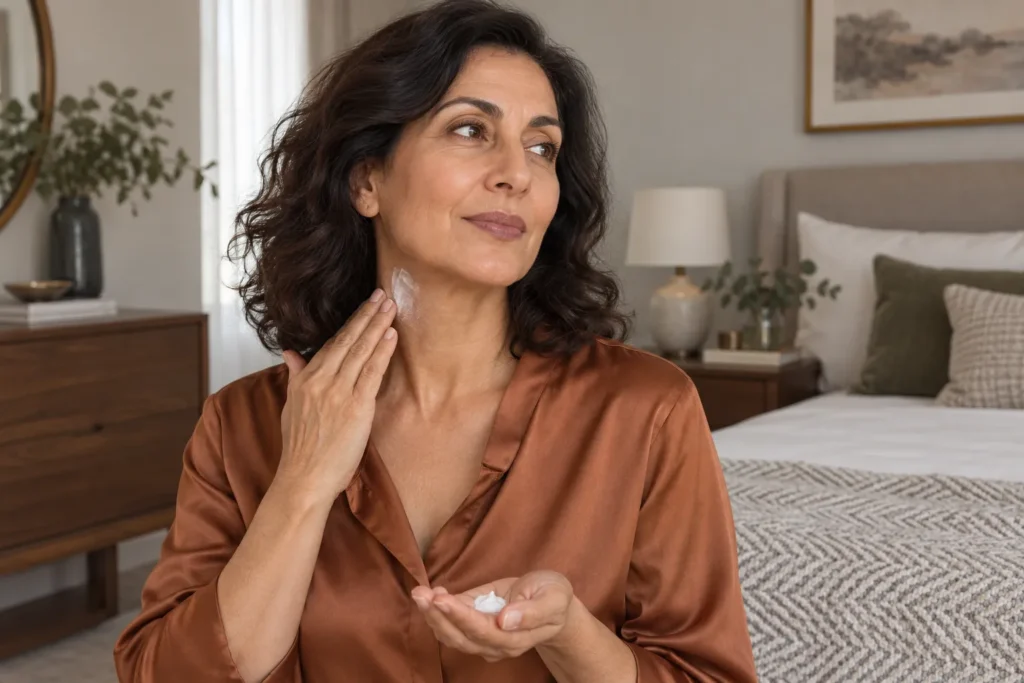
Your skincare routine at 60 does not have to look like your routine at 30. Skin changes over time, and products that once felt rich may suddenly disappear into the skin without providing lasting comfort. Dryness can become more noticeable, the surface may look thinner or more crepey, and uneven tone, dullness and sensitivity can become harder to ignore. The answer, however, is not necessarily to keep adding more products.
For many women over 60, a better approach is actually quite simple. Cleanse gently, moisturise consistently, protect your skin from the sun and be selective about anything else you add. Your routine should work with mature skin rather than continually challenging it. The goal is comfortable, well cared for skin, not an impossible attempt to make 60 year old skin behave like 30 year old skin.
What Happens to Women’s Skin After 60?
Ageing affects several characteristics of the skin at the same time. Changes in collagen, elastin, natural oils, hydration and the outer skin barrier can influence how the skin looks and feels. Decades of ultraviolet exposure may also become increasingly visible through changes in pigmentation, texture and elasticity. For many women, the effects associated with menopause add another dimension.
This helps explain why mature skin concerns rarely arrive one at a time. You may have dryness alongside crepey texture, dullness alongside uneven looking tone, or sensitivity alongside a feeling that your moisturiser no longer lasts long enough. We explored this broader picture in Skin After 60: Why Moisturiser Alone May No Longer Feel Like Enough. Once several needs overlap, your routine needs to consider the skin as a whole.
You Do Not Need a Ten Step Skincare Routine
There is no rule saying mature skin requires a bathroom shelf full of products. In fact, continually layering cleansers, toners, exfoliants, acids, serums, oils and creams can make it difficult to know what your skin actually likes. If irritation develops, identifying the responsible product becomes even harder. Complexity is not the same thing as sophistication.
A good routine should have a reason behind every step. Start with the essentials and add something only when you know what job you want it to perform. This approach can be particularly helpful if your skin has become sensitive or reactive. Sometimes the most mature thing about mature skincare is knowing when enough is enough.
Step 1: Start With Gentle Cleansing
Cleansing should remove what needs removing without leaving your face feeling stripped. If your skin feels extremely tight immediately after washing, consider whether your cleanser, water temperature or cleansing technique may be too aggressive. Very hot water is unnecessary, and vigorous scrubbing does not make mature skin cleaner. Comfortable cleansing is a much better starting point.
Some women with very dry skin may not feel the need for an elaborate morning cleanse. Your evening routine may require more cleansing if you have been wearing sunscreen or makeup throughout the day. The exact product is less important than finding something your skin tolerates well. After cleansing, your face should feel clean without feeling as though it urgently needs rescuing.
Step 2: Moisturise Before Your Skin Becomes Uncomfortable
Moisturising is one of the foundations of mature skincare. As skin becomes drier with age, regular moisturising can help improve softness, comfort and the appearance of dryness related roughness. Waiting until your face feels painfully tight is rarely the best strategy. Make moisturising part of your routine rather than an emergency response.
If you moisturise and your skin feels dry again very quickly, simply applying larger amounts may not solve the problem. The formulation may no longer suit the level of dryness you are experiencing. Our guide Why Does My Skin Feel Dry Again Two Hours After Moisturising? explains why this can happen. Your moisturiser is allowed to change as your skin changes.
Step 3: Think About Hydration and Conditioning
Hydration and conditioning are related, but they are not exactly the same job. Humectant ingredients can help attract and hold water within the outer skin, while oils and emollient ingredients contribute differently to softness and conditioning. Mature skin may benefit from a formulation that considers several of these needs together. This is particularly relevant when lightweight moisturisers begin feeling insufficient.
Our article Dry Skin vs Dehydrated Skin: What’s the Difference? explores this distinction in more detail. You do not need to become a cosmetic chemist to choose a moisturiser. But understanding that different ingredients perform different jobs can help you look beyond marketing slogans. A complete formulation matters more than one fashionable ingredient printed in large letters on the front.
Step 4: Protect Your Skin From the Sun Every Day
If there is one mature skincare habit worth taking seriously in Australia, it is sun protection. Ultraviolet exposure contributes to visible changes including pigmentation, wrinkles and loss of elasticity, while also increasing the risk of skin cancer. Sunscreen therefore has a completely different job from your moisturiser. One should not be expected to replace the other unless the product is specifically formulated and labelled to provide appropriate sun protection.
Use an appropriate broad spectrum sunscreen on exposed skin and follow its directions carefully. Hats, shade, clothing and sensible decisions about time outdoors can provide additional protection. Starting at 60 is not too late because future ultraviolet exposure still matters. You cannot change yesterday’s sun exposure, but you can influence tomorrow’s.
Step 5: Decide Whether You Actually Need a Serum
Serums can be useful delivery formats for particular cosmetic ingredients, but being over 60 does not automatically mean you need one. Ask what problem the serum is supposed to address and whether that job is already being performed elsewhere in your routine. If you cannot answer that question, the product may simply be adding complexity. Skincare should solve problems rather than create more steps.
If you enjoy a serum and your skin tolerates it well, there is no reason you cannot use it. Introduce new products carefully, particularly if your skin has become reactive. Adding several products at once makes it difficult to identify what helped or what caused irritation. One considered addition is usually more informative than five simultaneous experiments.
Step 6: Be Sensible With Retinoids and Other Active Products
Retinoids and other active skincare ingredients can have legitimate cosmetic uses, but stronger is not always better. Mature skin that is already dry or sensitive may become uncomfortable when too many active products are layered together. If you use them, follow appropriate directions and pay attention to your own skin’s tolerance. Persistent burning, significant redness or peeling should not be treated as proof that a product is working.
The same principle applies to exfoliating acids. More frequent exfoliation does not automatically produce younger looking skin. We explored this problem in Over Exfoliated Skin: Signs You’ve Gone Too Far and How to Simplify Your Routine. Mature skin does not need to be continually irritated in the pursuit of smoothness.
Step 7: Pay Attention to Your Skin Barrier
The skin barrier deserves particular attention when dryness and sensitivity begin appearing together. If moisturiser suddenly stings, cleansing leaves your face extremely tight or products you previously tolerated become uncomfortable, your routine deserves a closer look. Simplifying things for a while may be more useful than immediately buying another active product. Barrier supportive care is often surprisingly uncomplicated.
Our guide How Do You Know When Your Skin Barrier Is Getting Better? describes practical signs of progress. Less tightness, reduced flaking, better moisture retention and a more predictable response to everyday skincare can all be encouraging. The aim is not a scientifically perfect barrier you can somehow measure in the bathroom mirror. It is skin that increasingly feels comfortable and manageable.
Step 8: Do Not Forget Your Neck and Chest
Many women spend decades carefully moisturising their faces while giving very little attention to the neck and upper chest. Then one day these areas seem to have aged much faster. The skin may look dry, crepey, finely wrinkled or uneven in tone. Past sun exposure can also become particularly visible here.
Your neck does not necessarily require an entirely separate shelf of skincare. Gentle cleansing, appropriate moisturising and sun protection can be extended beyond the jawline. Our article Crepey Skin on the Neck After 60: What Actually Helps? explains what topical skincare can realistically improve. Moisturising can help surface dryness and texture, but it cannot permanently tighten significant loose skin.
Step 9: Give Your Hands the Same Attention
Hands can reveal decades of living remarkably clearly. Frequent washing, cleaning, weather and ultraviolet exposure all contribute to the way they look and feel. Dryness can make lines and texture particularly noticeable. Regular moisturising is therefore just as relevant to your hands as it is to your face.
We explored this in Why Your Hands Can Start Looking Older Before Your Face. Keep moisturiser somewhere convenient if frequent handwashing is part of your day. Protect your hands during cleaning and gardening when appropriate. And remember the backs of your hands when thinking about sun protection.
Step 10: Moisturise Your Arms and Legs Too
Skincare after 60 should not stop at your neck. The arms and legs can become extremely dry, and fine crepey looking texture may become increasingly noticeable. Applying moisturiser only to your face while ignoring uncomfortable body skin makes little sense. Your skin remains an organ from head to toe.
For the legs, read Crepey Skin on the Legs: Dryness, Aging and Everyday Care. The same principle applies to crepey skin on the arms. Moisturising cannot reverse every structural change of ageing, but improving dryness can make mature skin softer, smoother and more comfortable. That is a worthwhile result.
What Should a Morning Skincare Routine Over 60 Look Like?
Your morning routine can be remarkably simple. Cleanse gently if needed, apply the moisturising products that suit your skin and finish with appropriate sun protection on exposed areas. Makeup can then follow if you wear it. There is no requirement to fit six serums between cleansing and sunscreen.
If your skin is particularly dry, your moisturising step deserves more attention than chasing every new active ingredient. A product that leaves your skin comfortable through the morning may be more useful than several products that make the routine complicated. If you use additional treatments, give each one a clear purpose. Your morning routine should prepare your skin for the day, not exhaust it before breakfast.
What Should an Evening Skincare Routine Over 60 Look Like?
The evening routine begins with removing sunscreen, makeup and the day’s accumulation from the skin using a cleansing method you tolerate well. Follow with moisturising so your skin is not left feeling dry and tight. If you use a targeted active product, evening may be an appropriate time depending on the product’s directions. But your routine still does not have to become complicated.
Pay attention to what happens when you remove optional products. If your skin becomes calmer when you simplify the routine, that tells you something useful. You can gradually decide which products genuinely deserve to return. Skincare should earn its place in your routine.
What About Menopause and Postmenopausal Skin?
For many women over 60, menopause is no longer a recent event, but its relationship with skin does not suddenly become irrelevant. Changes associated with lower oestrogen can influence hydration, collagen, thickness and other characteristics of the skin. These changes occur alongside chronological ageing and cumulative environmental exposure. The result can be a different skincare experience from the one you had before menopause.
Our article The Best Skincare Routine During Menopause explores this transition more specifically. The important point is not to blame every dry patch on hormones. Rather, recognise that hormonal and chronological ageing can overlap. Your skincare routine should respond to what your skin needs now.
What About Dull Skin After 60?
Mature skin can sometimes look dull even when nothing is medically wrong. Dryness, surface texture and accumulated sun exposure can all influence how light reflects from the skin. Improving hydration and surface conditioning may therefore help the complexion look fresher. That is different from promising to transform the biological age of the skin.
In Dull Mature Skin: 8 Reasons Your Complexion Has Lost Its Glow, we look at several possible contributors. The answer is not always stronger exfoliation. Sometimes improving dryness and simplifying an overloaded routine can make a surprisingly visible difference. Healthy looking mature skin does not need to shine like polished glass.
What About Uneven Looking Skin Tone?
Decades of sun exposure can become increasingly visible through freckles, spots and areas of uneven looking pigmentation. Some changes are cosmetic, while new or changing lesions require appropriate medical assessment. This distinction becomes particularly important in Australia. Do not assume every new spot is simply another harmless sign of ageing.
Our guide Uneven Looking Skin Tone After 50: Why It Happens and How to Support Better Looking Skin discusses the cosmetic side of the issue. Sunscreen remains central because preventing additional ultraviolet exposure is different from trying to correct what has already happened. A moisturiser can improve dryness and surface appearance, but it is not a substitute for sun protection or skin checks.
Why We Think Mature Skin Needs a Different Formulation Philosophy
This is where the thinking behind Reno Cream becomes important. We did not begin by choosing one fashionable anti ageing ingredient and then constructing the entire product story around it. We started by looking at overlapping needs commonly experienced by dry, mature and problem prone skin. From there, we considered ingredients that could perform complementary jobs within one formulation.
Glycerin and hyaluronic acid contribute to the hydration side of Reno Cream, while black seed oil provides an oil based component within the formula. MSM and allantoin form part of the wider formulation alongside vitamin E, a vitamin C derivative and selected botanical extracts. We do not expect one ingredient to moisturise, condition and answer every cosmetic concern by itself. Different ingredients have different jobs.
The philosophy behind that approach is simple: skin needs first, ingredient jobs second, formulation third. It moves the conversation away from chasing whichever hero ingredient happens to be trending. The question becomes whether the complete formula makes sense for the needs you are trying to support. For mature skin with several overlapping concerns, that distinction can be particularly useful.
Where Reno Cream Fits Into a Routine for Women Over 60
Reno Cream was designed as a multifunctional cosmetic moisturising cream for dry, mature and problem prone skin. Its role is to moisturise and condition, helping the skin feel softer, smoother and more comfortable. Because dryness can affect the face, neck, hands, arms and legs, a versatile formulation can also help simplify the number of moisturising products you need. That was a deliberate part of the design philosophy.
It is equally important to explain what Reno Cream is not. It does not replace sunscreen, prescription treatments, medical assessment or professional procedures. It cannot permanently tighten significant loose skin or reverse every structural change associated with ageing. Multifunctional skincare should mean doing several appropriate cosmetic jobs well, not promising to do the impossible.
Why One Cream Can Sometimes Make More Sense Than Five
Modern skincare has become remarkably specialised. There are creams for the face, neck, chest, hands, arms, knees and practically every other body area. Sometimes specialised products are useful, but sometimes several areas are experiencing the same fundamental problem: dry skin that needs hydration and conditioning. In those circumstances, one versatile moisturising product can make everyday care much simpler.
This was the idea behind One Cream, Multiple Skin Needs: Why We Designed Reno Cream Differently. Simplicity can improve consistency because a routine is easier to follow when it does not require an instruction manual. The aim is not to claim that every skin concern is identical. It is to recognise where several concerns share overlapping needs.
The Skin Trifecta Method for Women Over 60
The Skin Trifecta Method™ gives us a straightforward framework for mature skincare: Repair, Nourish and Defend. Repair means looking at habits that may be unnecessarily stressing dry or sensitive skin and creating a gentler environment. That can mean reducing harsh cleansing, excessive exfoliation and very hot water. It does not mean claiming that a cosmetic cream can medically repair every form of skin damage.
Nourish means consistently providing hydration, oils and conditioning that help mature skin remain comfortable. This is where the ingredient philosophy behind Reno Cream fits into the routine. Different ingredients contribute different functions, while the complete formulation is what ultimately matters. Nourishing mature skin is an ongoing habit rather than something you do only when dryness becomes unbearable.
Defend means protecting the skin from avoidable stress. Appropriate sunscreen, protective clothing and shade are particularly important under Australian conditions. Defending can also mean avoiding products you already know irritate your skin and wearing gloves when cleaning or gardening. What you prevent can sometimes be just as important as what you apply afterwards.
What Is the Best Skincare Routine for a 60 Year Old Woman With Very Dry Skin?
Start gently. Use comfortable cleansing, avoid unnecessarily hot water and moisturise consistently with a formulation rich enough for the level of dryness you are experiencing. Protect exposed skin from the sun and be cautious about layering multiple active products onto skin that is already uncomfortable. Give the routine enough consistency to judge whether it is actually helping.
If dryness is severe, persistent or accompanied by intense itching, inflammation, cracking or a rash, do not simply keep buying stronger moisturisers. There may be more happening than ordinary age related dryness. Appropriate medical assessment can help identify conditions requiring a different approach. Good skincare includes recognising when a cosmetic routine has reached its limit.
What Is the Best Skincare Routine for a 70 Year Old Woman?
The principles do not suddenly change when you celebrate your seventieth birthday. Gentle cleansing, effective moisturising, appropriate sun protection and carefully selected additional products remain a sensible foundation. What may change is the degree of dryness and the amount of conditioning your skin prefers. Individual skin needs matter more than the number printed on your birthday card.
Some women at 70 have relatively comfortable skin, while others experience substantial dryness and sensitivity. Health, medications, environment, genetics and decades of sun exposure can all influence the picture. Skincare should therefore be personalised around what your skin is doing rather than built entirely around age. Seventy year old skin is not one single skin type.
How Long Should You Give a New Routine?
Do not judge every skincare change after one application. Immediate comfort is useful, but many aspects of a routine are better assessed by watching what happens over time. Is your skin less tight, less flaky and more comfortable from morning to evening? Are you experiencing fewer episodes of unexpected sensitivity?
Introduce major changes gradually when possible. If you replace five products at once and your skin improves, you will not know which change mattered most. The same problem occurs if irritation develops. A measured routine makes it easier to learn from your own skin.
When Should You See a Doctor or Dermatologist?
Skincare can help with ordinary dryness and cosmetic concerns, but not every change after 60 belongs in the beauty aisle. Persistent rashes, severe itching, significant inflammation, unexplained bleeding, sores that do not heal and new or changing lesions deserve appropriate professional assessment. Sudden or widespread changes should also not automatically be dismissed as normal ageing. Your age should never be used as an explanation for everything.
Regular attention to your own skin is particularly valuable after decades of Australian sun exposure. Become familiar with what is normal for you and seek advice when something changes significantly. A moisturiser cannot diagnose skin disease. Knowing that boundary is an essential part of responsible mature skincare.
Your Best Routine Is the One Your Skin Actually Likes
There is no universal perfect routine for every woman over 60. Some women enjoy several carefully chosen products, while others do extremely well with a gentle cleanser, a good moisturiser and sunscreen. What matters is whether your routine has a clear purpose and whether your skin remains comfortable using it. Your bathroom shelf does not need to impress anybody.
Pay attention to the signals your skin gives you. If it remains dry, consider whether your moisturising approach needs changing. If it continually stings or burns, reconsider the products and habits surrounding it. If it feels comfortable and predictable, resist the temptation to disrupt everything simply because a new trend appears online.
At this stage of life, good skincare does not need to be about fighting your age. It can simply be about understanding what your skin needs now and caring for it accordingly. That philosophy sits behind Reno Cream and the Skin Trifecta Method™. For women over 60, a strong routine can still come back to three remarkably practical ideas: Repair, Nourish and Defend.