
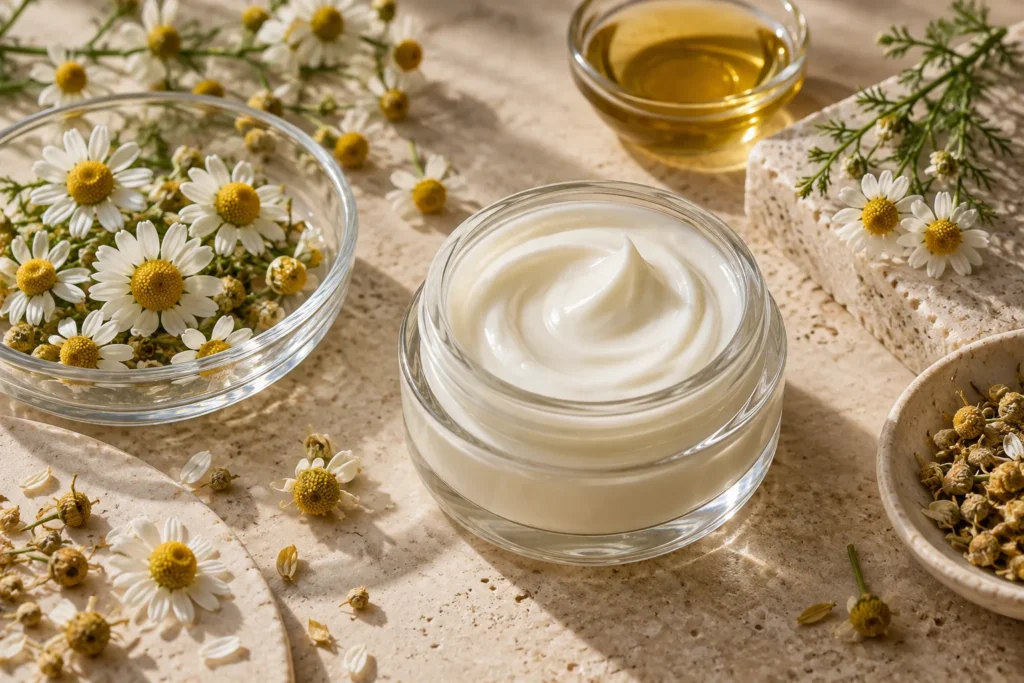
Gentle care can feel almost radical when the skincare world keeps telling you to do more. More exfoliation, more active ingredients and more visible change are often presented as the only path forward, even when the skin already feels tight, dry or easily unsettled. Mature skin can reach a point where every new product seems to arrive with both hope and apprehension. Chamomile matters in skincare because it represents a different idea: meaningful support does not have to feel aggressive.
For many people, chamomile is familiar long before it appears on an ingredient list. Its soft flowers and long tradition create an immediate association with calm, but a good cosmetic formula needs more than emotional recognition. German chamomile, commonly identified as Matricaria recutita or Matricaria chamomilla, contains a complex mixture of plant compounds that has attracted scientific and formulation interest. Used thoughtfully, it can contribute gentle botanical conditioning to products designed for dry and stressed-looking skin.
What chamomile brings to modern skincare
Chamomile contains naturally occurring flavonoids and terpenoid compounds, including apigenin, alpha-bisabolol and related constituents. The exact composition depends on the species, plant material and extraction method, which is why not every chamomile ingredient is interchangeable. Research has explored antioxidant and inflammation-related activity in particular extracts and compounds, often in laboratory or specialised settings. Cosmetic formulation translates that interest into a more measured aim: helping the skin feel soothed, conditioned and comfortably cared for.
This difference between research potential and finished-product benefit deserves respect. A cream containing chamomile should not be described as though it treats every cause of redness, irritation or sensitivity. It can, however, be confidently positioned as part of a gentle, moisturising system for skin that looks stressed or feels uncomfortable. That is a valuable role when the skin has become less tolerant of harsh routines.
Chamomile also offers formulators a botanical with both heritage and contemporary relevance. Its traditional reputation invites trust, while its characterised plant compounds provide a rational basis for continued study. The ingredient is most useful when those two stories are held together without exaggeration. Familiarity may bring someone to the product, but formulation quality is what earns a place in the routine.
Why gentle support still matters
There is a tendency to treat gentleness as the absence of action, as though a product is only effective when it tingles, peels or produces rapid visible change. For dry, mature and stressed-looking skin, that assumption can be costly. Repeated irritation can leave the outer barrier feeling more vulnerable and make ordinary cleansing or weather changes harder to tolerate. Gentleness is not passive when it protects the conditions the skin needs for comfort.
A gentle routine can still be sophisticated. It can attract water to the skin, soften rough texture, supply emollient lipids and include botanicals selected for complementary conditioning roles. It can improve how the skin looks and feels without demanding that the skin endure discomfort first. Chamomile belongs naturally in that kind of formulation.
Our article on why mature skin can become more sensitive explains why products that once felt harmless may suddenly seem too strong. Changes in dryness, barrier function and environmental tolerance can alter the experience of an entire routine. The answer is not always another active serum. Sometimes the skin needs fewer sources of stress and a more dependable moisturising foundation.
The emotional weight of skin that feels unsettled
When the skin feels reactive, it can change how you move through the day. You may avoid trying a new foundation before an event, worry that a shower will leave your face tight, or check whether redness is visible under bright light. These are small decisions, but their repetition can take up emotional space. Skincare should help return some of that space rather than adding another reason to worry.
Mature skin often carries visible history, including years of expression, sunlight, weather and ordinary living. Those changes are not failures, yet dryness and discomfort can make them feel harsher than they are. A well-moisturised surface reflects light more evenly and can make fine lines and rough texture look softer. Gentle conditioning therefore supports both physical comfort and the way the skin is perceived.
Chamomile cannot determine confidence by itself, but it can be part of a cream that makes care feel reassuring. Its presence signals a formulation philosophy interested in support rather than punishment. When paired with humectants, emollients and barrier-conscious ingredients, it contributes to a routine that feels calmer from beginning to end. That emotional quality should not be dismissed as unscientific; products must be pleasant enough to use consistently.
Chamomile is more than a comforting name
Botanical ingredients are sometimes added in tiny decorative amounts so a product can sound natural. Reno Cream takes a different approach to the botanical story. Chamomile sits within a selected blend that includes Centella asiatica, licorice, green tea, rosemary, ginger and other complementary extracts. The blend forms one part of a wider formulation that also includes water-binding, emollient, vitamin and conditioning ingredients.
This matters because the skin does not experience chamomile in isolation. It experiences the complete cream, including how easily it spreads, how much moisture it provides and how comfortable the finish remains hours later. A botanical may have interesting compounds, but the product still needs enough substance to support dry mature skin. Formula first is not a rejection of botanicals; it is what allows them to be genuinely useful.
We describe this principle in why Reno Cream combines multiple skin-supporting ingredients. One plant can contribute a characteristic, but overlapping skin concerns need a more complete answer. Chamomile earns its place as a gentle supporting botanical. It is strengthened by the ingredients around it rather than diminished by them.
Repair: create a kinder environment for the barrier
The Repair step of the Skin Trifecta Method™ begins with the outer skin barrier. When cleansing, friction and active products repeatedly disturb that surface, water can be lost more readily and the skin may feel tight or rough. Repair in cosmetic skincare means supporting that barrier with moisture, emollience and gentler habits. It does not require the promise of rebuilding every structure or reversing age.
Chamomile fits this step as part of a conditioning formula for skin that looks stressed. Its long association with soothing care is supported by scientific interest in compounds such as apigenin and bisabolol, although the effects of a finished product depend on the specific extract and formulation. We use it for a complementary cosmetic role rather than a disease-treatment claim. That keeps the promise honest and the product purposeful.
Repair also involves what you stop doing. Reduce very hot water, avoid scrubbing flaky areas and pause overlapping exfoliants when the skin feels unsettled. Use a gentle cleanser only where needed, then apply moisturiser while the skin is slightly damp. A botanical cream works best when daily habits are no longer undoing its support.
Nourish: combine botanical care with proven moisturising structure
Nourish is where chamomile meets the practical foundation of the formula. Glycerin and hyaluronic acid help attract and hold water at the skin surface, while oils and emollients soften rough texture and improve flexibility. Black seed oil, vitamin E, MSM and allantoin contribute further conditioning and supportive characteristics. Chamomile adds botanical breadth to this established moisturising system.
The combination is important for mature skin because dryness is rarely one-dimensional. The skin may need water, lipids, softness and relief from the tight feeling that returns after washing. A light botanical gel might feel refreshing but fail to provide enough lasting comfort, while a rich cream without humectants may not address the need for surface hydration as effectively. A multi-functional formulation brings those needs together.
Nourishment should be felt in ordinary moments. The skin should feel more comfortable under clothing, the hands should feel less rough after washing and the face should not immediately feel tight after cleansing. These are cosmetic outcomes, but they influence whether a routine becomes trusted. Chamomile supports that experience as one member of a well-designed team.
Defend: protect the comfort you have created
Defend extends skincare beyond the jar. Sunscreen, shade, soft clothing, gloves for household cleaning and moderate shower temperatures all reduce sources of ongoing stress. A moisturiser can support the skin, but it cannot cancel every hour of UV exposure or repeated contact with detergent. Defence gives the routine a chance to last.
Chamomile’s researched antioxidant characteristics are one reason it remains interesting to formulators, but a chamomile-containing cream does not replace sun protection. The botanical can contribute to the conditioning character of the formula while sunscreen and physical measures handle exposure. This division of labour is both realistic and effective. Every step is allowed to do the job it is suited to do.
The full Skin Trifecta Method™ guide shows how Repair, Nourish and Defend work together. It is especially useful when the skin has several concerns and the routine has become confusing. Instead of buying a separate product for every line, patch and change, you can build around three clear needs. Chamomile fits that framework because it supports the whole rather than demanding its own complicated ritual.
Why chamomile pairs well with Centella and allantoin
Chamomile, Centella and allantoin each bring a different formulation story. Chamomile is valued for gentle botanical conditioning, Centella for its characteristic triterpenes and research interest, and allantoin for its established role in skin-protective and conditioning products. Together they create a broader support system than any one of them could provide alone. Their value is amplified by the moisturising base around them.
This does not mean that more ingredients automatically create a better product. Compatibility, concentration, stability and sensory feel still matter. A long ingredient list can be chaotic if each addition was chosen for marketing rather than function. Reno Cream’s combination is guided by complementary jobs within a unified cream.
For a closer look at one of those partnerships, our guide to allantoin for dry, stressed-looking skin explains why gentleness can be an active formulation choice. Both allantoin and chamomile support a philosophy that respects vulnerable-looking skin. Neither needs to be described as a miracle to be valuable. Reliability is a stronger selling point than exaggeration.
Why chamomile is not the same as fragrance
People sometimes assume that any floral botanical is present mainly for scent. Chamomile extract and added fragrance are not the same thing, and a plant name does not tell you the complete sensory profile of a finished product. Formulators may select chamomile for its conditioning characteristics rather than to make the cream smell like flowers. The full ingredient list and formula context matter more than the image suggested by the name.
It is also important not to assume that every natural ingredient suits every person. Botanical extracts are complex, and the finished product should be introduced thoughtfully when the skin is already reactive. Apply a small amount to a limited area first if you are uncertain, then observe the skin before expanding use. This is a practical part of product introduction, not a generic warning that weakens the formula’s value.
The same measured thinking applies to all skincare. A synthetic ingredient is not automatically harsh, and a botanical is not automatically gentle simply because it comes from a plant. Formulation quality determines how those materials work together on the skin. Reno Cream combines botanical and established cosmetic ingredients because performance matters more than ideology.
When a simpler routine may work better
If the skin feels overwhelmed, pause and look at the number of products being used. A cleanser, toner, exfoliating acid, retinoid product, brightening serum, oil and fragranced moisturiser can create a great deal of overlap. Even individually useful products may become too much when layered without a clear plan. Simplifying allows the skin and the person using the routine to breathe.
Begin with gentle cleansing, one comprehensive moisturiser and daytime sun protection. Keep that routine stable long enough to notice whether tightness, roughness or visible stress begins to improve. Add other products only when there is a specific reason and the skin is comfortable. This gives every step a purpose.
Our article on why simplifying a skincare routine can help stressed skin offers a practical reset. Chamomile makes sense in this context because it belongs to a multi-functional cream rather than creating another separate layer. One thoughtful product can deliver moisture, emollience, conditioning and botanical support together. Simplicity can still be sophisticated.
How to use a chamomile-containing cream
Apply the cream to clean skin once or twice daily, adjusting the amount to the area and the level of dryness. Slightly damp skin after bathing provides an ideal surface because the product can spread evenly and help hold water near the outer layers. Use gentle strokes rather than vigorous rubbing, especially on areas that look fragile or feel sensitive. Give rough zones a second light layer if they still feel tight.
On the body, focus on the shins, forearms, elbows, hands, feet, neck and chest. These areas often receive less attention than the face even though they meet clothing, weather, washing and sunlight every day. On the face, apply a comfortable amount and allow it to settle before sunscreen or makeup. Consistency is more valuable than an occasional heavy application.
Notice how the skin feels over several hours. A good moisturising cream should not be judged only by the first minute or by whether it disappears quickly. Look for sustained comfort, improved softness and a less rough or parched appearance. Those signs tell you more about the routine than a dramatic initial sensation.
What gentle progress can look like
Progress may be quieter than the before-and-after culture suggests. The skin may feel less tight when you smile, the hands may remain softer between washes, or the shins may look less powdery under clothing. Fine lines can appear softer when dryness is reduced, and the surface can look more luminous when rough texture is better conditioned. These are worthwhile changes even though the skin still looks naturally mature.
A dependable routine also changes the relationship with the mirror. Instead of searching every morning for something new to correct, you can notice whether the skin feels supported. This shifts skincare away from criticism and towards maintenance, comfort and respect. Chamomile belongs in that gentler emotional landscape.
There will still be days when weather, sleep or stress shows on the skin. A good routine does not promise immunity from life. It gives the skin a more supportive baseline and provides a familiar response when dryness returns. That steadiness is one of the most valuable qualities a product can offer.
Why gentle botanical support belongs in Reno Cream
Reno Cream was created for people whose skin needs more than a brief layer of moisture. Its multi-functional formulation addresses the connected needs of dry, mature and problem-looking skin through hydration, emollience, conditioning and thoughtful botanical support. Chamomile contributes to that purpose with a gentle formulation character. It is not a token flower and it is not asked to perform every job.
The broader formula includes glycerin, hyaluronic acid, black seed oil, MSM, allantoin, vitamin E, a vitamin C derivative and selected botanicals. Together they reflect the Skin Trifecta Method™ of Repair, Nourish and Defend. That framework makes room for chamomile’s strengths while keeping the essentials of moisturising and barrier support at the centre. This is how gentle care becomes purposeful care.
If strong routines have left the skin asking for something calmer, discover Reno Cream for dry, mature and stressed-looking skin. Apply it consistently, protect the skin from avoidable stress and allow the complete formula to support comfort and softness over time. Chamomile matters because gentleness still matters. In mature skincare, a product that respects the skin can be one of the most powerful choices you make.